


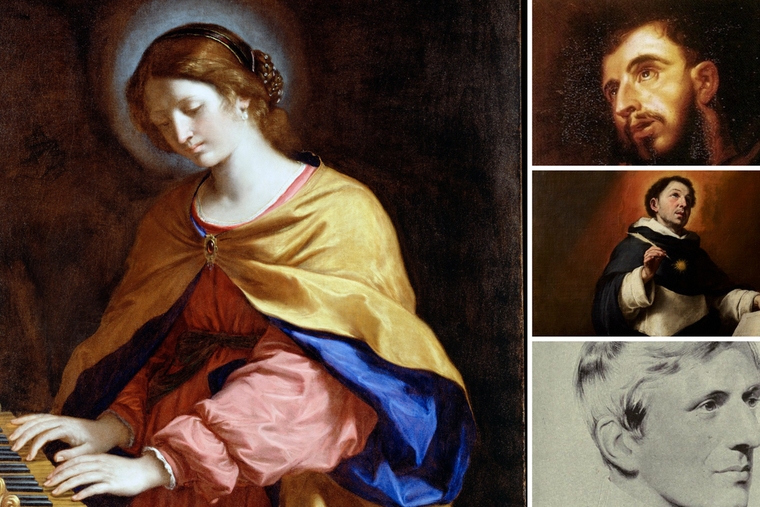
The feast of St. Cecilia, the patron saint of music, falls on Nov. 22. As with many saints from antiquity, what we know of her life is uncertain, other than that there was widespread devotion to her from an early period. Her connection with sacred music is even less clear, though certainly widespread. Her patronage is quite commonly invoked by all manner of sacred musicians.
There are plenty of saints who were musicians themselves, some of them quite accomplished, and even more who had a refined appreciation of music. One thinks of St. Philip Neri, who counted Giovanni Pierluigi da Palestrina among the devotees of his oratory and who composed pieces for their worship.
There are not so many saints that we know for their musical compositions. This month, Pope Leo XIV offered three for our consideration: St. John Henry Newman, St. Thomas Aquinas and St. Francis of Assisi.
Newman and Aquinas were named “co-patrons of the Church’s educational mission” by the Holy Father on All Saints’ Day, when he declared Cardinal Newman to be a doctor of the Church. Aquinas and Newman are thought of as scholars, not musicians, but far more people — unwittingly — know both saints through their hymns rather than their theological writings or preaching.
Aquinas provides the soundtrack, as it were, of the Church’s Eucharistic devotion. While the settings vary over time and place, the texts traditionally sung at Eucharistic adoration — O Salutaris Hostia, Pange Linqua, Tantum Ergo — were composed by Thomas. Adoro Te Devote is another of his Eucharistic hymns, often sung at Holy Communion during Mass.
Few Catholics have memorized, for example, the proofs for God’s existence offered by Thomas. Millions can sing his hymns by heart.
The same might be said for St. John Henry Newman, though his hymns are not as widely known. On All Saints’ Day, Leo did quote from the Church’s newest doctor — and from one of his hymns.
“This reference to the darkness that surrounds us echoes one of St. John Henry Newman’s best-known texts, the hymn Lead, Kindly Light,” Leo said.
“In that beautiful prayer, we come to realize that we are far from home, our feet are unsteady, we cannot interpret clearly the way ahead. Yet none of this impedes us, since we have found our Guide: ‘Lead, Kindly Light, amid th’encircling gloom, Lead Thou me on; Lead, Kindly Light, The night is dark, and I am far from home, Lead Thou me on.’”
The Holy Father summarized Newman’s philosophy of education — about which he wrote an entire book — in the brief verses of his hymn: “The task of education is precisely to offer this Kindly Light to those who might otherwise remain imprisoned by the particularly insidious shadows of pessimism and fear.”
That echoed the homiletic choice of Pope Benedict XVI, who, at Newman’s beatification in England in 2010, decided to close his homily not with a quotation from Newman’s vast theological corpus, but with a verse from one of the Newman hymns:
“What better way to express the joy of this moment than by turning to our heavenly Father in heartfelt thanksgiving, praying in the words that Blessed John Henry Newman placed on the lips of the choirs of angels in heaven:
Praise to the Holiest in the height
And in the depth be praise;
In all his words most wonderful,
Most sure in all his ways!
(The Dream of Gerontius).”
That same composition includes another Newman hymn, Firmly I Believe and Truly, a masterful summary of the act of faith in the Trinity, the Lord Jesus and the Church.
Devotion to St. Francis of Assisi is so widespread that it includes diverse emphases — the Poor Man, the friend of animals, the fearless preacher. He is also known as the “minstrel of God,” who broke into song in praise of God and for effective teaching. This year, the Franciscan Order is celebrating the 800th anniversary of the most famous of his songs, the Canticle of the Creatures — one of the oldest surviving texts in Italian literature.
Sometimes known by other titles, the Canticle of the Creatures praises God for all his works and his works for leading to the praise of God. Thus, Francis sings of “Brother Sun, Who is the day and through whom You give us light. And he is beautiful and radiant with great splendor; and bears a likeness of You, Most High One.”
The repeated praises offered — Praise be to You! — were used by Pope Francis for the title of his 2015 encyclical, Laudato Si — a major magisterial document that took its name from a hymn. The Canticle is theologically sound and spiritually sober, including this remarkable stanza:
“Praised be You, my Lord, through our Sister Bodily Death,
from whom no one living can escape.
Woe to those who die in mortal sin.
Blessed are those whom death will find in Your most holy will,
for the second death shall do them no harm.”
Just two days after Pope Leo quoted Newman’s hymn on All Saints’ Day, he turned to Francis’ Canticle at a Mass offered for the deceased cardinals and bishops of the past year. It was likely an homage to the eighth centenary of the hymn.
“Yes, we can sing: ‘Praised be You, my Lord, through our Sister Bodily Death,’” Leo preached. “The love of the Crucified and Risen Christ has transfigured our death: He has turned it from an enemy into a sister, he has tamed it.”
The sacred Scriptures are filled with canticles and songs, and there is the entire Psalter. The Liturgy of the Hours puts those songs on the Church’s lips throughout the day. The vision of the Book of Revelation is that of the angels and saints in song around the throne.
It is thus fitting to sing with saints here on earth. This month, three of the great saint singers — Francis, Thomas and John Henry — were proposed, suitable inspirations for St. Cecilia’s day.