<p><!-- BEGIN THEIA POST SLIDER --></p>
<p> <br />
</p>
<div>
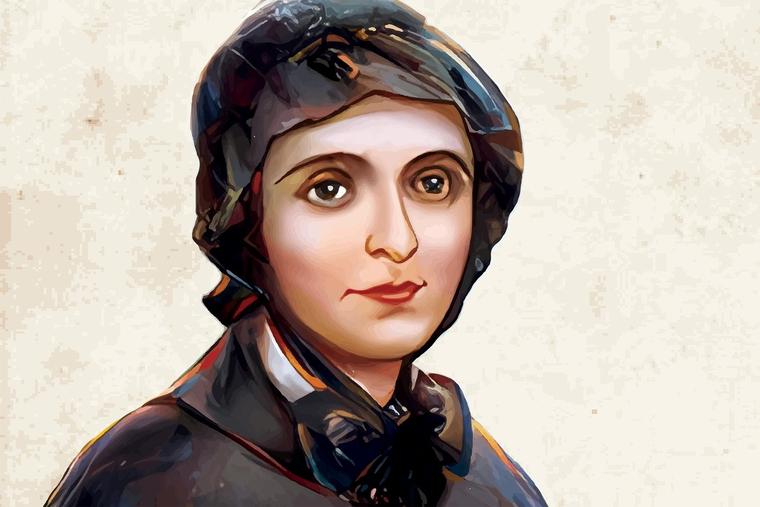
<p><a href="https://www.vatican.va/content/paul-vi/en/homilies/1975/documents/hf_p-vi_hom_19750914.html">“A saint! She is the first daughter of the United States of America to be glorified with this incomparable attribute!”</a> These were the words of Pope Saint Paul VI on Sept. 14, 1975, as he canonized the first native-born American, Elizabeth Ann Seton.</p>
<p>In 1774, two years before the Declaration of Independence, Elizabeth Bayley was born.</p>
<p>Her background was typical of so many of those who were part of Revolutionary America. Her ethnicity was English, her religion was Anglicanism, and her material circumstances were comfortable (her father was a doctor). Things would change, however, when the child’s mother died in 1777. Subsequently, the woman who would become Elizabeth’s stepmother was by all accounts indifferent to the child and her sister.</p>
<p>Elizabeth had a great love of the Bible. It is said the young Elizabeth was also given to intense contemplations of the natural world. As a child, she was prone to great wonderment or great despair at the ways of the world. During her life, she would come to know both these sentiments well.</p>
<p>Aged 20 years old she married William Seton. He was wealthy, and his prospects were good. What is more, the young couple was deeply in love. All looked set for a blissful life.</p>
<p>Within four years her father-in-law had died, which suddenly plunged the newlyweds into running the family business. Those business affairs soon grew precarious. So too, and perhaps more worryingly still, did her husband’s health. In 1828, while Elizabeth was expecting the couple’s fifth child, she watched as the family business was declared bankrupt. With that William’s health broke.</p>
<p>The couple retreated to Italy. William had friends there through business. It was felt a change of climate and circumstances would help him. But Italy proved as disastrous, as it would also be mysterious in the lives of those who had set out to get there from America.</p>
<p>When the couple arrived at an Italian port, local authorities, having heard reports of yellow fever Stateside, refused them entry. As a result, the couple were forced to spend weeks in quarantine. The cold and the damp of that residence proved fatal to William who, suffering from tuberculosis, died a mere eight days later.</p>
<p>Elizabeth found herself not only alone in a foreign country, but a widow and separated from her children. Yet, it was to be in Italy that she was to find a deeper love than the human one she had lost.</p>
<p>Her husband’s friends, the Filicchis, had been due to host the couple in Italy. They were devout Catholics. They proved a much-needed lifeline to Elizabeth, who was to spend months with them in Italy. This time was to prove a turning point in her life as she was exposed for the first time to the Catholic faith — an experience that left a deep impression. The human kindness of the Filicchis was impeccable; their help imminently practical; their concern for Elizabeth truly Christian. All of this created a spiritual hunger in the young widow. When she boarded the ship bound for New York, she wanted to become Catholic.</p>
<p>Elizabeth is often referred to as the first native-born American to be canonized. Objectively, this is of course true. But it is only half the story. Her Christian faith was embryonic while in her native land, but it was in a foreign country, namely Italy, where that faith was to begin its fuller gestation before finally coming to birth back in America. On that ship from Italy bound for the port of New York, Elizabeth was already Catholic in her heart if not yet fully professed sacramentally. Like so many others before her, she now carried back with her to the New World a faith as old as Europe itself.</p>
<p>When she arrived back in the United States she had changed. Those awaiting her arrival sensed this immediately. It was not simply that she was now a widow either. Her friends and family listened with horror to talk of “Rome” and her experience of a religion that raised so many suspicions among them. They set out to dissuade her from her newfound religious attraction. Eventually, Protestant clergymen were enlisted to meet with Elizabeth to dissuade any conversion. The result was a year of inner turmoil for the newly-arrived widow.</p>
<p>What continued to draw her toward the Church was the Eucharist. During these months of searching, she wrote to her sister-in-law Rebecca. In that correspondence, she spoke of how she marveled at the Blessed Sacrament present in Catholic churches. Furthermore, she was impressed by how that same Sacrament was carried to the dying and the sick, sensing how much of a consolation it was for those to whom it was brought. </p>
<p>She then admitted something to her then-Protestant relative: “The other day, in a moment of excessive distress,” Elizabeth wrote, “I fell to my knees without thinking when the Blessed Sacrament passed by, and cried in agony to God to bless me, if He was there. … My whole soul desired to know only Him.”</p>
<p>Strangely that simple act of reverence, of worship, of submission was to prove decisive. Her dark night soon ended.</p>
<p>“I will go peaceably and firmly to the Catholic Church,” she wrote. “Faith is so important to our salvation, I will seek it where true faith first began, seek it from those who received it from God Himself.”</p>
<p>In 1805, in the teeth of much family and societal disapproval, Elizabeth Seton was received into the Catholic Church. When, finally, and for the first time she received Holy Communion, she wrote: “At last, GOD IS MINE AND I AM HIS! … I HAVE RECEIVED HIM!”</p>
<p>If her interior life had begun anew, her temporal existence became even more straitened. When her sister-in-law Rebecca followed Elizabeth into the Church, the latter found she was looked upon with even more suspicion. Needless to say, Elizabeth’s subsequent attempts to support herself and her children in New York City came to nothing. </p>
<p>Unexpectedly, it was then that Elizabeth was asked if she could move with her family to Baltimore to help start a Catholic school there. She did so and, in so doing, discovered a new vocation, that of teacher. But at St. Mary’s College, Baltimore, she was to discover with her fellow teachers the idea of a religious community dedicated to educating the young. </p>
<p>On the Feast of the Annunciation 1809, the 35-year-old Elizabeth took vows of poverty, chastity and obedience before Archbishop John Carroll, Bishop of Baltimore. She was now a religious sister of the newly formed Sisters of Charity. Based upon the life and witness of St. Vincent de Paul, the order’s rule was later ratified in 1812 and would grow rapidly from its inception. Henceforth Elizabeth would be known as Mother Seton.</p>
<p>Having at last found earthly respite in the Church, curiously she felt that God was calling her home now. It was a thought that filled her with a strange joy: “The thought of going home, called out by His Will — what a transport.” While still a Protestant, Elizabeth had been struck by the differences in the rituals for the dying of her co-religionists when compared to those of Catholics. She had told the Filicchis how blessed she felt Catholics were to have a priest at their deathbed. She wrote: “The one you call Father of your soul attends and watches it in the weakness and trials of parting nature with the same care you and I watch our little infant’s body in its first struggles … on its entrance into life.”</p>
<p>Due to all that had happened to her, Mother Seton understood well the passing nature of this temporal realm. She had experienced its fleeting joys and endured its woes longer. These had convinced her of the transitory nature of this life. Amid her greatest suffering, however, she had discovered the Catholic faith and more particularly the mystery of the Eucharist dwelling at its heart.</p>
<p>When she died in 1821 at only 46 years old, it was not so much an ending as a new beginning. Just as her husband’s death on a foreign shore had set in motion a chain of events that was to end with his wife born into a new life. Now her death on familiar American soil was to usher this woman into blessed eternity.</p>
</p></div>
<p><br />
<br /><a href="https://www.ncregister.com/blog/st-elizabeth-ann-seton-and-the-power-of-the-eucharist">Source link </a></p>
<p><!-- END THEIA POST SLIDER --></p>

St. Elizabeth Seton and the Inexorable Power of the Eucharist| National Catholic Register