


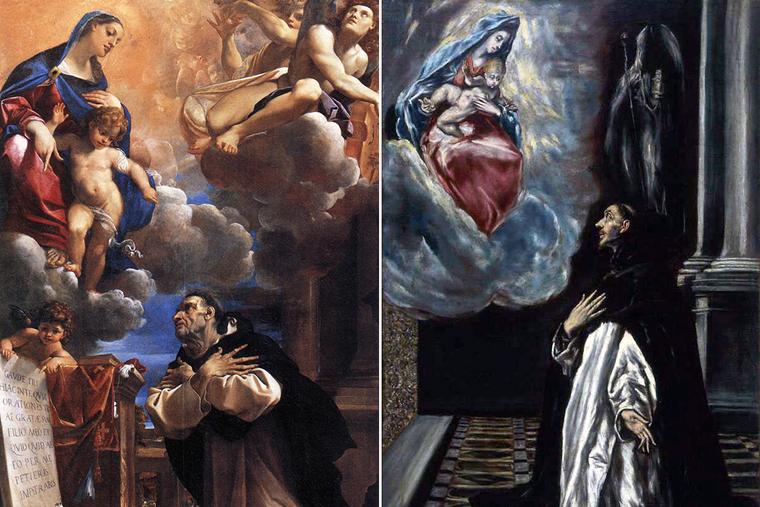
SAINTS & ART: From the heart of Poland to the distant lands of Ruthenia, the Dominican known as the ‘Apostle of the North’ spread the Gospel with zeal and devotion.
The average Catholic with a cursory knowledge of the August liturgical calendar might note that the Dominicans are represented by the founder of their order, the great St. Dominic, whose obligatory memorial is marked on Aug. 8.
But August has plenty of important Dominican saints. St. Rose of Lima, a Third Order Dominican, is observed as an optional memorial on Aug. 23. Dominicans honor St. Mannes on Aug. 18 — he was St. Dominic’s older brother, who was among the founding members of the new Dominican order and who played important roles in the order’s work in France and Spain. The Solemnity of the Assumption of Our Lady is important to Dominicans because of their profound devotion to the Blessed Virgin Mary.
And then there’s the feast of St. Hyacinth or, as he is known in Polish, St. Jacek, on Aug. 17.
St. Jacek is an obligatory memorial across Poland and, in some dioceses, even a feast. Lest one think he is primarily a local Polish saint, however, consider that the painting we will use to discuss him was painted by El Greco (above right), a scene repeated by Ludovico Carracci (above left).

St. Hyacinth or Jacek is called the “Apostle of the North” because he brought the newly-formed Dominican order to Poland and other Slavic countries, having received the habit from St. Dominic himself.
He came from the noble Silesian Odrowąż family, born around 1183. He was well educated, schooled in Kraków, Prague, and Bologna, receiving doctorates in law and divinity from the last. He was well-connected: his uncle was the archbishop of Kraków, then capital of Poland, whom he accompanied to Rome. It was there that he met and claimed to have seen a miracle performed by St. Dominic. He entered the order there in 1220, undertaking studies there in a program that would later become the famous Dominican university, the Angelicum.
Returning as friars to Poland via the Czech lands, Hyacinth and companions spread the order in what today is the Czech Republic, across Poland, carrying it also to the Baltic coast (Gdańsk) and Prussia before heading east into Ruthenia and what we now call Ukraine. (Some records even claim further travels for St. Hyacinth, but the historical record seems to be lacking.) The Dominicans eventually even established themselves in Kyiv. They were also active in the affairs of their order, participating in chapters in Italy and France. His last years were spent in Kraków, where he died Aug. 15, 1257, and is buried.
Numerous miracles were attributed to Hyacinth throughout his life. He was regarded as one of Europe’s important missionaries. Although his cult sprang up early, historical events like wars and councils deferred action until, finally, Jacek was canonized in 1594. He is among Poland’s principal patrons.
In art, St. Jacek appears dressed as a Dominican, usually with their white habit and black cappa or cloak. He will usually be depicted with a monstrance, given his cultivation of the cult of the Eucharist, an image of the Blessed Virgin Mary (devotion to whom he spread) and often a book.
The cult of St. Jacek was well disseminated across Europe in the 16th and 17th centuries, the time of his canonization, which is why many artists painted miracles or other elements from his life.
I’ve chosen a painting from around 1610 by the great painter of Spain, El Greco, “The Apparition of the Virgin to St. Hyacinth.” The saint, clad in a Dominican habit and cappa, kneels in a church while gazing lovingly at an apparition of the Blessed Virgin Mary, who presents the Baby Jesus to him. The church is apparent in the background, from the columns and statuary. The willowy form of the three persons is unique to the painting style of El Greco.
El Greco sometimes repeated themes and this scene was reproduced by him twice, both of which are housed in the United States. The painting above is in the Memorial Art Gallery associated with the University of Rochester in that upstate New York city. A variant on the painting, largely in terms of technique features, is held by the Barnes Foundation in Philadelphia.
Why this painting? Two reasons: to showcase the pan-European devotion to St. Hyacinth that persisted even long after his death and, just having observed the Solemnity of the Assumption, to highlight St. Hyacinth’s devotion to Our Lady. He actually died on that feast but, as the Solemnity preempts everything else and Aug. 16 is the optional memorial of St. Stephen of Hungary — the king who spread the faith among the Hungarian people and was canonized a century before Hyacinth was even born — Aug. 17 was the first available date.