<p><!-- BEGIN THEIA POST SLIDER --></p>
<p> <br />
</p>
<div>
<p>COMMENTARY: It’s more than fitting that the octave day of St. Pier Giorgio Frassati’s canonization falls on the Feast of the Exaltation of the Holy Cross</p>
</p></div>
<div>
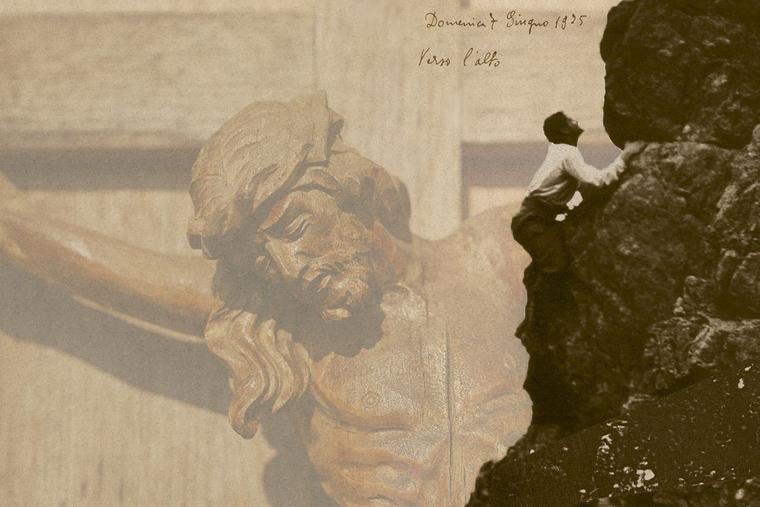
<p><i>Verso l’Alto! </i>Toward the heights!</p>
<p>Posthumously, it became St. Pier Giorgio Frassati’s signature phrase, written in his own hand on a photograph toward the end of his life. Pope Leo XIV quoted it in his canonization homily last Sunday. </p>
<p>“’The day of my death will be the most beautiful day of my life,’” the Holy Father quoted St. Pier Giorgio. “In his last photo, which shows him climbing a mountain in the Val di Lanzo, with his face turned towards his goal, he wrote: <i>Verso l’alto</i>.” </p>
<p>This Sunday — which happily marks Pope Leo XIV’s 70th birthday, the first time the Church has had a 70-year-old pope since 1990, the year of Pier Giorgio’s beatification — “<i>Verso l’alto</i>” provides an image of Sunday’s Mass.</p>
<p>This Sunday is the Feast of the Exaltation of the Holy Cross and the assigned readings <a href="https://bible.usccb.org/bible/readings/091425.cfm">speak of exaltation</a>, of being lifted up. Jesus speaks of his future passion in light of the bronze serpent that Moses fashioned (Numbers 21:8-9) and mounted on a pole, so that all those afflicted by the venomous serpents might look upon it and live.</p>
<p>In the verses immediately before perhaps the most famous Bible verse of all (John 3:16), Jesus explains the dynamic of salvation history, the descent of God that makes possible the ascent of man: </p>
<blockquote><p>No one has gone up to heaven except the one who has come down from heaven, the Son of Man. And just as Moses lifted up the serpent in the desert, so must the Son of Man be lifted up, so that everyone who believes in him may have eternal life. For God so loved the world that he gave his only Son, so that everyone who believes in him might not perish but might have eternal life (John 3:13-16).</p></blockquote>
<p><i>Verso l’alto</i>. </p>
<p>Jesus comes down to us that he might be lifted up, and that we might accompany him toward the heights. That the octave day of St. Pier Giorgio’s canonization falls on the Exaltation of the Holy Cross is more than fitting. </p>
<p>More than that, Pier Giorgio’s <i>Verso l’alto </i>is an invitation that appears in every Mass. In the “preface dialogue” the priest says, <i>“Sursum corda”</i> (“Lift up your hearts”). The Italian translation makes the heights more clear: <i>“In alto i nostri cuori.”</i></p>
<p>It is possible and playful to loosely translate <i>“Sursum corda”</i> as <i>Verso l’alto</i>. Toward the heights lift your hearts. We might piously imagine the mountaineering saint at that moment, encouraging us to lift our hearts toward the heights, to the real summit of his life, which was the Eucharist more than any mountain peak. </p>
<p>In Italian, the <i>“alto”</i> appears also in the Gloria, where <i>“Gloria in excelsis Deo”</i> is translated <i>“Gloria a Dio nell’</i><b><i>alto</i></b><i> dei cieli”</i> — “the heights of heaven” or, more simply as we sing in English, “the highest.”</p>
<p>The Italian <i>“alto”</i> comes from the Latin <i>“altum,”</i> which appears in Luke 5:4: <i>“Duc in altum”</i> (“Put out into the deep”). There, it means the deep waters, to leave behind the comfort of the shallows, to take a risk for the catch.</p>
<p>“Altum” is a versatile Latin word, for it can mean heights as well as depths. In Luke 5 it means the latter but, for example, in the Olympic motto it means height: <i>Citius, Altius, Fortius — Faster, Higher, Stronger</i>.</p>
<p><i>“Altum”</i> thus captures the profound mystery of the cross, for in falling to the ground, falling under the cross, Jesus descends to the depths of human weakness, sin, cruelty, abandonment. Subsequently, he is lifted up, not only from the ground, upon a pole like the bronze serpent, but toward the heights of heaven, toward the Father to whom he commits his spirit. </p>
<p>That dynamic is repeated as Jesus is taken down from the cross, placed in the depths of the tomb, only to rise again and ascend to heaven. Descent, ascent, depths, heights, the bronze serpent and the Cross: <i>altum, alto, Verso l’alto</i>.</p>
<p>That is the reality sacramentally present at every Mass. The <i>“Sursum Corda — In alto i nostri cuori”</i> invites our hearts to go to where soon our eyes will follow, as we gaze upon the consecrated Host elevated by the priest toward the heights. <i>Verso l’alto </i>is an altogether fitting prayer in such a moment.</p>
<p>This Sunday, Pope Leo XIV will commemorate the martyrs of the 21st century, of whom there are already thousands. Massacres of Christians have taken place in Iraq, Nigeria and Sri Lanka, to count only the most infamous examples. </p>
<p>The martyrs are cast upon the ground, to the depths, and thus are lifted up as was Christ Crucified. They live the mystery of salvation, the descent and ascent, and upon the mountain of suffering — Mount Calvary — they move toward the heights. </p>
<p><i>Verso l’alto!</i></p>
</p></div>
<p><br />
<br /><a href="https://www.ncregister.com/commentaries/desouza-verso-lalto">Source link </a></p>
<p><!-- END THEIA POST SLIDER --></p>

St. Pier Giorgio Frassati’s Motto Is Christ’s Invitation to You| National Catholic Register