<p><!-- BEGIN THEIA POST SLIDER --></p>
<p> <br />
</p>
<div>
<p>Several developments at the Oct. 4-29 session point to this objective.</p>
</p></div>
<div>
<p>Leveling hierarchical distinctions in the Church without removing them entirely has emerged as a principal objective of Pope Francis’ Synod on Synodality.</p>
<p>That is perhaps the chief conclusion to be drawn from the first session of the synod, which took place Oct. 4-29 at the Vatican. The second, and presumably last, session will be held in October next year.</p>
<p>Advance speculation had focused on whether the synod would address hot-button issues like ordaining women and giving blessings to same-sex couples. But although these topics were discussed — with no consensus being reached — the synod’s more immediate goal was the less dramatic, but in the long run arguably more significant, objective of cutting back on clergy-only hierarchy.</p>
<p>Several things that happened at the session suggest as much.</p>
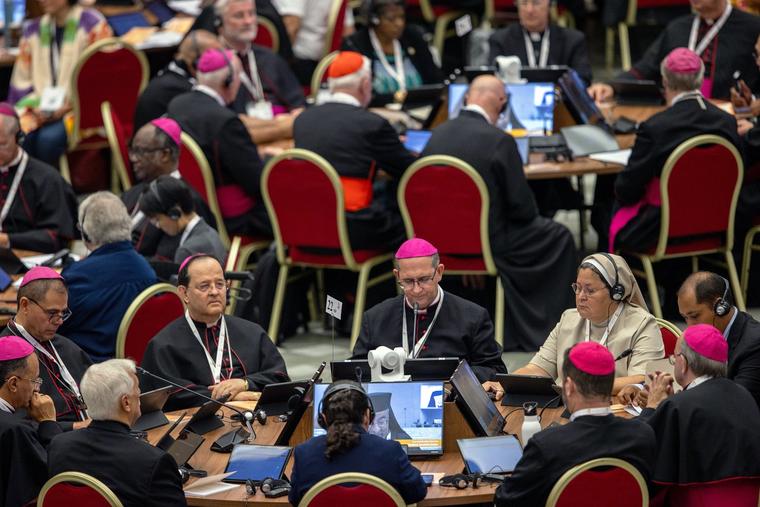
<p>One was the seating arrangement. In a dispatch from the synod, Christopher Lamb, Rome correspondent of the London <i>Tablet </i>and a Synod on Synodality booster, wrote enthusiastically of what he called “a new moment” — cardinals, bishops and laypeople all sitting together at round tables. Even the Pope sat there while addressing the synod, Lamb noted.</p>
<p>The symbolism was clear — rank doesn’t count at a synod.</p>
<p>Father Dario Vitali, an Italian theologian serving as coordinator of theological consultants at the synod, carried things beyond symbolism when he told the participants that in the synodal Church of the future, “we will have to rethink the whole Church, all the institutions, the whole life of the Church in a synodal sense.”</p>
<p>And Cardinal Michael Czerny, prefect of the Holy See’s Dicastery for Promoting Integral Human Development, provided the clincher when he told a news conference, “I think that the identification between [holy] orders and offices is something that is being overcome.”</p>
<p>What does that mean? Cardinal Czerny gave this explanation:</p>
<p>“In other words, we’re understanding orders not to be necessary for every office which until now has been headed by a cleric and in fact a hierarch and in some cases even a cardinal. … There’s no danger to the nature of the Church because there are responsibilities which are already being, and which perhaps will increasingly be, entrusted to non-cardinals, non-bishops, non-priests.”</p>
<p>The trajectory of events being described here did not begin with the Synod on Synodality. In fact, it goes back a half-century and involves the progressive clericalization of the Catholic laity. A little history sheds light on that.</p>
<p>The Second Vatican Council (1962-65), speaking of the apostolate of the laity, said laypeople have “this special vocation: to make the Church present and fruitful in those places where it is only through them that she can become the salt of the earth” (<a href="https://www.vatican.va/archive/hist_councils/ii_vatican_council/documents/vat-ii_const_19641121_lumen-gentium_en.html"><i>Lumen Gentium</i></a>, 33).</p>
<p>That formal recognition of lay apostolate directed to evangelizing the secular order was real progress. But within a few years, the word “apostolate” had disappeared from the Catholic vocabulary as a description of the laity’s special role and been replaced by “ministry.” Originally, lay ministries were limited to liturgical offices, but over time “ministry” came to be used for just about anything laypeople do in a church setting. That is approximately where the clericalization of the laity stands now.</p>
<p>If the change that Cardinal Czerny outlined — letting laypeople hold some offices in the Church now reserved to people in holy orders — becomes reality, that will be the next step in clericalizing the laity. Meantime, apostolate carried on by lay people and directed to evangelizing an increasingly de-Christianized world will be even more out in the cold. Score one for synodality, I guess.</p>
</p></div>
<p><br />
<br /><a href="https://www.ncregister.com/blog/synod-on-synodality-and-clericalizing-the-laity">Source link </a></p>
<p><!-- END THEIA POST SLIDER --></p>

Synod on Synodality and Clericalizing the Laity| National Catholic Register