


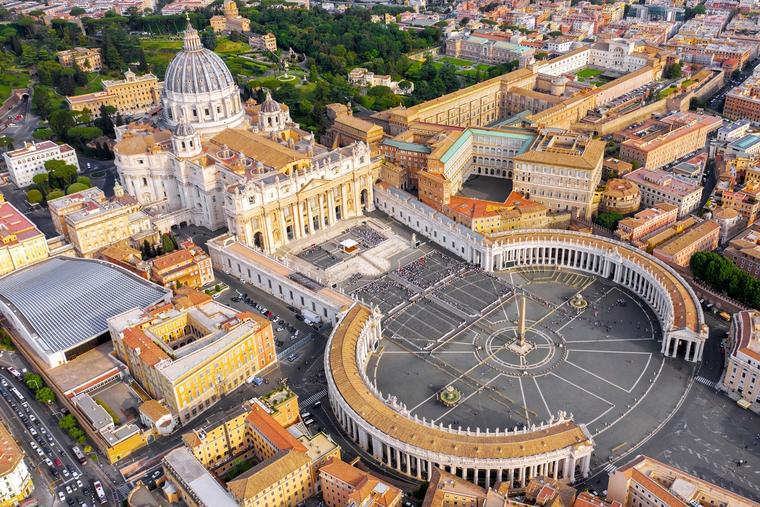
Vatican officials emphasize that ‘contacts between the Society of St. Pius X and the Holy See are ongoing’ ahead of planned episcopal consecrations.
The Vatican has responded to the Society of St. Pius X’s announcement Monday that it plans to consecrate bishops — so far without Rome’s approval — by saying that dialogue is continuing and is aimed at avoiding rupture or unilateral decisions.
In a brief statement sent to the Register Tuesday, Vatican spokesman Matteo Bruni said that “contacts between the Society of Saint Pius X and the Holy See are ongoing, with the aim of avoiding rifts or unilateral solutions to the issues that have arisen.”
The Priestly Society of St. Pius X (SSPX), which exists in a state of “institutional irregularity” or “imperfect communion” with the Holy See, announced Monday that it plans to consecrate new bishops on July 1, even without authorization from the Holy See.
The SSPX exclusively celebrates the traditional Latin Mass and maintains doctrinal differences with certain teachings and reforms of the Second Vatican Council.
SSPX superior general Father Davide Pagliarani said he had requested an audience with Pope Leo last August to present, “in a filial manner,” the current situation of the SSPX, including its need for bishops.
He then followed up with a second letter, explicitly expressing the SSPX’s need for new bishops to continue their ministry, but he said he received a response that did not respond to their requests. Father Pagliarani, with the unanimous backing of his Council, then decided to proceed unilaterally with consecrating new bishops in July.
Tuesday’s Vatican’s statement offers hope that either some kind of agreement can be reached to stave off the consecrations, or that they could proceed with a mutually agreed canonical framework in place.
Since Archbishop Marcel Lefebvre’s illicit consecration of four bishops in 1988, which led to their excommunication, relations between the Vatican and the SSPX have oscillated between cautious rapprochement and renewed strain, without reaching full canonical regularization.
Dialogue noticeably improved from about 2003 onward, and reconciliation with the SSPX was one of Benedict XVI’s priorities. In 2009 the Pope lifted the 1988 excommunications of the four bishops, and subsequent doctrinal talks attempted to secure SSPX acceptance of the Second Vatican Council, but negotiations stalled in 2012.
Pope Francis shifted to a more pragmatic, pastoral approach when, in 2015, he granted SSPX priests the faculty to validly and licitly absolve sins, a concession later made permanent. Two years later, he allowed diocesan bishops to delegate SSPX priests to witness marriages, but dialogue again stalled that year.
The election of Father Pagliarani in 2018 brought about a firmer doctrinal line on Vatican II and greater skepticism toward any canonical arrangement perceived as requiring compromise.
Observers say unilaterally moving ahead with new consecrations after explicitly seeking — and not receiving — Rome’s agreement signals a clear divergence of judgment that could harden positions on both sides, making any future canonical solution more difficult.
As throughout this process of dialogue, the key sticking point is the extent to which the SSPX will make concessions or hold firm regarding its doctrinal positions in relation to the Second Vatican Council. These center on religious liberty, ecumenism, and relations with non‑Christian religions.
Abbé Claude Barthe, a French diocesan priest, formerly of the SSPX who now teaches at the international seminary of the traditional Institute of Christ the King Sovereign Priest, is urging prudence in the face of the current developments.
“I think we need to be very careful when talking about this matter,” he told the Register on Tuesday. “It is clear that the highly publicized affair of the episcopal consecrations announced by the SSPX is one of the consequences of the wound opened in the Church by the last council and by the liturgical reform that followed. It would be reasonable for this affair to give rise to open and peaceful exchanges of views between the ‘two parties,’ the Holy See and the SSPX.”