


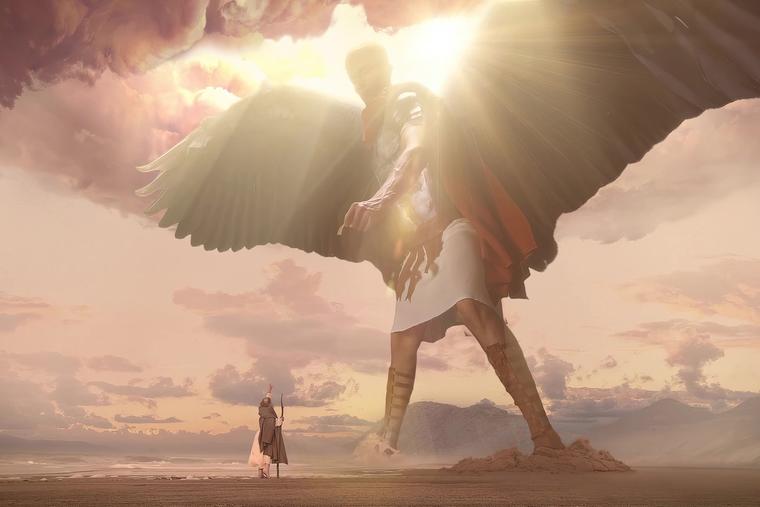
Blending sacred art and live action with a sweeping historical vision, the film brings the Book of Revelation vividly to the big screen and into the life of the Church today.
Mention of the End Times and the Book of Revelation always piques people’s interest. That is one reason why audiences should be excited to see the new movie, The Apocalypse of St. John.
But the reason to see this riveting film goes beyond simple curiosity and the draw of the title itself.
This film deals with the mystifying Book of Revelation in a fascinating way, but even more so in a way that appears to bring the Apocalypse from the parchments on which St. John wrote it — through its relevance and unfolding over the span of 2,000 years — directly into our hearts in the present time. The film reveals which parts of Revelation seem to apply to contemporary society, and how.
What makes the film exciting is not only the interpretations but also the way they come to life visually. Each part rivets our attention through storytelling presented in live action, religious art, and vibrant maps and graphics.
The film is colorful and full of sensible, thought-provoking detail, all presented and explained by the authoritative voice of a narrator in a way that is easy to understand.
Many scenes use various pieces of art as visual partners to illustrate the narrative and explanations.
Naturally, live actors appear throughout. St. John writing the Book of Revelation serves as the framework and anchor. Beginning in A.D. 95, the Evangelist appears many times throughout the film. On the island of Patmos, we follow him contemplating and writing Revelation on parchments, usually while seated in a cave. We accompany him by the waters as he contemplates or receives inspiration on what to write.
Much live action interspersed throughout the film includes the 24 elders mentioned in Revelation, the four horsemen, Elijah and Enoch, angels and others.
Real enlightenment comes as the film focuses on the letters to the seven churches found in the first three chapters of Revelation. The interpretations of saints and theologians — and how they understand Christ’s words to the seven individual churches as relating to the Church throughout the centuries — are enlightening.
The film sheds light on the meaning of the seven churches, seven golden candlestands, and seven stars in the first half of Revelation in a way that captures our attention and keeps it riveted and enthralled as explanations of their possible meanings unfold.
The action and explanations also draw viewers along to the 24 elders, the Lamb opening the seven seals, the seven trumpets, the four horsemen and the seven plagues — all with their possible meaning for the Church. Again, the narrative depicts historical events across the centuries from different perspectives, with everything slowly pointing toward and leading up to the Second Coming of Christ.
Even in dire times, there are countermeasures, so to speak. For instance, one scene during the opening of the seals shows people holding and praying the Rosary.
This gives us yet another opportunity to realize that every time St. John approaches the Parousia, he stops, goes back, recapitulates and then picks up again from a more detailed perspective.
The explanations and the action never slacken throughout the film. They act like a magnet, drawing us to the next scene and the next explanation, which appear to be mirrored in our own era.
The film stops the story at the end of Revelation 11, though viewers will surely hope it will dash headlong into the remaining chapters — all the way to Chapter 22 and the return of Christ.
The next chapters will come in the future in what promises to be a continuation starting at Chapter 12 and moving through the destruction of the beast and the dragon — and, rather than catastrophe, the ultimate victory in Christ’s return and God’s triumph for the world.
For now, however, there is plenty to see and ponder in this film, where the drama and interest level remain consistently high. There is never a slack moment during The Apocalypse of St. John. It promises to be tremendous on the big screen.
The Apocalypse of St. John will play in theaters nationwide Feb. 15-17 (Feb. 15 and 17 in English; Feb. 16 in Spanish). Check for theaters near you.