<p><!-- BEGIN THEIA POST SLIDER --></p>
<p> <br />
</p>
<div>
<p>I don’t deserve God’s loving mercy. Neither did St. Matthew. And neither do you. But rejoice, for his mercy endures forever.</p>
</p></div>
<div>
<p>I was changing after gym class when the teacher suddenly called me out into the hallway. He was a grim, flabby man with a dark goatee and bloodshot eyes.</p>
<p>“Was it you?” he asked with contempt.</p>
<p>“Was what me?”</p>
<p>“Erik’s wallet.”</p>
<p>I don’t remember exactly how, but I managed to clear my name. And it was true: I hadn’t taken Erik’s wallet. I left the encounter disoriented: <i>How had I come under suspicion in the first place</i>? Then it dawned on me that Erik had fingered me himself. We’d been pals in elementary school. But by eighth grade, I was a wannabe bad kid and he was a nobody. I couldn’t let the indignity go unpunished.</p>
<p>So I ordered him to stand on the bench in the locker room in his boxer shorts and call himself a pejorative for all to hear.</p>
<p><i>Say it again</i>, I commanded to the delight of the other boys. And he did. <i>Say it louder</i>.</p>
<p>I remember his lip quivering while he stared straight and followed my orders; I remember relishing in the fact that my social stock was about to soar while Erik’s would nosedive.</p>
<p>The memory of the scene has never stopped haunting me. For a few terrible minutes I had allowed myself to become an instrument of evil. And worse, I enjoyed it.</p>
<p>I’ve been tempted to rationalize away the memory by telling myself that it wasn’t the “real me” who terrorized Erik that day. But I know in my heart that it <i>was </i>me — me and no one else.</p>
<p>In puzzling over the existence of evil, we tend to look outward toward things like tsunamis and genocides — calamities that are difficult to reconcile with an all-loving God because they yield suffering that seems gratuitous. But at least as troubling is the capacity for evil that resides within the individual human heart. How is it that we are capable of such evil if we are made in the image and likeness of God?</p>
<p>The short answer is that God made us free to reject love in order that we might love at all. Had our capacity to choose been restricted in the slightest — had we been predestined to love God and one another — the sum total of our affections would equal something far less than love.</p>
<p>But since we are indeed free to reject love, we are capable of terrible evil.</p>
<p>A cursory glance through human history confirms our capacity in this regard. But perhaps no group rejected love as thoroughly as the tax collectors of ancient Judea. This may seem like a stretch — to the modern mind, the term “tax collector” evokes images of IRS agents in shabby suits and tortoiseshell spectacles. But the taxmen of Jesus’ time had more in common with mafiosos than accountants. They were thugs and shylocks who preyed upon their own people on behalf of a foreign occupier. Fully empowered by the might of the world’s most powerful military force, which had pillaged and ransacked their people only two generations prior, they were traitors of the worst kind.</p>
<p>The wildly popular television series <i>The Chosen</i> portrays the most famous ancient Judean tax collector, the apostle Matthew, not as an instrument of evil, but rather as a sympathetic figure who is drawn into the trade as a result of a neurological disorder. Brilliantly played by Paras Patel, the character’s evident autism serves to diminish his culpability. This creative choice renders him more palatable to a modern audience. It also makes his social acceptance within the group of apostles more believable.</p>
<p>But it is doubtful the real Matthew suffered from a disability that would excuse his depravity. It would have been difficult, if not impossible, for a tax collector to establish and maintain his authority without exercising the type of treachery that implies premeditation and full consent of the will. For instance, it was common for tax collectors to:</p>
<ul>
<li>inflate the value of property and income in order to charge more tax, from which they’d skim off the top,</li>
<li>give predatory loans and enforce collection with violence,</li>
<li>and shake people down on the street at a moment’s notice, sometimes twice a day.</li>
</ul>
<p>Fans of <i>The Chosen </i>rave about this “lovable” version of Matthew. But the real Matthew was likely a terrifying figure. Think Tony Soprano without a sense of humor.</p>
<p>It is perhaps unfortunate that <i>The Chosen</i> domesticated Matthew in such a way. A more realistic accounting of Matthew’s treachery would better reveal the overwhelming power of Christ’s summons. If a tax collector of ancient Judea could be made new with two simple words — “follow me” — then truly <i>all</i> things are possible with God.</p>
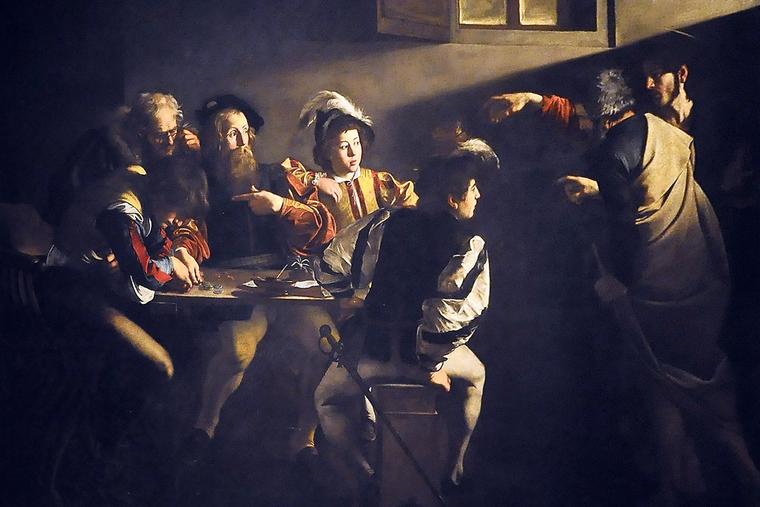
<p>What makes the call of Matthew so marvelous is its implausibility. In Caravaggio’s famous depiction of the event, Matthew is seen hunched over a table with other well-to-do figures, clothed in finery and counting coins. Jesus stands in the doorway, his hand outstretched toward Matthew in a manner reminiscent of God’s hand in Michelangelo’s Sistine Chapel fresco. In response, Matthew points to his own chest as if to ask, “Who? <i>Me</i>?” </p>
<p>“Yes, you,” Jesus says with His gesture. “I know everything about you. And I still love you.”</p>
<p>From there, all it took was the faintest “yes” in Matthew’s heart to transform a monster into a saint, a mobster into Christianity’s first evangelist.</p>
<p>The call of Matthew always makes me weepy because I, too, know the meaning of evil. I didn’t deserve to be called by Christ, neither did Matthew, and neither did anyone else.</p>
<p>Such is the overpowering nature of God’s mercy.</p>
</p></div>
<p><br />
<br /><a href="https://www.ncregister.com/blog/call-of-st-matthew-reveals-divine-mercy">Source link </a></p>
<p><!-- END THEIA POST SLIDER --></p>

The Call of St. Matthew Reveals God’s Overpowering Mercy| National Catholic Register