<p><!-- BEGIN THEIA POST SLIDER --></p>
<p> <br />
</p>
<div>
<p>When this series was originally published three years ago I noted that, in Years B (Mark, this year) and C (Luke) of the Sunday readings cycle, there are two possible Gospels for the Third, Fourth and Fifth Sundays of Lent.</p>
<p>Because Lent is a time of preparation of catechumens (those officially preparing for Baptism) at the Easter Vigil, it is <i>always </i>permitted to use the Gospels for Year A (Matthew) in any year, because they specifically reference baptismal themes: <a href="https://www.ncregister.com/blog/scriptures-and-art-third-sunday-of-lent-year-a">Jesus and the Samaritan woman</a> (“I am the Living Water”), Jesus and the Man Born Blind (“I am the Light of the World”) and Jesus and Lazarus (“I am the Resurrection and the Life”). These “scrutiny readings” (so-called because they are connected with the “scrutiny” or examination rites for catechumens) are always available for these Sundays, even if a parish does not have catechumens.</p>
<p>There are, however, alternative choices in s B and C. They don’t necessarily follow the principle of focusing on a particular Evangelist (e.g., this choice for this Sunday comes from John, not Mark) but they do differ from the scrutiny readings. As these three Gospels were not treated three years ago, I make up for lost time.</p>
<p>Today’s Gospel (John 2:13-25) focuses on Jesus “cleansing the Temple.” It refers to Jesus driving the moneychangers and merchants out of the Temple precincts, using a whip to evict them. There are also “cleansing of the Temple” episodes in every Gospel: Matthew 21:12-17; Mark 11:15-19; and Luke 19:45-48. Paul Turner’s <i>Words Without Alloy, </i>which details the history of how the three-year Sunday cycle was constructed, focused more on the debate of whether the scrutiny Gospels should be used every year versus alternatives from s B and C. It says that the choice of John (who is inserted only for “special occasions” in the liturgical year) was determined by a desire in B to John’s focus “on the ascent of the Lord to the glorification of the Passion and of Easter” (p. 66). That’s why Year B choices are all John: next week, we read of Jesus’ conversation with Nicodemus, the week after of the grain of wheat that dies in order to rise. </p>
<p>Who were these moneychangers and merchants? Jews came from the world over to offer sacrifice in the Temple in Jerusalem. They brought all sorts of currencies with them, though probably mostly Roman. The Jews of Israel and Judea brought Roman coinage: remember when Jesus asks for a coin when questioned about the legitimacy of paying taxes, and speaks of “rendering unto Caesar” because his image was impressed on it?</p>
<p>The problem was that all those currencies were secular currencies, and the Temple had its own sacred currency. This also connected with the Old Testament prescription (Exodus 30:13) for the upkeep of the holy place, which had a fixed Biblical value. So, those who came to worship at the Temple needed to exchange their secular currencies for the sacred currency — and there were those who had no scruples about applying disadvantageous exchange rates.</p>
<p>The core of Temple worship was sacrifice of various kinds. That implied animals for sacrifice. When Jesus is presented in the Temple, for example, the Old Testament prescribed offerings for a male firstborn and for the cleansing of a woman after childbirth. For the latter, Leviticus (12:6, 8) stipulates the offering of a lamb and a dove, providing that “if she cannot afford a lamb” she may offer two doves. These animals often had to meet certain ritual prescriptions. The Temple merchants offered a market, again with varying prices and probably quality (as long as it met minimum requirements).</p>
<p>The Polish author Roman Brandstaetter, writing his life of Christ, also speaks of how those who held the high priesthood in New Testament times depended on Roman approval and, therefore, both the opportunities for “gifts” in that regard as well as the incentive for the Temple establishment to cooperate with (if not control) the commercial trade in its precincts. Clearly, opportunities for abuse were rife.</p>
<p>It is that commercialism and dishonest trade (see Amos 8:5) that Jesus wants to drive out as incompatible with the sacredness of divine worship and its venue.</p>
<p>Jesus fashions a whip out of cords to drive away the “traders” as he overturned their tables. (Some translations call that whip a scourge, but <a href="https://www.ncregister.com/blog/rosary-and-art-second-sorrowful-mystery">that’s not accurate</a> because true scourges had bone or metal attached to them to rip skin, as the kind used on Jesus). Obviously, the immediate pushback was: “Who do you think you are? By what right are you doing this when we have permits and licenses?” </p>
<p>Jesus, of course, uses this opportunity to speak of the Temple of his Body as well as of authentic worship of God “in spirit and truth.” That said, it doesn’t endear him to the establishment.</p>
<p>Biblical scholars themselves are perplexed: was there one cleansing or two? The account in today’s from John occurs early in that Gospel (Chapter 2). The accounts in the Synoptics fall later. The Johannine chronology might even suggest this episode is somewhere at the beginning of Jesus’ public ministry, while the Synoptics suggest it is towards its end. I am not a biblical scholar, so will not weigh in on how to resolve this question.</p>
<p><b>Today’s Gospel has been depicted by various artists. </b>It is clearly a favorite of El Greco’s, who appears to have painted it multiple times: see <a href="https://en.wikipedia.org/wiki/Christ_Driving_the_Money_Changers_from_the_Temple_(El_Greco%2C_Washington)#/media/File:El_Greco_13.jpg">here</a>, <a href="https://en.wikipedia.org/wiki/Minneapolis_Institute_of_Art#/media/File:El_Greco_(Domenikos_Theotokopoulos)_-_Christ_Driving_the_Money_Changers_from_the_Temple_-_Google_Art_Project.jpg">here</a> and <a href="https://harvardartmuseums.org/collections/object/231539">here</a>. The first is held by the National Gallery in Washington, the second by the Minneapolis Institute of Art, and the last by the Harvard Art Museums.</p>
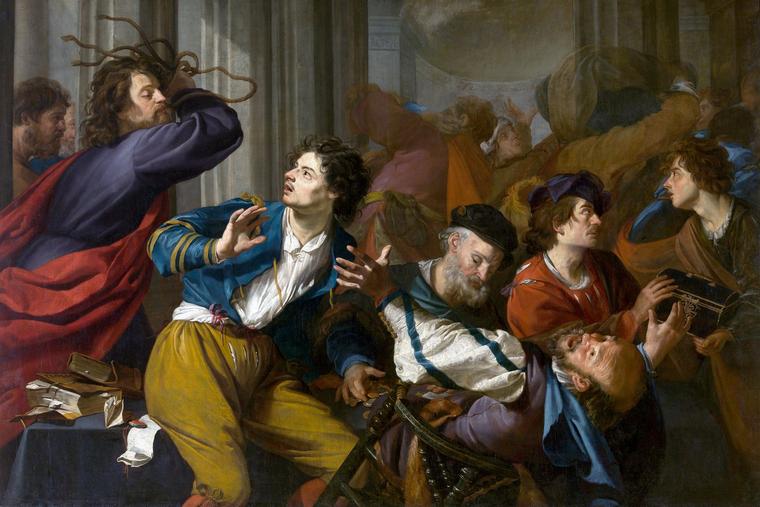
<p>I chose to comment, however, on the Gospel’s depiction by the 17th-century Flemish artist, Theodoor Rombouts, and held in the Royal Museum of Fine Arts in Antwerp. He is considered to have been influenced by the style of Caravaggio, e.g., the reliance on <i>chiaroscuro</i>, contrasts of light, shadows and darkness. Christ, on the left, bends forward with his whip to drive the moneychangers out. His first target, the most illumined, bends in the same direction as Christ is driving him as his ledgers and records lie on the table to his right. The next two figures are also driven in the same direction, the third even falling backward. But by the time we reach the fourth and fifth, their postures betray some resistance, even as the fourth hands the fifth his moneybox for safekeeping. Christ is dressed in the traditional attire we see him in as a first-century Jew. The moneychangers are anachronistically attired in the best of 17th-century Flemish trader garb. </p>
<p>And that’s why I chose it. It is not unusual for artists of this period to bring their contemporaries (and, by extension us) into the biblical event by inserting into their paintings figures in the dress and style of their times. Within the past five years, the U.S. bishops investigated one of their own, known for distributing cash “gifts” to influential clerics in envelopes. And the scandals that plagued the Church post-2002 Boston and post-2018, when then-priest and later-Cardinal Theodore McCarrick was “credibly accused” of fondling an altar boy on Christmas Eve in St. Patrick’s Cathedral sacristy, suggest things more sordid than those who turned a holy place into “just” a den of thieves. The vices Jesus attacked remain human vices and, therefore, the one who hears the Gospel can also ask — like the Apostles at the Last Supper — “Is it I, Lord?</p>
</p></div>
<p><br />
<br /><a href="https://www.ncregister.com/blog/scriptures-and-art-the-cleansing-of-the-temple-year-b">Source link </a></p>
<p><!-- END THEIA POST SLIDER --></p>

The Cleansing of the Temple| National Catholic Register