


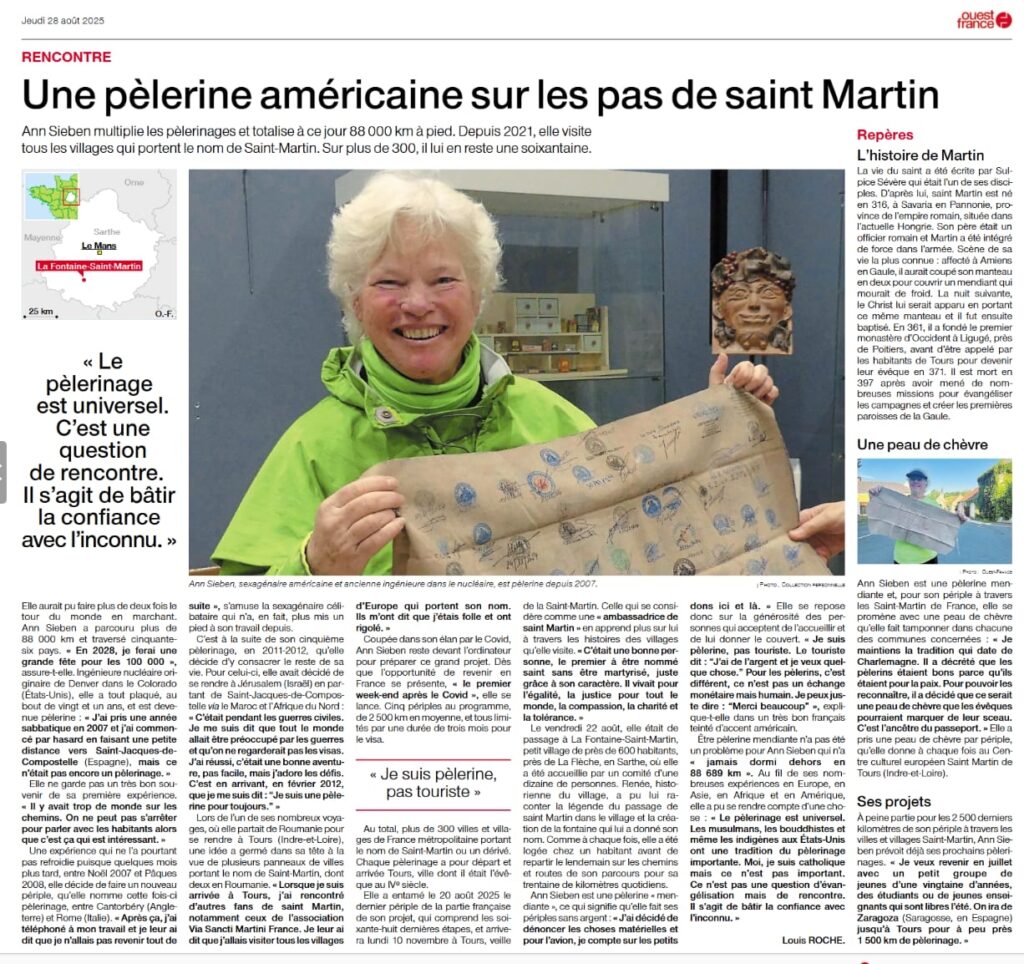
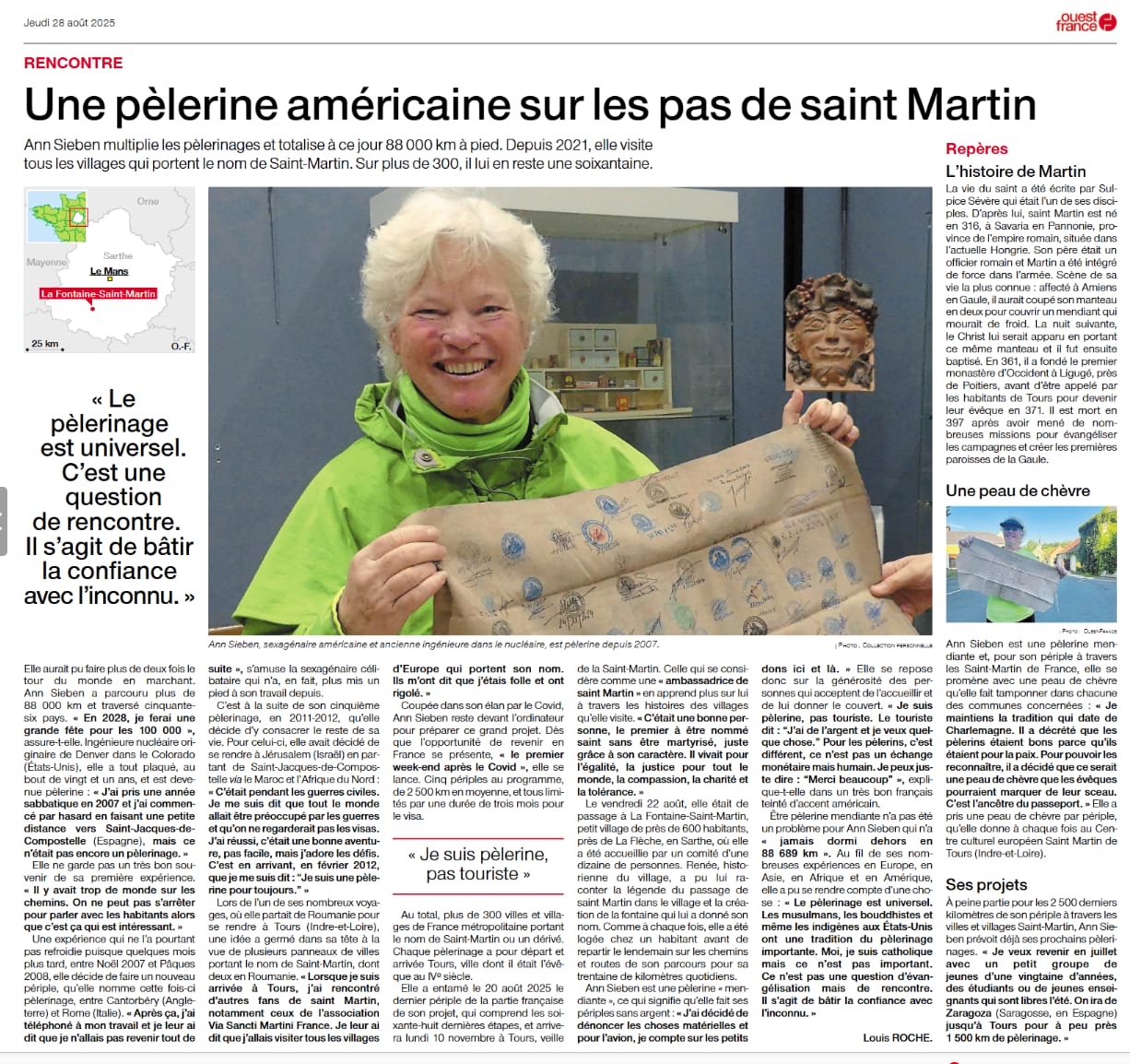
The name of Ann Sieben, an American pilgrim, is spreading across France alongside the memory of the saint whose name and great exploits she is reviving: St. Martin of Tours. And it must be said: Her profile stands out. A former nuclear engineer from Denver, Sieben gave up her career 18 years ago to live as a permanent pilgrim.
When she set out on foot from Tours (in the center of France) this summer, she was already three-quarters of the way through a project that few would dare even to imagine: visiting every town in France named after St. Martin. Her aim is to complete the last stretch — 53 towns still left to visit — just in time for the feast of St. Martin, Nov. 11.
For this pilgrim, who has walked more than 55,000 miles in 56 countries so far, the journey is not only about crossing distances but also about weaving human connections through the example of one of Europe’s most beloved saints.
Ambassador of St. Martin
What began as a sabbatical walk from Canterbury to Rome in 2007 eventually turned into a lifelong calling.
“I realized over time that this was what I’m here to do,” she recalled in an interview with the Register. “To walk, to encounter people where they live, with no ulterior motive; to see Christ in their faces, and to try to reflect it back to them is what gives meaning to my life.”
Her latest project is entirely dedicated to St. Martin of Tours, the fourth-century soldier-turned-bishop remembered above all for cutting his cloak in two to share with a beggar — an act that took place in the city of Amiens (in northern France), where Sieben recently visited. She often describes herself as an “ambassador of St. Martin,” conscious that his memory remains alive across the continent. During a six-month walk along the Danube and Rhine from 2017 to 2018, retracing the Roman frontiers where Martin once served as a soldier, she noticed how many towns in France bear his name. “By the time I reached Tours, I had an inspiration: I will visit every town in Europe named after St. Martin. I’ll start with France.”
What drew her especially to Martin was not the way he faced death but how he lived. “He was the first saint recognized not for martyrdom but for the example of his life. That is huge,” she said, noting that St. Martin also founded Europe’s very first monasteries, shaping the continent’s Christian identity for centuries to come.
That project took shape during the quiet months of the COVID pandemic, when Sieben sat at a computer planning routes instead of walking them. She mapped out 305 French towns and villages named after Martin (there are more towns named after him than for anybody else in all of Europe) organizing them into five great loops beginning and ending at the Basilica of St. Martin in Tours, where he served as bishop until his death. Now on her final loop, she has already visited about 255 towns, often welcomed by mayors, parishioners and local newspapers eager to accompany her for a stretch of the way.

Embracing Uncertainty
Her pilgrim’s life is rigorously simple.
“I walk the whole day,” she explained. “On this St. Martin project, it averages 35 kilometers [22 miles] a day, spanning eight or nine hours.” She rises with coffee, shoulders her pack, and sets off, always ready to stop at any village with a church dedicated to the beloved missionary saint.
Along the way, she likes to use small gestures to spark conversation, like asking for water. “That’s how it starts,” she said. “Then I explain what I’m doing: I tell people about St. Martin, and they tell me about their lives. Pilgrimage is about building trust among strangers. That is the very foundation of peace.”
Though often invited to stay by locals, she prepares her routes carefully, aided by the European Cultural Center of St. Martin, which promotes the Via Sancti Martini pilgrim trails across the continent. Mayors sometimes organize receptions or dinners in her honor, yet she insisted she is never worried about where she will sleep. “I’m a small, middle-aged woman. I look harmless. People welcome me in. We share a meal, a glass of wine, and it’s always with joy. I’ve never spent a night outdoors nor have I ever worried about it.”
For her, not knowing what the next day will bring is what gives meaning to the journey, making it truly fruitful. “Every day is a new day in Pilgrim Land! And that’s what I love the most,” she said. “I realized long ago that uncertainty is the condition of faith. So I just learned to embrace uncertainty.”
Re-Humanizing the World
Sieben’s transition from nuclear engineer to a permanent pilgrim was gradual but decisive. One pilgrimage led to another, until her fifth — an arduous trek from Santiago de Compostela in Spain to Jerusalem across North Africa during the Arab Spring — sealed her vocation.
“I was faced with many challenges,” she said, “but I also experienced such love within humanity. That’s when I knew this was my path.”
She has since walked to honor saints, crossing seas and borders: James, Peter, Andrew and others, until all signs pointed toward the saint born in Hungary who spread throughout all the countries of the Old Continent.
For Sieben, a pilgrimage is more than walking; it is a way of re-humanizing the world.
“Pilgrims have no ulterior motive,” she said. “We’re not out to sell anything or convert anyone. We’re out to smile, to listen, to be persistent but polite, and to build trust.”
That approach, she believes, offers an antidote to a culture often marked by suspicion and division, especially in a world where people have become accustomed to interacting through screens and avatars.
Her hope is that more people will discover paths beyond the famous Way of St. James.
“Almost nobody walking to Santiago knows who St. James was,” she said. “But those who walk the Via Sancti Martini know who St. Martin was and what he stood for. This is an older, more traditional network of pilgrimage, and it can be truly transformative.”
Once she completes the St. Martin of France this fall, Sieben will briefly return home to New Mexico, then set out again — this time tracing the influence of Martin on Celtic saints in Scotland and northern England. By 2028, she hopes to celebrate her 100,000th kilometer (62,000th mile) on foot.
But the numbers matter less to her than the spirit of her vocation. “The world needs more pilgrims!” she concluded cheerfully. “Not enough of us are out there. Imagine if more people walked into villages as strangers and left as brothers and sisters. That’s what pilgrimage can do.”