


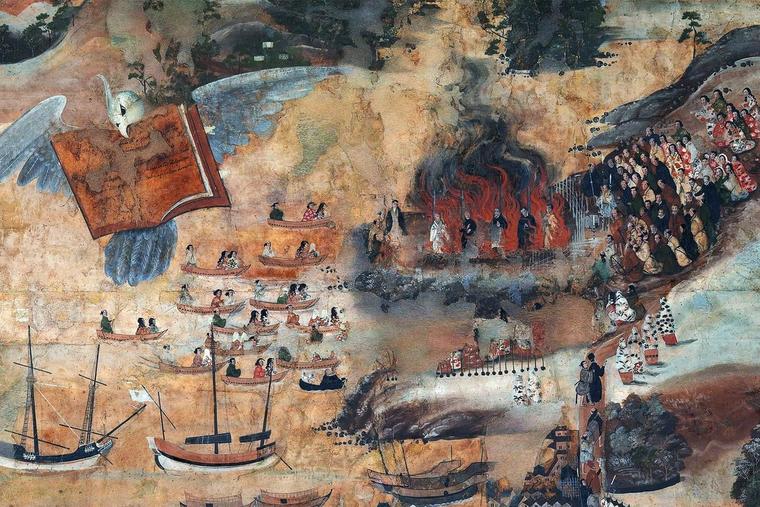
In December 1616, as two shogunal commissioners scoured Nagasaki for a Japanese priest — torturing great numbers of locals in their search — a humble Jesuit brother named Leonardo Kimura offered himself up to the torturers as a substitute for their man, thereby turning down the heat on the Catholic community.
The Kimura family hailed from Hirado, where Leonardo’s great-grandfather had been baptized by St. Francis Xavier (1506-1552), the pioneering missionary who had introduced the Japanese to Christ. Leonardo was born in 1575 in Nagasaki, which in 1580 would be donated to the Society of Jesus by Omura Sumitada, the first Japanese daimyo, or domanial lord, received into Holy Mother Church.
Leonardo most likely grew up in Nagasaki’s Hirado-machi, an enclave peopled with Catholic exiles from the island of Hirado who had come to live Catholic lives free from oppression by a Christ-hating daimyo. There was also persecution by Buddhist clergy jealous of the Catholic missionaries, who robbed them of money and prestige by preaching incontrovertible truth and exhibiting the love of Christ in the flesh, thus stanching the flow of alms from the common folk.
Christian love offered a stark contrast to the moral rot visible everywhere: Buddhist priests feigning celibacy while openly consorting with their pet catamites; unwanted infants left on the roadside to die; corpses of slaves killed by their master thrown out “to be eaten of dogges, an ordinary matter in these partes, the lives of all slaves being in the masters handes, to kill them when he will, without controle of any justice,” Richard Cocks, an English resident of Hirado, observed. In fact, human corpses were used by men and boys to test the keenness of their swords.
And then there was the Catholic Faith, with its Ten Commandments and its Love thy neighbor as thy self.
At 11 years of age, Leonardo Kimura entered the Jesuits’ school in Nagasaki. “Being endu’d with a quick Wit, and sound Judgment,” one historian writes, “they appointed him at the Age of thirteen Years to catechize the Heathens.” He would only be admitted into the Society of Jesus at age 27, however, and would never be ordained a priest.
Although these facts might seem to point to purely man-made obstruction — given the well-known reluctance of the Jesuit hierarchy in Japan to ordain native Japanese to the priesthood (St. Francis Xavier established the Church in Japan in 1549, but the first Japanese priest was not ordained until 1608) — I suspect that the Hand of God was guiding Leonardo Kimura’s journey to eternity.
Let us turn the clock hands to 1614, when Tokugawa Ieyasu, the “retired” shogun, banned Christ utterly from the empire — or so he intended. To preach Christ, or help or harbor those who did, now brought death with tortures, a fact that Brother Leonardo knew full well when he offered himself to the shogun’s police as a substitute sacrifice in December of 1616.
By November 1619, Leonardo Kimura had spent three years in jail in Nagasaki, Omura, and then Nagasaki again, awaiting the day of his martyrdom. Those years proved a crucible of miracles.
Jail life was horrific in the Japan of Leonardo’s day: men were crammed together like canned sardines in dark, fetid cells, squatting naked, pressed among fellow inmates crawling with vermin, many dying of dysentery or other poxes. Yet Leonardo saw this man-made hell as an opportunity to win souls to Christ.
In a letter he wrote in Japanese from his cell, jammed among his fellow prisoners, he repeatedly expressed gratitude. The word for “grateful” (or “gratitude”) appears six times. One example:
The jail being far too small, they have started to take down the wall on one side to build an extension … The timbers have come from the church that used to stand in Hakata-machi, from the other churches throughout the city, and the hospital attached to the church. … If you think that because the timbers of the churches were used to build the jail, I am back home again, this is really something to be grateful for.
Leonardo’s gratitude to God expressed itself especially in evangelization. During his imprisonment, he baptized 86 souls, both prisoners and jailers, reminiscent of St. Paul in prison:
I want you to know, brethren, that what has happened to me has really served to advance the gospel, so that it has become known throughout the whole praetorian guard and to all the rest that my imprisonment is for Christ; and most of the brethren have been made confident in the Lord because of my imprisonment, and are much more bold to speak the word of God without fear (Philippians 1:12-14).
Eventually, Leonardo was deemed so dangerous to the shogun’s Christ-extermination agenda that he was transferred to the distant jail at Omura, where he spent more than a year crouched in a cell whose ceiling was so low that his head touched it even while seated. Still, Leonardo scourged himself daily, perhaps to prepare himself for martyrdom. Jesuit historian Francois Solier tells us that he fasted every day except Sundays and scourged himself daily except on feast days, for the mortification of his body.
Nothing, it seems, could dampen the redoubtable Jesuit’s spirit — not even burning at the stake.
On Nov. 17, 1619, orders finally came down from Edo (today’s Tokyo): Leonardo and four companions were to die the next morning. Father Solier writes that Leonardo spent the entire night encouraging his companions and praising God for their approaching martyrdom, which he regarded as a long-awaited blessing.
Leonardo’s companions in death were Domingos Jorge — a Portuguese resident of Nagasaki, married to a Japanese Catholic woman — who had given lodging to Father Charles Spinola; and three lay members of the Confraternity of the Holy Rosary: André Murayama Tokuan, a Nagasaki-born Catholic who had lodged religious; João Yoshida Shozaemon, a native of Kyoto baptized in Nagasaki, who had found a poor religious living rough in the wild and brought him into his home; and Cosme Takeya Sozaburo, a Korean brought to Japan at age 11 and baptized, condemned for having lodged two Dominican fathers. In jail he taught himself to read “to console himself with holy books,” Father Solier writes.
On the appointed hour, the martyrs’ procession to the execution ground resembled a victory parade more than a shaming display of condemned criminals.
C. R. Boxer writes:
The weakest member of the party was given a litter, and Hasegawa [the governor] offered another to Domingos Jorge; but the brave Portuguese replied that ‘he would go afoot and unshod, in order to imitate Our Lord Jesus Christ, who afoot and unshod went to Calvary hill in order to die for us.’ The captain was as good as his word, and walked with a red bonnet on his head ‘so gladly that it seemed he was going to a country picnic rather than to be burned alive.’
All Nagasaki turned out to witness the spectacle. The martyrs were burned on the shoreline below the mountainside where the 26 Martyrs had been crucified 22 years and nine months earlier. Nine months: that proto-martyrdom in Nagasaki had indeed given glorious birth.
Crowds lined the roadside, while others covered the hillside to the martyrs’ right as they marched toward their final glory. Even the bay was filled with boats of onlookers, including Portuguese merchants and sailors offering prayers for Domingos Jorge, their countryman, and a boatload of children from the Congregation of Our Lady singing hymns and spiritual canticles.
Arriving at the enclosure where they would be roasted alive, each man bowed reverently to his appointed stake, and all embraced one another in a consummately Christian fulfillment of Jesus’ command, Love one another as I have loved you.
The executioners tied them to their stakes and lit the firewood encircling them. Father Solier relates that as the smoke rose and the fire spread, all stood firm, defying the flames, while Leonardo — feeling the heat — assured the onlookers with a cheerful and happy countenance that to him the fire felt like the merest ‘sweet dew.’ When his ropes burned away, this faithful Jesuit bent earthward and, taking up flaming embers in his hands, “placed them with great reverence on his head like so many jewels from heaven,” singing the psalm Laudate Dominum Omnes Gentes. Clearly, Brother Leonardo regarded his fiery death as yet another reason to thank God for an undeserved mercy.
The astonished onlookers responded with a thunderous chorus of Iezusu! Maria!, resounding the holy names until the flames completed their work and sent five faithful souls to heaven — where they still hear our prayers.
(These five holy martyrs were beatified by Pope Pius IX on May 7, 1867.)
Luke O’Hara lived 23 years in Japan, where his interest in Japan’s martyrs drew him into the Catholic Church. His articles and books can be found at his websites, kirishtan.com and lukeohara.com