


The film’s death scene is enhanced by the glorious singing of the opera singers who play the nuns — but the glories of the life to come belong to these martyrs, who were willing to die for their Lord, their faith and their country.
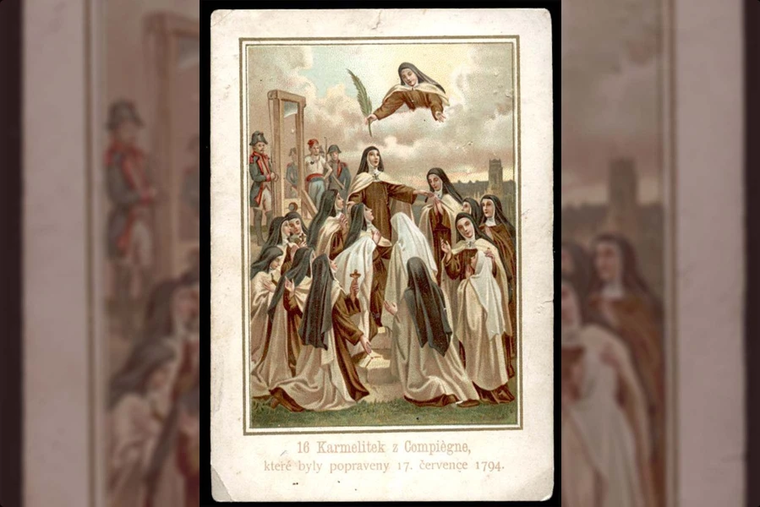
France’s Reign of Terror did not begin overnight. The de-Christianization of France, like that of most countries, began with smaller persecutions. But the result was the infamous execution of Carmelites from a convent in Compiègne, who willingly laid down their lives to obtain peace in their country. This miracle occurred 10 days after their deaths with the death of the man at the center of the persecution, Robespierre.
The story of the nuns’ calm demeanor as they sang religious hymns and helped each other mount the scaffold to be beheaded by the guillotine is so remarkable that it inspired a fictionalized book, which was the basis for Dialogues of the Carmelites, one of the world’s most-performed operas. Viewers of this new EWTN documentary go behind the scenes of this opera in the present day to know what really happened.
Blessed: The Martyrs of Compiègne is based on the recollections of Sister Marie of the Incarnation, who was absent when her sisters were arrested, as well as the present-day Carmelites of Compiègne who safeguarded their forebears’ stories and promoted their eventual canonization.
Blessed airs at 10:30 a.m. ET, Wednesday, July 16, on EWTN, and again 10 p.m. ET on Saturday, July 19; EWTN.com/everywhere (in French with English subtitles, TV-14).
Why did the revolutionaries go after 16 nuns in an obscure convent? As the French Revolution dragged on, the government’s empty coffers needed to be refilled. Their solution was to demonize the Church so that its assets could be nationalized. The de-Christianization campaign included anti-religious masquerades where stolen vestments were used in vulgar displays to mock religion and a so-called “Festival of Reason” was held in Notre Dame Cathedral, even as Mass was banned.
As the situation worsened, the prioress, Mother Teresa of St. Augustine, told her nuns that those who wished could make a consecration of their lives “so that the divine peace [Our Lord] had come to bring to the world would be restored to Church and state.” Despite the fear of two of the nuns, all made the consecration, which they renewed every day for two years. Perhaps some were encouraged by a dream that a nun of their order had experienced 100 years before, predicting that most of the nuns in that convent would be martyred. The nuns were not looking for martyrdom, but they were prepared to face it when it arrived.
The persecution at the Compiègne convent began when members of the town council violated the convent, demanding to speak with each nun individually. They had read a novel by a French philosopher that posited that many young girls were forced into convents against their will. Each nun was flanked by two soldiers, who wrote down their every word. The verdict: All the religious were happy to be there.
The government then ordered that no religious could take vows. This distressed a 27-year-old novice, who had to remain a novice for five years. Eventually, religious orders were banished altogether, and the nuns were forced to disperse to different homes in Compiègne. where they kept their vows as best they could.
This story is so rich in fascinating details — bolstered by the courage of the nuns. After their arrest, Mother Teresa traded her coat so her nuns might have some hot chocolate. This wasn’t to ease their hunger, but because she didn’t want her nuns to shake as they climbed the scaffold, lest spectators think they were afraid.
Why were they killed? They were deemed fanatics who clung to “puerile beliefs and silly practice of religion.”
As the Carmelite nuns were being murdered, they renewed their vows. This meant that the novices who had been unable to take their vows died as Carmelite nuns.
The film’s death scene is enhanced by the glorious singing of the opera singers who play the nuns — but the glories of the life to come belong to these martyrs, who were willing to die for their Lord, their faith and their country.
This is a shortened adaptation from the “EWTN Wings” weekly programming email. To have info about EWTN shows and specials sent directly to your inbox, sign up at EWTN.com/wings.