<p><!-- BEGIN THEIA POST SLIDER --></p>
<p> <br />
</p>
<div>
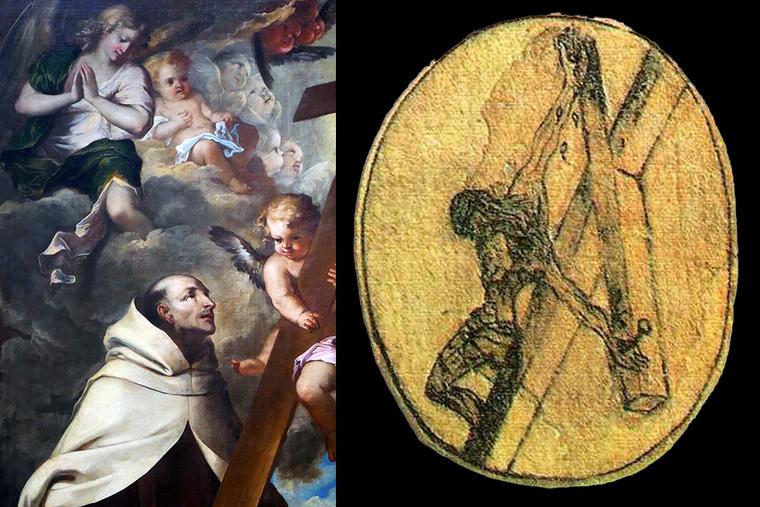
<p>SAINTS &; ART: From his mystical poetry to his unique sketch of Christ Crucified, St. John of the Cross reveals the beauty of suffering in union with God.</p>
</p></div>
<div>
<p><a href="https://www.newadvent.org/cathen/08480a.htm">John de Yepes</a> came into the world in Spain in 1542, the child of silk weavers. He grew up poor, was apprenticed, and had the fortune partially to attend a Jesuit-run school. Severe in his mortifications, he had visions calling him to religious life in its austere grandeur. In 1563, he entered the Carmelites, taking the name-in-religion of John of St. Matthias.</p>
<p>John lived in the Spain of St. Teresa of Ávila. She was engaged in efforts to reform the Carmelite order by returning to its more rigorous, primitive roots. John began to implement the reforms of what would become the Discalced (“barefoot”) Carmelites in a male community, working with Teresa to carry her reforms forward. Eventually, as her community grew, John also became their chaplain.</p>
<p>He was eventually caught up in the internecine conflict between the established Carmelites and this reform-by-return-to-the-sources branch. The apostolic nuncio seemed to give some support to the latter and gave John an appointment in it, but when John’s original Carmelite community in Medina summoned him home and he refused (invoking the nuncio’s commission), he was arrested and imprisoned for about nine months in a small cell in Toledo. It was during that period that some of his greatest poetry and mystical writings happened. Arrested in December, he managed to escape the following and worked to establish reformed Carmelite houses through mostly southern Spain. Eventually, the two branches of the order came to peace and mutual recognition, but John’s health gave out and he died in 1591. He was canonized in 1726 and declared a Doctor of the Church in 1926.</p>
<p>The rich body of his mystical writings and poetry remains read today. Books like <i>Dark Night of the Soul, Ascent of Mount Carmel </i>and <i>The Living Flame of Love </i>remain stellar classics of the spiritual life. </p>
<p>John’s devotion to Christ Crucified, union with whom the soul is called to, is exemplified in his own sketch of the Lord depicted above. The simple sketch approaches the Lord from a unique angle: upward, looking down at him. His body pushed forward, his torso distended because the center of gravity in that body has been shifted upward, his arms pulled and supporting a full body’s weight — this is a truthful depiction of the torture crucifixion represented. It particularly underscores the breathing problems crucifixion caused by relocating the center of a body’s weight. The arms extended upward to the crossbeam form a triangle, alluding to the Blessed Trinity, Our Lord’s head a circle, the unity of the Godhead. </p>
<p>John’s sketch has stood out in art for its unique perspective. It was said to have inspired Salvador Dalí’s famous 1951 painting, <a href="https://en.wikipedia.org/wiki/Christ_of_Saint_John_of_the_Cross">“Christ of St. John of the Cross,”</a> depicting Jesus from the same angle, albeit front rather than back view. Dalí claims to have had a vision to paint the image. The body of water is a bay near where Dalí lived.</p>
<p>I believe there is also a similar perspective in Mel Gibson’s 2004 film, <i>The Passion of the Christ</i>, in which, at the moment of his death, we see Jesus almost from the perspective of God the Father looking down from heaven, with a teardrop that destroys Satan’s Kingdom.</p>
<p>To read more, see <a href="https://www.newadvent.org/cathen/08480a.htm">here</a>.</p>
</p></div>
<p><br />
<br /><a href="https://www.ncregister.com/blog/saints-and-art-st-john-of-the-cross">Source link </a></p>
<p><!-- END THEIA POST SLIDER --></p>

The Mystical Art of St. John of the Cross| National Catholic Register