<p><!-- BEGIN THEIA POST SLIDER --></p>
<p> <br />
</p>
<div>
<p>COMMENTARY: In both the Polish and American cases, where is the Church creating the space in which unity might be recomposed, modeling rational discussion as the antidote to social media snark?</p>
</p></div>
<div>
<p>CRACOW — Adam Michnik was one of the great wordsmiths of the revolution of conscience that began to form in mid-1970s Poland, that was fully ignited by John Paul II in June 1979, and that triumphed in the Revolution of 1989. </p>
<p>It was Michnik, defending nonviolent methods of anti-communist resistance, who neatly observed that “those who start by storming bastilles will end up building their own.” It was Michnik who, in a 1977 book, defended Polish Catholicism to anticlerical dissident comrades by stating bluntly that “for many years now, the Catholic Church in Poland has … stood out in defense of the oppressed,” playing a role in the struggle against tyranny that “it is impossible to overestimate.” It was Michnik who described the Nine Days of John Paul II in June 1979 as having taught “a great lesson in dignity.” </p>
<p>Yet in 1991, when John Paul II returned to the post-communist Poland he had helped liberate and the theme of his pilgrimage was announced as the Ten Commandments, Adam Michnik said to his friend (and mine), Dominican Father Maciej Zięba, “This is the end of Polish democracy.” </p>
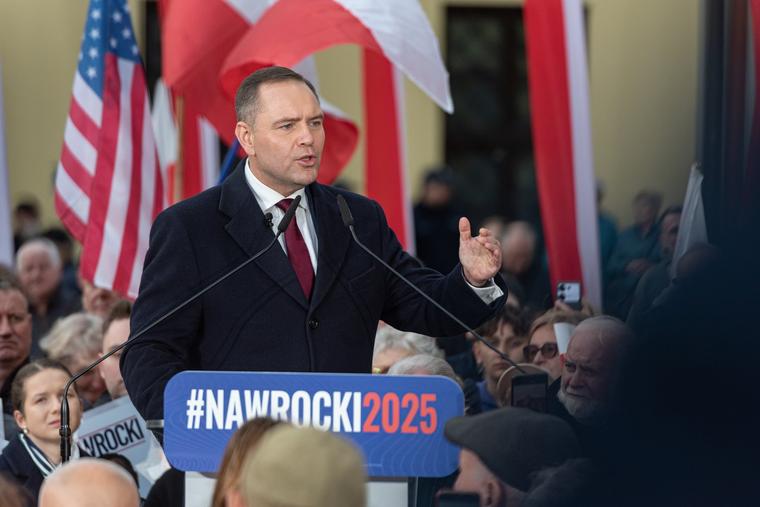
<p>I was reminded of this sad, jarring juxtaposition when, in the wake of Poland’s June presidential election, a Polish political commentator with whom I had had previous e-mail exchanges sent me an article in which he claimed that the narrow victory of Karol Nawrocki, the more conservative candidate, had turned Poland into a “global laughingstock,” a country capable of resistance but “incapable of sustaining normal, serious government: whatever we [Poles] build, we immediately set out to destroy.” </p>
<p>That this reaction was more than a little overwrought — and what I hope was not what that Polish commentator meant by “normal, serious government” — was illustrated when the losing presidential candidate, Rafał Traszkowski, the mayor of Warsaw who had banned crucifixes in public offices, assuaged his frustrated supporters by leading the LGBT parade sponsored by the City of Warsaw, in which (as a Polish friend reported), “Satanists with pro-abortion slogans made their debut.” </p>
<p>What to make of all this? </p>
<p>There is something, I think, to the claim that Poles are great at resistance but not-so-great at governance. Almost thirty years ago, I asked a distinguished Polish theologian why that seemed to be the case, and that good Dominican gave the perfect Thomistic answer: because the idea of freedom that came to Poland in the High Middle Ages was William of Ockham’s notion of freedom as sheer willfulness, rather than Thomas Aquinas’ concept of freedom as tethered to truth, ordered to goodness, and guided by reason. </p>
<p>The post-communist Catholic leadership of Poland has also made its share of blunders, fueling the fears of the secular left that a publicly engaged Polish Catholicism would create something like Franco’s authoritarian Spain. And it was not just left-leaning secularists who were concerned: my friends among the former students of John Paul II were appalled some years ago when a Polish archbishop said in a Good Friday sermon that those who did not vote for the conservative party in the impending parliamentary elections were like Pontius Pilate. </p>
<p>Like every democratic country, Poland is a unique case. But yet another Polish political commentator — one of the most learned and insightful men I know — put his finger on something of more general concern when he responded to my query about the meaning of that recent, bitterly contested Polish presidential election in these terms: </p>
<p>“…the declining phase of liberal democracy (in the form we know) is an exceptionally grim spectacle. The elections are perpetuating a division that increasingly calls into question the existence of a political community as a unity beyond divisions. There is something of the state’s self-aggression in this. For huge amounts of money, the state is organizing an exciting spectacle of mutual hatred that is leading to the disintegration of society into tribes that despise each other.” </p>
<p>For the moment in Poland, those mutually antagonistic tribes are, in the main, subordinating their antipathies to their mutual (and quite legitimate) concerns about revanchist Russian imperialism. But what of the United States?Shouldn’t my friend’s concerns about the viability of the “political community as a unity beyond divisions” ring a few bells here? And in both the Polish and American cases, where is the Church creating the space in which that unity might be recomposed, modeling rational discussion as the antidote to social media snark? </p>
<p>Hard questions, to be sure, but questions that cannot be avoided if the democratic ship is to steer its way between the rock of statist authoritarianism and the hard place of state-imposed wokery. </p>
</p></div>
<p><br />
<br /><a href="https://www.ncregister.com/commentaries/poland-us-perils-polarization-weigel">Source link </a></p>
<p><!-- END THEIA POST SLIDER --></p>

The Perils of Polarization| National Catholic Register