


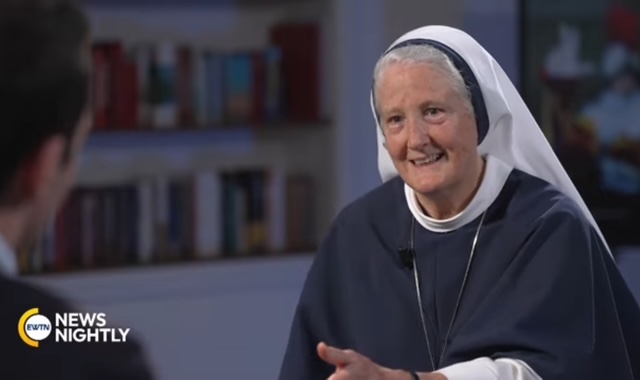
Mother Agnes Mary Donovan of the Sisters of Life was enjoying a successful career as an Ivy League psychology professor when she experienced a call to religious life during an 8-day Ignatian retreat. It was a call, she says, “to love, to give all of my mind, my heart, my soul, the entirety of my life” to God, and to trust in his plan for her life.
Not long afterward, Mother Agnes became one of the founding sisters — and eventually the first superior general — of the Sisters of Life, a religious institute founded in 1991 by Cardinal John O’Connor in New York.
In addition to taking vows of chastity, obedience, and poverty, the Sisters of Life take a fourth vow: to protect and enhance the sacredness of human life.
GIVEN, a nonprofit organization that helps young women identify their gifts for the Church and the world, recently named Mother Agnes as the recipient of its 2026 Fiat Award, which recognizes women whose lives embody the response of Our Lady through faithful leadership, service, and love in the Church and the world.
Ahead of that announcement, Mother Agnes spoke to EWTN News’ Colm Flynn about her path to religious life and the sisters’ pro-life ministry.
As she explains, the message they share every day is “to answer that very ache in the heart of man, which is to say that you are of infinite value, that you came from a creator who created you with a particular purpose for your life.”
The following transcript of her conversation with Flynn was edited for length and clarity.
Where did you go to study psychology?
I went first just to the local community college. Then I went to the University of Pittsburgh, and then I went on to a state school to get a degree to work in education, educational psychology. And finally, I completed my doctorate [at the University of North Carolina] in Chapel Hill.
You ended up then as a professor, was it, at Columbia University in New York?
I was.
And you were teaching psychology there. In your head, what was the end game? Were you thinking, “OK, I’ll just stay here in New York. I’m in academia now. This is it. I’ll climb the ladder.”
Absolutely. [I] loved it. Loved it. Thought I’d be there forever. [I] was, in fact, buying a house in upstate, northern PA, near my parents and saying, “This will be great. I’ll live in this city. I’ll have a place where I can retreat from the noise and do sabbaticals and be close enough to be really a part of my parents’ life.”
You had made it, Mother Agnes, in the worldly sense … Then what happened? What made you think then one day, “I think there might be more to this than what I’m doing now?”
The way it happened was that I was on a retreat at the end of my first year of teaching in New York. It was an 8-day [Ignatian] retreat where you pray in silence and basically listen to and see things that you don’t see when you’re not silent and you’re not praying. I think what happened was that essentially an encounter with the love of God just turned my life upside down. Because I was very happy living life and enjoying it and giving all the good things to God. And I thought that I was supposed to plan my life [according to that.] And this was an encounter which revealed to me that no, God had a plan for my life.
Was it a calling that you felt?
Yes, definitely a calling. A calling to give all of my life to God, and he would decide what that would look like. So, in other words, it was a call to love, to give all of my mind, my heart, my soul, the entirety of my life.
And did you think, “Well, to do that fully, I must become a religious sister?”
It seemed obvious to me. It seemed obvious. And I told my retreat director that. I said, “I’ll be in a convent next year at this time.” And he said, “Oh, no, no, no, not so fast.” And I said, “I will.” I just knew.
The Sisters of Life, [how would you] describe it to someone you just met in an elevator and they said, “Oh, what do you do? What is your charism?”
We live in an age when most people don’t get up in the morning and feel that their life matters deeply. They question the meaning and the purpose of their lives. Our purpose as Sisters of Life is to answer that very ache in the heart of man, which is to say that you are of infinite value, that you came from a creator who created you with a particular purpose for your life. And only you can fulfill that purpose. And so, we get up every day to proclaim that to the world, that you are sacred. You have a sacred origin, you have a sacred destiny, and that every moment through life matters.
How long did it take before women started arriving at your doors, calling your telephone and looking for help?
Not very long. As postulants! So that means we were two months [along] and we received our first call [from] a young woman from a nearby Catholic university who was pregnant and who wanted to talk to someone.
When you heard that young woman call, what do you hear on the other end of the phone?
What you hear is a lot of chaos, a lot of confusion, deep, deep anxieties about making a decision that will be irrevocable. You hear fear, and you hear also, in many of them, you hear hope that they will hear something that will be clarifying, that will help them to establish a foundation on which to make that decision.
So these would be women who would be considering having an abortion because of an unexpected pregnancy.
That’s right. Practically all the women we serve are in that very situation. They’re deliberating among their options.
Why do you think they’re calling you? Do you think that they’re too ashamed to tell maybe their parents or they just don’t know what to do, how this would ever work out? “I’m going to go ahead with this, but maybe … I’ll just call them in case?”
Just in case. Yes, I would say so. I think that the women that call us are calling us because they want to know everything before they make that decision. They may not be practicing their faith, but they have some life of faith within them. They don’t want to ignore that, because everything in their being tells them that this is an important decision. And so our job is simply to help them slow down long enough to simply think through and with their heart, more than their mind, what is before me and what my options are. And that’s what we do. It’s really a call to listen deeply to the heart of another and to allow her to speak what is within her heart so that she can hear herself.
Is it easy to get through to people at that stage when there is, as you say, so much chaos and confusion and anxiety? And the easy option society is telling them is, “Look, do this [have an abortion.] Problem solved,” is what society says.
Well, many who come to us have already had that experience, where they have quickly made a decision and they have lost a child to abortion. And this may be their second pregnancy, and they’re not willing to move so quickly. And they really want to think it through. But not all. But I would say probably at least half of the women we serve [have had that experience.]
Why are they not so quick the second time?
Because the experience of abortion is not what it’s described to be. It’s an experience they never want to have again. No woman would ever choose abortion if she had options that were real. And that’s our job as we listen to them. “What would you do,” we’d say to them, “if everything were different?” And they’ll tell us. “And what would you need? What would you need to make it different?” And she’ll tell us all of the things that are necessary.
What is that? Money, support, daycare?
Exactly. All that. And then we, with a cadre of coworkers — hundreds of coworkers, thousands who have worked with us — will put that together and help her find what she needs so that she can reasonably make that decision. Because the decision for abortion is often one that is vaguely coerced by the culture, by withdrawing all the supports that are needed.
You said [earlier in the interview] you wanted to have six children when you were a little girl. How many children do you think you have today?
[Laughs.] Who knows? I hope there’s many! The Sisters of Life, I know, we have probably more than 10, 12, 15,000. A whole village of children.
Isn’t it incredible?
It’s wonderful. And happy mothers. Mothers who have lived a difficult life, maybe, most times, a difficult life. Raising a child on her own, but with the support of family, with the support of communities, with the support of the Church, [she] has made it. And that’s how she feels: “I made it.”
