


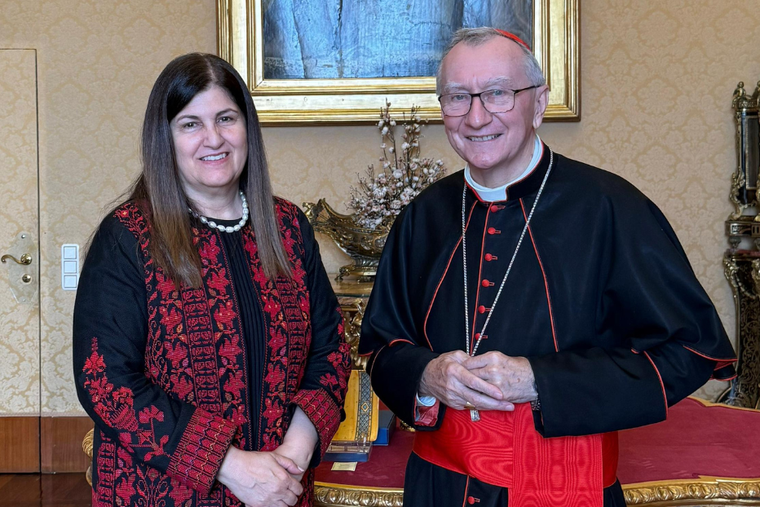
The Holy See supports peace and must continue to raise awareness of the humanitarian crisis in Gaza, enabling us to participate in peace negotiations, Varsen Aghabekian, the foreign minister of Palestinian Authority, told EWTN News in an exclusive interview Sunday.
Aghabekian on Sept. 1 held a bilateral meeting at the Vatican with Cardinal Pietro Parolin, the Vatican’s secretary of state. During her stay in Rome, she also visited the Sovereign Military Order of Malta, meeting with Riccardo Paternò di Montecupo, the order’s grand chancellor, and discussing the Order of Malta’s humanitarian initiatives in Palestine.
The Jordanian-born diplomat, a Christian of Armenian heritage, received her higher education in the United States, earning a master’s degree in nursing administration from Purdue University and a doctorate in education policy and management studies from the University of Pittsburgh. She was appointed foreign minister in March 2024.
In this September interview, Aghabekian recounts her meeting in the Vatican, emphasizes the Holy See’s efforts for peace, and advocates for multilateral peace negotiations to establish a just resolution to the war in Gaza, which was initiated by the Palestinian nationalist organization Hamas on Oct. 7, 2023.
The Palestinian Authority is currently led by Fatah, a Palestinian nationalist and social democratic political party whose chairman is Mahmoud Abbas, the president of the Palestinian Authority. Hamas has controlled Gaza since 2007.
While Aghabekian accuses Israel of rejecting peace for 30 years, both Israel and the United States have proffered multiple peace deals over the years that the Palestinian Authority has rejected.
Pope Leo XIV and his top aides met on Thursday with Israeli President Isaac Herzog.
What was the reason for your visit to the Vatican?
This is part of a broader journey. I have been visiting several countries to get support for the recognition of Palestine, and other countries that have already recognized the Palestinian State, like the Holy See. In this case, I brought attention to the increasingly catastrophic situation and the need to move on a political track in preparation for the New York conference.
Who did you meet in the Holy See?
We met with Cardinal Pietro Parolin, Vatican secretary of state, and had a very frank discussion on the situation in Gaza and the West Bank. We spoke about the conditions under which Palestinian Christians are leaving, the dwindling number of Christians, the general violations of the humanitarian law, and the need to stop the war in Gaza.
What is the situation like in Gaza?
There is a need for unimpeded humanitarian assistance. There is also a need to pay attention to the West Bank. The expansion of Israeli settlements jeopardizes the two-state solution. Everything that is encroaching on the two-state solution was discussed today.
Did you find that the Holy See is supportive of the Palestinian situation? Do you think it could do more?
The Holy See is committed to promoting peace. As Christians, we are peacemakers. So, in that respect, we are for the rights of people to self-determine, and we are against violations, and we are against any violence perpetuated by anyone against another. So, in that sense, the Holy See recognized the two states long ago; it recognized the Palestinian state long ago (in 2015), and we need the Holy See’s support. We need the Pope to speak of the plight of the Palestinians. We need the Pope to talk about the importance of peace because his voice resonates well with the world. We expect that his words can put some sense into what is going on.
What can be a possible path to peace? The situation now seems irreversible …
It has to be reversible; we have to believe it is reversible. Anytime you occupy a land, you do not comply with international law. So, if we all believe in international law and the need for compliance with it, we need actually to comply with it. What is happening today? What Israel is doing in terms of annexation, in terms of erasing people, in terms of displacing people, in terms of building the settlements, moving the population to occupied land, is all the point.
Do you have actual numbers of the humanitarian plight in Israel?
Today, you learn that 2 million people in Gaza are displaced. They have been displaced not once, not twice, not thrice, but several times. Let’s remember that 65% of the population is already or was a refugee population. They were given refugee status in 1947-1948, so they have been displaced more than once. Starvation is a reality in the war fields, as confirmed by a U.N. report that has declared a famine, indicating that this is not merely a narrative about whether people are starving or not.
We see what the war is costing in terms of lives. We woke up today with the news that hundreds of people were killed in the last 24 hours, including 38 seekers of humanitarian aid.
And then there are medical problems, social ailments. … You can name it all. In two years of war, people haven’t received proper medical care, and many haven’t visited a dentist, resulting in oral problems developing.
Additionally, children have been out of school for two years. What does that do to you in terms of mental health? What does it do to you about their outlook for the future to see blood and death around them? The situation is far more than catastrophic.
Israel justifies the occupation and the attacks with the need to eradicate Hamas. What can Palestine do to destroy Hamas?
Hamas is not just a physical structure. I mean, you can kill people, dismantle buildings, but Hamas is an ideology, and that ideology is nurtured as long as there is no justice. As long as Palestinians do not see a future, do not see a light at the end of the tunnel, there will always be people who believe that violence can be a solution, that violence can be a way out, because they saw that the peace camp has brought them nothing. This is the way out because they see that the other camp, the peace camp, has brought them nothing. I mean, we have embarked on a peace process with Israel over three decades ago, and what did that end up with? More of the occupation. Everything came out after the peace process was started.
So people see that the violence is at least hitting in one way or another, because the peace camp is not bringing back Palestine.
What is the solution then?
The only way extremists on all sides, the Palestinian side, and the Israeli side, would be tamed is through a peace process that respects the rights of most parties, that says that there’s a better future for all. And that future is governed by international law and the world order; anything else will be breached.
Do you think that the Holy See can be a driver in this peace process?
Yes, because as I said, the Holy See’s words resonate well in the world. We need to continue discussing the peace and the principle in that case. Jesus has told us, “Blessed are the peacemakers.” This is the reason why we need to continue on this path.
We know that most of the Catholics in Palestine are Arabic. What is the impact these Catholics can have?
Christians are part of the Palestinian makeup. Christian organizations are the third-largest employer in Palestine after the Palestinian Authority and onward. Christians have made significant contributions in various fields, including health, education, social welfare and tourism.
We saw the protest of the Israeli people against the situation in Gaza. Is there a possible connection between Palestinians and Israelis on the matter of peace?
We would welcome any move towards that, and there are, of course, Israelis against the war. We need to hear their voices more often because they can make a difference. Some voters hold the government accountable, and they can have their say, but we need to see the board on the streets and have a more London-style board.
Is your ambition that more countries will always recognize the state of Palestine?
We currently have 149 countries recognizing the State of Palestine. We expect other countries to follow suit in this regard. Some of them already voiced their intent to recognize Palestine unconditionally. Different countries have put conditions. However, we expect other countries to recognize the state of Palestine. I don’t know the exact number, but the more the better.
Israel claims to be at war with Hamas, and not to be at war with Palestine. So who is going to sit at the table of peace?
The table of peace would require everyone to sit. Palestinians first, because the PLO is the only entity that has political leverage on the entirety of Palestinian territory. If there are no Palestinians, the peace process itself will be shaffled. However, you also need to secure arrangements with all other brokers, as many require collaboration with others. Palestinians, however, will be key players, because they will be the ones to fulfill the responsibilities the day after.
The Pope will likely go to Lebanon in December, after the trip to Turkey. Did you invite the Pope to come to Palestine?
I want the Pope to visit Palestine when the time is right. It would be a lot of logistical work under normal conditions, so you can imagine what it would be like in such situations. However, in the near future, things will be more conducive. And, of course, we would love to have the Pope.