


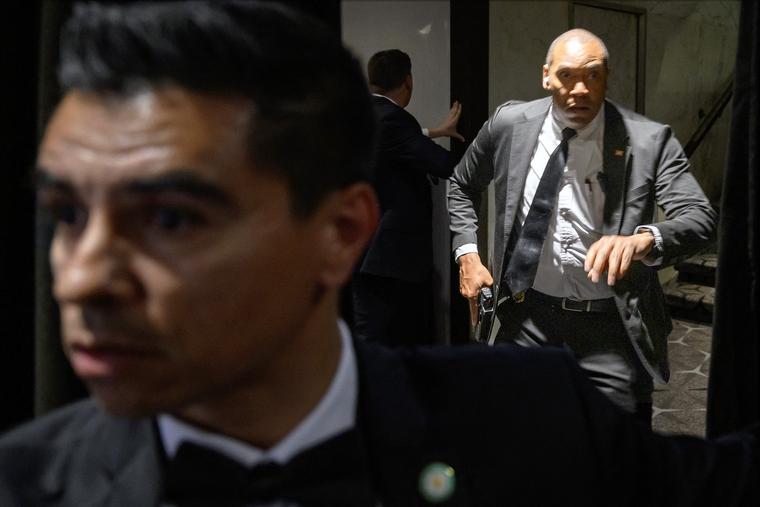
COMMENTARY: An attempted attack on the White House Correspondents’ Dinner points to a deeper trend: In a polarized West, violence is becoming thinkable again.
It was in a 1950s motorcycle picture that the exchange is made. Marlon Brando, the “Wild One” in the movie’s title, is asked what he and his fellows are rebelling against. Brando’s character, Johnny, answers, “What’ve you got?”
If we’re not quite in an age of revolution in the West, there are many acting, or play-acting, as though we are. Ivy League graduate Luigi Mangione, who went to Penn, the same school as President Donald Trump, has become something of an icon on the left for murdering insurance executive Brian Thompson in 2024. Trans-identifying young people have shot and killed children in religious schools in Tennessee and Minnesota.
The New York Times, the most influential newspaper on the planet, recently featured a fawning interview with leftist influencers Hasan Piker and Jia Tolentino, justifying Mangione, embracing Marxism and endorsing “microlooting” — robbing stores and (in Piker’s case) even national museums — as some sort of principled stand against the powerful. Both Piker and Tolentino, like Mangione, come from upper-middle-class or wealthy backgrounds, but that doesn’t seem to have caused much introspection on their part.
The infatuation today with revolutionary violence is not limited to words. Cole Allen — the 31-year-old teacher and Caltech graduate who attempted to shoot up the White House Correspondents’ Dinner (WHCD) in an effort to target the U.S. president and senior Trump administration officials on April 25 — seems to have been steeped in the online fever swamps of anti-Trumpism. He had moved from social-media posting on Bluesky and protests to traveling across the country to try to commit murder. Allen demonized Trump for a variety of perceived or imaginary ills, including issues related to foreign policy and immigration. In his manifesto, emailed to contacts 10 minutes before he acted, Allen clearly expected to die in the attempt, thanking “my family, both personal and church, for your love over these 31 years.”
Understanding the political motivation for violence can be a complicated thing. Ideology is complex, but there are some clues. Research shows that American universities have moved sharply to the left over the past 50 years. In 1969, 45% of faculty considered themselves to be far-left/liberal. In 2022, that figure had climbed to 74% (conservative/far-right had fallen from 27% to 11% in the same time frame).
Trend lines seem to point toward greater polarization, not just in the United States but in the West in general. Unemployment rates for young people are higher than for older cohorts. A decline in entry-level hiring and the rise of artificial intelligence seem to be making this worse. Anthropic CEO Dario Amodei has projected a 50% decline in entry-level white-collar jobs within the next five years. In the Global South, the problem of so-called “downwardly mobile would-be elites” has led to turmoil and revolution. That challenge now seems to be heading West.
Jason Burke’s new book The Revolutionists, on the extremists who hijacked the 1970s, speaks of the political, social and economic ferment that led to terrorists like Germany’s Red Army Faction and Italy’s Red Brigades: “The use of violence, even to murder, thus became an unavoidable duty.”
Bishop Robert Barron condemned the WHCD attack by Allen, warning of “the viciousness and tribalism that are so prevalent on the internet and that contribute mightily to the violence we see in our political culture. Can we please remember that it is possible to disagree with a politician’s ideas without demonizing and dehumanizing him?”
Pope Leo XIV’s upcoming encyclical, reportedly titled Magnifica Humanitas, will surely have much to say of the tremendous challenges emerging from technological trends, including AI, that are impacting the future of work and the dignity of man. These trends are at least key contributing factors to the current polarization.
Even before the new encyclical, there are few organizations that have as much experience, or as much to say, as the Church on these matters. From St. Augustine to Joseph de Maistre to Leo XIII to Jacques Maritain and Dietrich von Hildebrand, Catholic thinkers have wrestled with the challenge of unsettled, revolutionary, polarizing times. Far from having to avoid politics, the Church may have much to say — may be called upon to say much, whether it is ready or not — about the human condition in the coming years.
The pitfalls for the Church’s prophetic voice are obvious. In Latin America, in response to revolutionary times and perceptions of injustice, many looked — disastrously — to a Catholic left that in the end wound up being mostly about violent Marxist revolution and very little about Catholicism. Colombian Father Camilo Torres began with a passion for the poor and ended up carrying a gun and dying in a botched ambush in the service of the Marxist Ejército de Liberación Nacional (ELN). The ELN, which featured several priests in its senior ranks through the years, still exists, still fights and has made much of its money from kidnappings and drug trafficking.
But if leftism is a real threat to an authentic Christian witness, and it is, so would a Church too comfortable and complacent with the halls of power. That seems less likely in much of the West because much of the West seems to be increasingly post-Christian — more of a vacuum than anything else, although the vacuum seems to have stopped growing.
There are those on the far left and far right with passionate intensity, and then there are great masses that believe in nothing and no one. Still, far-right “groypers,” far-left antifa, constant incitement on social media, disinformation, unemployment, boredom and nihilism make for a toxic brew. What American writer Rod Dreher has called “Weimar America” promises to be a dangerous, volatile place. But this will be, for us — for the Holy Church — not a time to shrink back, but to stand and shine more brightly amid the coming darkness.