<p><!-- BEGIN THEIA POST SLIDER --></p>
<p> <br />
</p>
<div>
<p>The end of the world is when we die but the end of the world is not the end of us.</p>
</p></div>
<div>
<p>Is it possible to summarize the meaning of life in a thousand words or so? Can the key questions that have preoccupied great philosophers for millennia be encapsulated in the idiomatic nutshell? The answer is yes. And the reason is that the key questions have been answered with authority by the Author of Life Himself.</p>
<p>What is truth? Who is man? Who are we? And where are we going?</p>
<p>The first of these questions was asked by Pontius Pilate in his native Latin: <i>Quid est veritas</i>? It was asked of Jesus Christ. He refrained from answering Pilate directly but gave the answer to his disciples.</p>
<p>What is truth?</p>
<p>“I am the Way, the Truth and the Life!”</p>
<p>We can leave aside, for the purposes of the present discussion, what Christ means when he states definitively that he is the way and the life. But he does state definitively that he is the truth. The first question is, therefore, answered.</p>
<p>What is truth? Christ is truth!</p>
<p>What about the second axiomatic question?</p>
<p>Who is Man?</p>
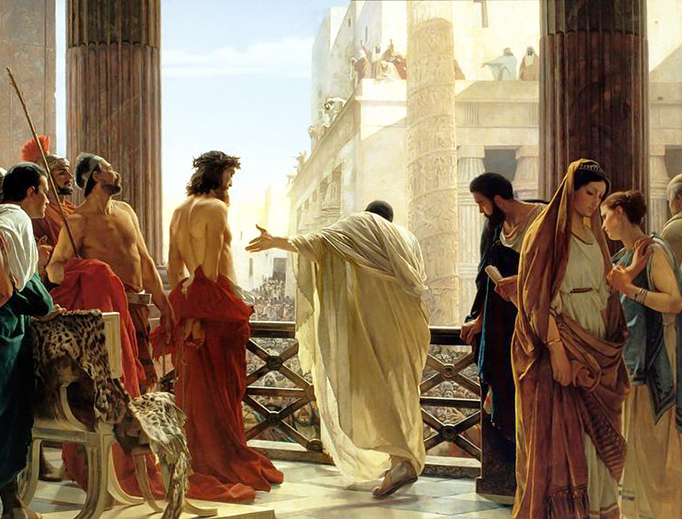
<p>This time Pontius Pilate does not ask the question; he answers it. “Ecce homo,” he says, as he shows the scourged Christ to the hate-filled crowd.</p>
<p>“Behold the Man!”</p>
<p>Christ is the Man! He is the Perfect Man. He is the man whom we are all called to be, or at least the man whom we are all called to try to be as much like as we can. The more we become like Christ, the more fully human we are becoming. He is the perfect archetype of which we are very imperfect types.</p>
<p>And this brings us to the third question.</p>
<p>Who are we?</p>
<p>We are the <i>imago Dei</i>. We are made in the image of God. The problem is that we are broken images. “Son of man, you cannot say, or guess, for you know only a heap of broken images. …” This brokenness means that we are at war with ourselves. We are split personalities. We are divine and yet deviant. The divine image in us is <i>homo viator</i>, who is the journeying or wayfaring man who seeks the kingdom of heaven. <i>Homo viator</i> seeks to be united with God, in goodness, truth and beauty. He is man on the journey of life, a journey which is also a pilgrimage. <i>Homo viator</i> is on the quest for heaven. He seeks the wholeness which is holiness.</p>
<p>And yet he is given the freedom to either choose or refuse the pilgrimage of life. <i>Homo viator</i> chooses the good; <i>homo superbus</i> (proud man) refuses the good. Instead of seeking to become more fully human by becoming more fully like Christ, <i>homo superbus</i> rejects the perfect image of God, choosing to worship instead the image of himself. Instead of setting out on the appointed way, he chooses to go his own way instead.</p>
<p>And so it is that the broken image of man is at war with himself, choosing or refusing the good. This war between good and evil, Aleksandr Solzhenitsyn reminds us, takes place in each individual human heart. There is no escaping this uncivil war within the depths of our brokenness except to escape into the arms of Christ. Ironically, therefore, we are seeing the broken image of ourselves when Pontius Pilate shows us the scourged Christ. The scars which we inflict on Christ, we also inflict on ourselves and our neighbors. The sins of <i>homo superbus</i> crucify Christ but they also crucify others. In wounding Christ we wound ourselves. Sin is a self-inflicted wound which scourges us and crowns us with thorns.</p>
<p>Having ascertained who we are, it’s time for the next axiomatic question: Where are we going?</p>
<p>This is easy. We are going to die. In Tolkien’s formulaic words we are “mortal men doomed to die.” We are defined by our mortality. We cannot escape death. It awaits each of us. This is why the memento mori, the reminder of death, is something we should welcome because it keeps in mind the Four Last Things: Death, judgment, heaven and hell. These four last things should be the first things we keep in mind as we journey through mortal life because we do not know when this mortal journey ends, though we do know that it will end and that it must end, sooner or later.</p>
<p>But there is a much deeper paradox. The reason that the last things should be the first things that we keep in mind is because the last shall be first, as Christ tells us. But he also tells us that the first shall be last. This is not a contradiction but is the mystery of love which unlocks the meaning of life. “For whosoever will save his life shall lose it: and whosoever will lose his life for my sake will save it.”</p>
<p>Following death comes judgment and following judgment comes either hell or heaven. <i>Homo superbus</i> puts himself first, saving himself by sacrificing others. <i>Homo viator</i> puts himself last, sacrificing himself for others. <i>Homo superbus</i> seeks to save his own life and loses it eternally. <i>Homo viator</i> loses his life, laying it down for others, and attains salvation.</p>
<p>Put as bluntly as the Four Last Things themselves, <i>homo superbus</i> is going to hell and <i>homo viator</i> is going to heaven.</p>
<p>Where are we going? We are going to die.</p>
<p>But where are we going after we die? We are going to be judged?</p>
<p>And where are we going after we’re judged? We are going to heaven or hell.</p>
<p>And that’s why we should look where we’re going. We should keep our eyes on the heavens because, as that great philosopher Samwise Gamgee reminds us, “above all shadows rides the sun.”</p>
<p>The end of the world is when we die but the end of the world is not the end of us.</p>
<p>For those who live the mystery of love and know the meaning of life, the end will be the most glorious and triumphant of beginnings.</p>
</p></div>
<p><br />
<br /><a href="https://www.ncregister.com/blog/pearce-this-is-the-meaning-of-life-in-a-nutshell">Source link </a></p>
<p><!-- END THEIA POST SLIDER --></p>

This Is the Meaning of Life in a Nutshell| National Catholic Register