


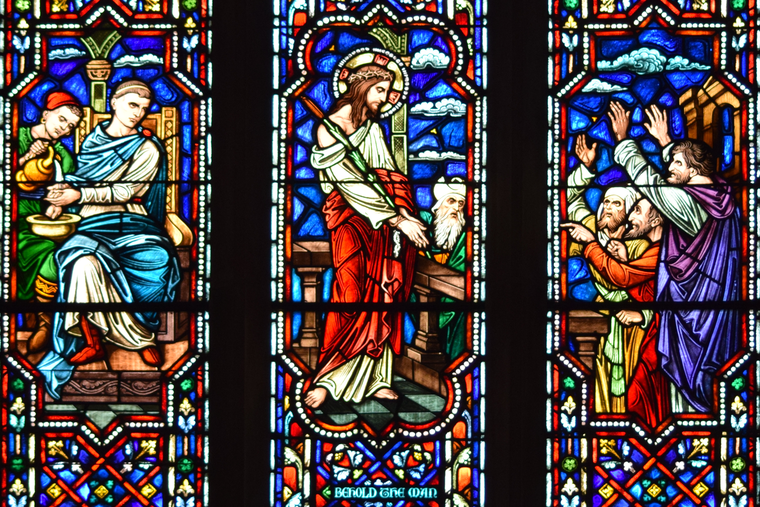
Editor’s note: Father Raymond J. de Souza recorded meditations on the Seven Last Words at St. Mary’s Cathedral in Ogdensburg, New York. They will air on EWTN on Good Friday at 1:00 p.m. (EDT). It will also be available at ewtn.com and EWTN+. Through Good Friday, those meditations will be published at the Register.
* * * * *
One of the criminals who were hanged railed at him, saying, ‘Are you not the Christ? Save yourself and us!’ But the other rebuked him, saying, ‘Do you not fear God, since you are under the same sentence of condemnation? And we indeed justly; for we are receiving the due reward of our deeds; but this man has done nothing wrong.’ And he said, ‘Jesus, remember me when you come in your kingdom.’ And he said to him, ‘Truly, I say to you, today you will be with me in Paradise’ (Luke 23:39-43).
The question of kingship was central in 1776. The Declaration made a long list of complaints against King George III, a list sufficiently grave that the signers argued that he no longer could claim the right to rule over them.
Jesus was accused of claiming a false kingship, of undermining the rule of the Roman emperor. The charge before the Sanhedrin was that of blasphemy; before Pilate it was that he was disloyal to Caesar. Pilate had him crucified under that charge: Jesus of Nazareth, King of the Jews. The chief priests objected. Pilate dismissed them; “What I have written, I have written” (John 19:22).
The Good Thief recognizes the truth of what Pilate wrote. He addresses Jesus as one who has a kingdom, and pleads for remembrance there. Jesus on the Cross does not look like a king. The crown of thorns pressed into his Sacred Head, and the purple robe previously draped upon him were instruments of mockery.
The kings of this world have the proper trappings; some revel in them. They do not permit themselves to be mocked. The challenge of the Christian disciple is to distinguish between the outward appearance and the internal reality. Jesus does not appear to be a king, but he is. He lays down his life for his friends.
Many rulers are frauds, corrupt charlatans, willing to lay down their friends for their own life, their power, their riches. The Christian, like the Good Thief, must be able to recognize the difference.
On July 4, 1776, the same day that the Declaration was signed, the Continental Congress struck a committee to design the official seal of the United States. It was an impressive committee, including Thomas Jefferson, John Adams and Benjamin Franklin. The seal, after years of deliberation, would include the eagle and the pyramid, watched over by the “eye of Providence.” But that was not the original proposal. Franklin suggested a biblical image for the seal, that of Moses parting the Red Sea. The idea of America as an “almost chosen people” was older than Lincoln.
Franklin proposed that the seal show “Moses standing on the Shore, and extending his Hand over the Sea, thereby causing the same to overwhelm Pharaoh, who is sitting in an open Chariot, a Crown on his Head and a Sword in his Hand. Rays from a Pillar of Fire in the Clouds reaching to Moses, to express that he acts by Command of the Deity.”
Franklin proposed as the Motto: “Rebellion to Tyrants is Obedience to God.”
There are different kinds of crowns. Jesus wears one on the Cross. Pharaoh wears one in the Red Sea. Different crowns for different kinds of kings.
Jesus, King of the Jews, promises Paradise to the Good Thief. Earthly kings promise paradise, too. They so promise because the desire for an earthly paradise is perpetually popular. The crowds wanted to make Jesus king because he multiplied the loaves and fish; they wanted an earthly paradise where the burden of working for food was lifted.
Only weeks after ancient Israel marched out of slavery through the Red Sea, they began to complain and murmur against Moses. The food was better in Egypt. They preferred Pharaoh, to be slaves in some kind of gourmet paradise. But Pharaoh was dead, so they made an idol out of food, the Golden Calf. The earthly paradise — and the false messiahs who promise it — remains seductive.
Thus, the temptation of politics, to seek by earthly means what God apparently cannot provide. The grasping began in Eden, and continues to this day, when political figures are regarded in messianic terms, and the faith is made subject to political considerations. That happened on Good Friday. It happened beforehand in the rebellion against Moses. It has happened countless times since, in every people and nation, including these United States.
The remedy remains the same, too, as recognized by the Good Thief: Turn not to Herod, not to Pilate, not even to the clerical establishment of the Temple, but to Christ, glorified not in majesty but in suffering. To ask admission to that kingdom and to that Paradise, which this world cannot provide.
Today you will be with me in paradise.
We adore Thee, O Christ, and we praise Thee, because by Thy holy cross Thou hast redeemed the world.