<p><!-- BEGIN THEIA POST SLIDER --></p>
<p> <br />
</p>
<div>
<p>COMMENTARY: To overcome the prevailing philosophy that permeates contemporary America’s discourse, Catholics must relearn how to engage the culture with our own moral language.</p>
</p></div>
<div>
<p>Many of us Catholics in the United States are actually liberal Protestants with rosary beads. To form our moral lives as Catholics is a constant battle to overcome the liberal Protestantism that we consumed with our mother’s milk and which permeates the very moral, social and political air that we breathe. Indeed, the moral and political philosophy of American liberalism is so pervasive that we have largely forgotten a distinctly Catholic vocabulary and grammar or — far worse — have collapsed our Catholic faith into our partisan political commitments. </p>
<p>As we face a presidential election with two candidates who hold many political and policy positions that are fundamentally at odds with Catholic moral doctrine, we Catholics must take a hard look at how we engage in public life. This must start with the very moral language with which we engage one another and the culture around us. This is an enormous undertaking because many of us have forgotten that language, if we ever knew it. We mistake the false language of liberal Protestantism for the truth of the Catholic faith. </p>
<p>First, some definitions are in order. </p>
<p>By liberal, I do not mean the way that someone on the left end of the spectrum of American politics would be identified. Rather, by liberal, I mean the basic moral anthropology that animates the entirety of the political continuum in the U.S., from the far left of the Democratic Party to the far right of the Republican Party. This is characterized by at least two elements: 1. Radical personal autonomy and 2. An absolute commitment to individualism, characterized by recourse to a language of “individual rights” as the basic moral foundation (or, indeed, for some the only measure of moral action). These two elements are not only contrary to the Catholic understanding of the human person, but corrosive of Catholic faith and witness. </p>
<p>Defined this way, virtually all Americans are liberals, whether of the left/progressive or right/conservative variety. “Left” and “right” are merely variations on a theme — mere intrafamilial disagreements. Thus, when I use the term “liberal” or “liberalism,” I am not referring to what we usually regard as the political left, or the Democrat Party. Rather, I am referring to the political theory that forms and informs the moral and political lives of virtually all Americans, including us Catholics. </p>
<p>In this American liberal political theory, human relationships are reduced to nothing more than contractual agreements by autonomous moral actors. This is another way of saying that the human person is naturally individual and isolated from every other human person. Contrary to the Catholic understanding, in liberalism the human person is not naturally social, and thus there are no natural social institutions. And because all institutions are voluntary and contractual, there is never any moral obligation to conform to any. We may refrain from the assertion of our absolute individual rights in exchange for others to similarly abstain. But nothing binds that agreement —which is purely voluntary — and it may be broken without compunction. </p>
<p>Sadly, this includes our relationship with the Church. </p>
<p>Thus, by “Protestant,” I mean at least two things: First, a tendency to identify the Church as yet one voluntary institution among others, created by nothing other than the wills of its members, none of which are answerable to the Church beyond the extent that they choose; and second, a tendency to think of the Church as making moral admonitions, but with no actual authority over our moral commitments or practices. This is because we reduce morality to individual subjective rights, which eclipse every moral and political question. Thus, like actual Protestants, our relative commitment to the moral teaching of the Church is mere coincidence. We reserve our actual personal commitments to autonomous individual conscience, which is independent from any authoritative magisterium. Individual subjective conscience — in both its formation and application — always trumps the Church’s teaching. </p>
<p>This is not merely the tendency of so-called “liberal” Catholics, but applies to many so-called “conservative” or “traditionalist” Catholics as well. The Church’s teaching is nothing more than a list of options to which one may consent or dissent without any scruple as to one’s standing in the Church. Agreement with the Church’s teaching is nothing more than serendipity. When we disagree, which is our right, we follow our own autonomous conscience without any consequence. If the Church presumes to correct us, we dissent or leave. This is not an expression of the Catholic teaching that conscience must be obeyed; rather it is the false theory that conscience cannot err. </p>
<p>Together, liberalism and Protestantism are the political and religious names that I give to the same moral anthropology — a moral anthropology that is, at best, in tension with Catholic discipleship, and, at worst, is contrary and incompatible with it. It is based in individual rights, voluntarism, and privatized morality. </p>
<p>And to put it in the most straightforward way this is the faith of a very large number of American Catholics. Many of us American Catholics are liberals before we are Catholic. Thus we subscribe to and practice the moral and political language of liberalism as the foundation and structure of our religious, moral, and political lives. Specific Catholic moral teachings may fill some gaps, but these doctrines are subordinate, and thus answerable, to our own autonomous consciences. We have learned the language of liberalism while forgetting the language of Catholicism. </p>
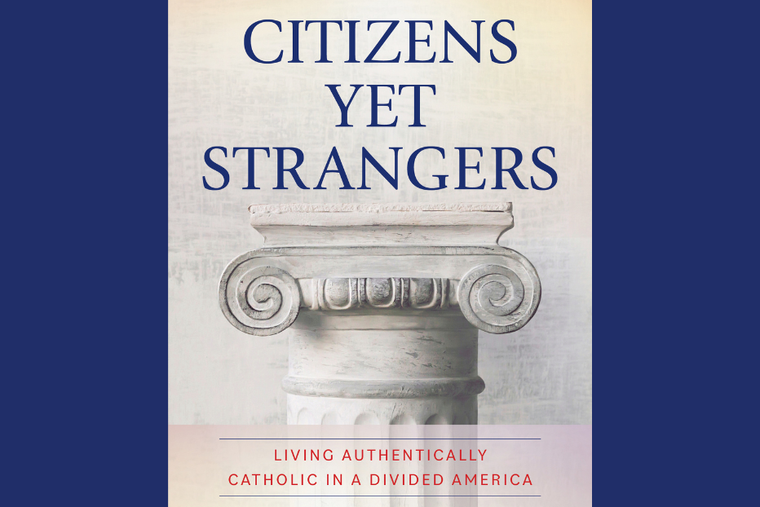
<p>In my new book, <a href="https://www.osvcatholicbookstore.com/product/citizens-yet-strangers-living-authentically-catholic-in-a-divided-america?ga_ref_list_id=taxonomy_3_term_65001ga_ref_list_name=Taxonomy%20Term:%20New%20Releases"><i>Citizens Yet Strangers: Living Authentically Catholic in a Divided America</i></a> (OSV 2024), I challenge American Catholics to draw back from this tendency to collapse Catholic moral thought into American liberal moral theory. This involves the recovery of the Church’s social doctrine, built upon the four pillars of Dignity, Solidarity, Subsidiarity, and Common Good. By revisiting this essential foundation of public and political life, we Catholics will be a more consistent witness to the Gospel. We must relearn to “speak Catholic” so that we can articulate a distinctly Catholic moral vocabulary to a world that desperately needs to hear it. As the false choice of the upcoming presidential election illustrates, this matter has never been more urgent. </p>
<p> </p>
<p><i>Kenneth Craycraft is professor of Moral Theology at Mount St. Mary’s Seminary &; School of Theology in Cincinnati. This article is adapted from Chapter One of his new book, </i><a href="https://www.osvcatholicbookstore.com/product/citizens-yet-strangers-living-authentically-catholic-in-a-divided-america?ga_ref_list_id=taxonomy_3_term_65001ga_ref_list_name=Taxonomy%20Term:%20New%20Releases" target="_blank" rel="noopener">Citizens Yet Strangers: Living Authentically Catholic in a Divided America</a><i> (OSV).</i> </p>
</p></div>
<p><br />
<br /><a href="https://www.ncregister.com/commentaries/citizens-yet-strangers-kenneth-craycraft">Source link </a></p>
<p><!-- END THEIA POST SLIDER --></p>

We Are All Liberal Protestants| National Catholic Register