<p><!-- BEGIN THEIA POST SLIDER --></p>
<p> <br />
</p>
<div>
<p>The history of how the cemetery came to represent many forms — religious, civic, military, private — but lost its Catholic heart.</p>
</p></div>
<div>
<p>In recent years, various Catholic institutions have been asked to articulate their “identities.” What makes a Catholic university Catholic? A Catholic hospital? A Catholic cemetery?</p>
<p>It’s not a foolish question. All these institutions were born in the Church — yet all have been imitated by the secular world — often convincing itself that these pale copies are just as good, even better, than the originals.</p>
<p>“But everybody dies,” you might say. “What’s so different about a Catholic cemetery?”</p>
<p>Start with the word itself. <i>Cemetery</i> derives from the Greek for “a place of sleep,” something like a dormitory. The term was first applied to Christian burial places because of the faith in the resurrection of the body.</p>
<p>From the very beginning, the places where Christians lay after death were bound up with their faith. As <i>The Catholic Encyclopedia</i> notes, early Christians (and Jews) wanted to be buried together — not out of segregation, but because faith remained their deepest bond, including faith about the future of their bodies.</p>
<p>In the Holy Land, that was natural, given its religious homogeneity and the fact that the earliest Christians were first Jews. As Christianity spread beyond its Jewish roots, however, this practice began to evolve. Christians came to be buried with other Christians, a phenomenon accelerated by the dispersion of Christianity throughout the Roman Empire, where believers remained a minority.</p>
<p>The first Christians were commonly buried in family graves, with wealthier brethren — following Acts 4:32 — often providing burial space for poorer fellow believers. Over time, these customs developed further, especially in Rome, where catacomb burial became common.</p>
<p>That’s another distinction of Catholic cemeteries — the preference for burial. Pagans didn’t differentiate between burial and cremation — for them, it was a practical decision. Jews and Christians, however, afforded reverence to the body (there were Jewish catacombs in Rome, too). For Christians, the catacombs reminded them of Jesus’ own tomb: a cave-like chamber in which a body could be placed.</p>
<p>Scholars note that catacombs were not the usual places where liturgies occurred regularly, except perhaps in periods of most intense persecution, but Mass was celebrated in them on various occasions, typically near tombs of martyrs. This reinforced the link between the Christian cemetery and prayer — including faith in the efficacy of prayer for the dead.</p>
<p>As the age of persecution gave way to the era of public Christianity, burial practices adapted again. Catacombs were largely a Roman phenomenon because of the city’s geology. When Christianity moved throughout the empire, the catacomb tomb evolved into a new tradition: burial in or near churches.</p>
<p>Pressure to bury inside churches grew to the point that various local councils explicitly forbade it, except for priests and certain others. Burial next to churches became commonplace — hence, the churchyard, an eschatological reminder to the living faithful, every time they walked in or out of church, of their communion with the faithful departed.</p>
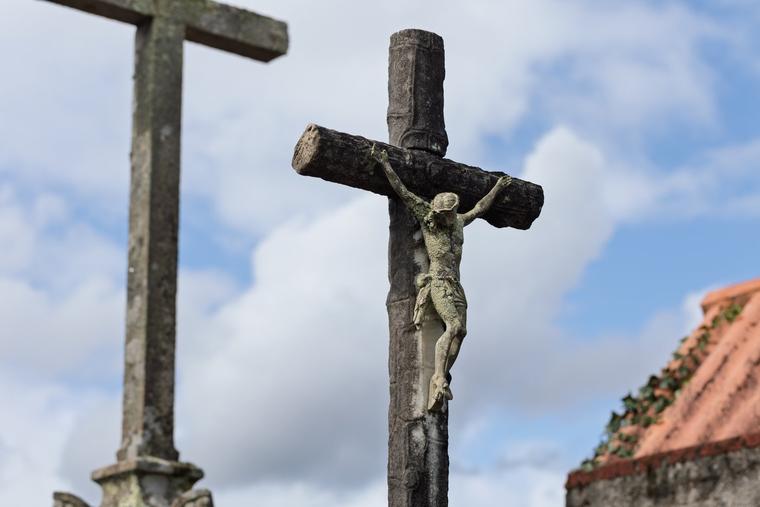
<p>In the Middle Ages, churchyards sometimes became community spaces, even marketplaces, prompting councils and synods to demand they be walled off and set aside as contemplative spaces. Cemeteries traditionally had crosses in them — since Christian death makes sense only through the passion, death and resurrection of Christ — and some had a charnel house or ossuary (to store human bones with dignity). Wherever Christians buried their dead, the unifying idea persisted: Burial was not merely disposal of remains but a testimony of faith in the Resurrection.</p>
<p>With secularization after the Renaissance and Enlightenment, civil governments began to require burial outside city limits in the name of “public health.” In one sense, this was not new: Rome theoretically required burial outside its walls, a norm less honored in the breach.</p>
<p>But this marked a major turning point in the story of Christian burial. By physically separating the parish church from the parish cemetery, this practice created in some people’s minds a dissociation of the graveyard from the parish and, thus, the church community. Unlike the churchyards, where parishioners walked among their predecessors, the lone cemeteries could seem merely places to “put the dead.”</p>
<p>Secular authorities also entered the picture. The Père Lachaise Cemetery in Paris, established by Napoléon, became the model for civic “garden cemeteries” such as Mount Auburn Cemetery in Cambridge, Massachusetts. These cemeteries gradually shifted focus from eschatology to landscaping and uniform headstones. Cemeteries were no longer places to reckon with death — <i>memento mori</i> — but sentimental consolations. Their populations were united not by faith but by geography.</p>
<p>Eventually, the word <i>cemetery</i> came to represent many forms — religious, civic, military, private — but lost its Catholic heart. Like “Christmas,” everybody came to use the term, without noting the great difference between the faith-filled Nativity celebration and the annual secular observation.</p>
<p>A Catholic cemetery, however, remains a place of faith, faith that God, who once gives life, never takes it back; faith about the Communion of Saints — the Church Militant, Suffering and Triumphant. It is a consecrated place, which means it is holy and not just a storage place for the dead.</p>
<p>Parish cemeteries have disappeared, in part because dioceses got into the business when parishes found cemetery management burdensome. A few new parishes today have revived parish cemeteries; more often, the current trend toward consolidation and closure of parishes means the parish cemetery is often an old parish’s sole surviving vestige.</p>
<p>Yet the Catholic cemetery remains what it has always been: a place of faith that bears witness to the whole truth of man — invited to be with God, body and soul, for eternity.</p>
</p></div>
<p><br />
<br /><a href="https://www.ncregister.com/features/what-is-a-catholic-cemetery">Source link </a></p>
<p><!-- END THEIA POST SLIDER --></p>

What Is a Catholic Cemetery?| National Catholic Register