<p><!-- BEGIN THEIA POST SLIDER --></p>
<p> <br />
</p>
<div>
<p>On April 14, Pope Leo XIV stood in Annaba, in the shadow of the Basilica of St. Augustine, on ground that has carried the memory of one of the Church’s greatest voices for more than 15 centuries. And for a moment, the noise of the week fell away.</p>
<p>It should have been one of the defining images of these days: an Augustinian Pope returning to Hippo, to the place where St. Augustine lived most of his life, preached and died. Instead, it passed almost quietly, eclipsed by headlines that will not last. </p>
<p>But something happened there that we should not miss.</p>
<p>When the Holy Father spoke in Algeria, he returned again and again to a simple theme: the search for God, the search for truth, and the dignity of every human person — echoing Augustine’s own restless search. For Augustine, these did not begin as a single pursuit, but became one — one search that ultimately led him to Christ. Standing in that place, the Pope went even further.</p>
<p>Preaching in the Basilica of St. Augustine, he spoke of a world in need of renewal, insisting that “the divine Word pervades history and renews it,” and that even now, in the midst of uncertainty and struggle, something new remains possible.</p>
<p>To see this clearly is to understand the visit.</p>
<p><amp-youtube layout="responsive" width="1170" height="658" data-videoid="_ErutUTKUws" title="In Africa, Pope Leo Retraces Footsteps of His Spiritual Father, St. Augustine | EWTN News Nightly"><a placeholder href="https://www.youtube.com/watch?v=_ErutUTKUws"><img src="https://i.ytimg.com/vi/_ErutUTKUws/hqdefault.jpg" layout="fill" object-fit="cover" alt="In Africa, Pope Leo Retraces Footsteps of His Spiritual Father, St. Augustine | EWTN News Nightly"></a></amp-youtube></p>
<h3>Not the Margins, but the Source</h3>
<p>Hippo is not simply a historical site. It is something deeper — a place where the memory of the Church still lives.</p>
<p>To modern eyes, Algeria can seem distant from the story of Western Christianity. But in Augustine’s time, Roman North Africa was anything but peripheral. Formed in Thagaste, educated in Carthage and ordained bishop in Hippo, Augustine came of age within a vibrant and contested world, wrestling with questions of truth, conversion, happiness, and the life of the heart. After his brief years in Rome and Milan, he returned to that same world with a vision shaped by rightly ordered love — ordered ultimately toward God — that would outlast the Roman Empire itself.</p>
<p>Pope Leo himself made this connection explicit, presenting Augustine not simply as a thinker, but as a witness to the dignity of the human person and the foundations of a just and peaceful society — realities essential for any lasting peace.</p>
<p>As Augustinian Father Martin Davakan observed, Hippo remains “one of the great spiritual places in the memory of the Church,” and for an Augustinian Pope to go there “is not just a pastoral visit … it is something much deeper. It is like returning to a source.” As he also noted, Africa is not at the edge of the Church but part of its living heart.</p>
<p>What the visit reveals is not a return to the margins, but a reminder of where something essential began — and where it still speaks.</p>
<p><amp-youtube layout="responsive" width="1170" height="658" data-videoid="DXGP9Eub7Is" title="LIVE | Pope Leo XIV in Algeria | Visit to Hippo and the Little Sisters of the Poor | April 14, 2026"><a placeholder href="https://www.youtube.com/watch?v=DXGP9Eub7Is"><img src="https://i.ytimg.com/vi/DXGP9Eub7Is/hqdefault.jpg" layout="fill" object-fit="cover" alt="LIVE | Pope Leo XIV in Algeria | Visit to Hippo and the Little Sisters of the Poor | April 14, 2026"></a></amp-youtube></p>
<h3>A Life at the Crossroads</h3>
<p>Augustine’s life unfolded across cultural, intellectual and religious boundaries. He grew up in a divided household: his father a pagan shaped by Roman civic life, his mother a Christian whose faith would mark him deeply. </p>
<p>Formed within two worlds, Augustine stood at the intersection of Roman and Numidian (in reference to ancient nomadic people of the area) life. His mother, Monica, was likely of North African Berber origin, and Augustine himself would have moved between languages, speaking both Latin and Punic. These were not abstract tensions but the conditions of his life. He did not inherit a unified worldview; he had to navigate one.</p>
<p>In that sense, his life is not far removed from our own. Many people today live amid similar divisions of belief and culture, especially young people searching for direction. Augustine’s search unfolded within those same realities, which makes him not distant, but genuinely relatable.</p>
<h3>After Empire, What Endures</h3>
<p>Not long ago, a question circulated widely: How often do men think about the Roman Empire? The answer, surprisingly, was often. Rome still lingers as a symbol of power and order. And yet Rome is gone. What endures is something less visible, but far more consequential.</p>
<p>Few today are likely to admit that they consciously think about Christianity, yet the categories through which the West understands life — like dignity, conscience, justice, and even the idea that power answers to something higher — are deeply shaped by it. We still live within that inheritance, even when we no longer name it. </p>
<p>Augustine lived at a time when some felt the world was coming apart. Yet, as Rome’s confidence waned, he did not defend it at all costs or withdraw from public life. He reframed the question. Political communities endure only insofar as they are ordered toward justice. Without that, Augustine believed they would lose their moral coherence. His famous formulation remains striking: “Without justice, what is a state but a great band of robbers?” (<i>City of God</i>, IV.4).</p>
<p>What survived the fall of Rome was not an empire, but a vision of life — one grounded not in power, but in truth.</p>
<p><amp-youtube layout="responsive" width="1170" height="658" data-videoid="evbt91Xg0bQ" title="Augustinian Prior General on How Rule of St. Augustine Shapes Pope Leo&#039;s Papacy | EWTN News In Depth"><a placeholder href="https://www.youtube.com/watch?v=evbt91Xg0bQ"><img src="https://i.ytimg.com/vi/evbt91Xg0bQ/hqdefault.jpg" layout="fill" object-fit="cover" alt="Augustinian Prior General on How Rule of St. Augustine Shapes Pope Leo&#039;s Papacy | EWTN News In Depth"></a></amp-youtube></p>
<h3>Why Leo Goes</h3>
<p>For an Augustinian Pope, returning to this landscape is not incidental. It is a return to the wellspring of a tradition that understands the human heart as restless — searching and oriented beyond itself. Augustine insisted that this search is awakened from within, through what he described as the “Interior Teacher,” the presence of Jesus Christ encountered in the depths of the heart.</p>
<p>In Algeria, that vision took concrete form. In his address to the local Church, Pope Leo identified three essential dimensions of Christian life: prayer, charity and unity. Elsewhere, he spoke simply: Where there is love and service, God is present, and even in a small and often hidden Church, there remains real hope.</p>
<p>These are not abstractions. They are the lived form of a life ordered toward God and neighbor.</p>
<h3>A Small Church, a Living Witness</h3>
<p>The Church in Algeria is small, but its witness is not. In a society where most are Muslim, Augustine remains widely respected as one of the great sons of the land, and the Christian community offers a quiet example of coexistence.</p>
<p>As the Pope observed, this witness is a call to “communion, dialogue and peace” and an opportunity to promote “peace, reconciliation, respect and consideration for all peoples.”</p>
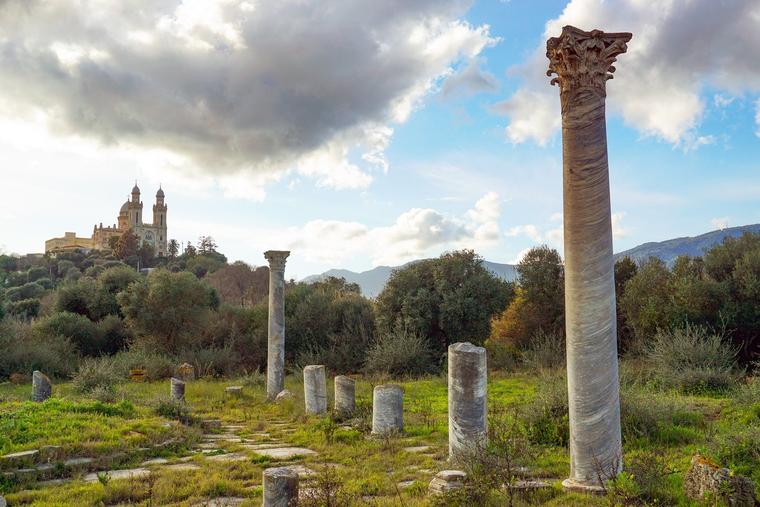
<p>Those who followed the visit saw this embodied on the ground. The ruins of Hippo still stand. One can see where Augustine once sat in his basilica, and on the hill behind rises the newer church built in his memory. During the visit, Pope Leo planted an olive tree that was grown from one in ancient Thagaste, Augustine’s birthplace.</p>
<p>As the newly elected (American) Augustinian prior general, Father Joseph Farrell, noted, the land itself still bears witness to Augustine’s presence in a way that is both historical and living.</p>
<p><amp-youtube layout="responsive" width="1170" height="658" data-videoid="yOyIa8ogpII" title="LIVE | Pope Leo XIV in Algeria | Holy Mass | April 14, 2026"><a placeholder href="https://www.youtube.com/watch?v=yOyIa8ogpII"><img src="https://i.ytimg.com/vi/yOyIa8ogpII/hqdefault.jpg" layout="fill" object-fit="cover" alt="LIVE | Pope Leo XIV in Algeria | Holy Mass | April 14, 2026"></a></amp-youtube></p>
<h3>The Work of Memory</h3>
<p>If this pilgrimage is seen only as a historical gesture, it will pass quickly from attention. But if it is received, it becomes something more. Augustine’s world, like our own, was marked by competing beliefs and uncertainty. His response was not withdrawal, but depth.</p>
<p>There is a deeper continuity here. Pope Leo XIV did not return to Algeria as a visitor, but as one formed by the very tradition and charism that took shape in this place. His presence there is not simply an encounter with the places that shaped Augustine, but a witness to what it means to be formed by that same search — and, <a href="https://x.com/i/status/2044012935509344478">as his being visibly moved in the land of his patron showed</a>, an invitation for the rest of us to follow where it leads.</p>
<p>What is required, then, is not a return to the past, but a recovery of memory — a return to the heart, where truth is encountered and where we come to know not only who we are, but to whom we belong. At its core, the question is simple: Do we remember who is calling us, and are we willing to follow?</p>
<p>There are signs, even now, that this call is being answered. Across the United States, more adults are entering the Church. In the Archdiocese of Philadelphia, where I serve, Catholic schools have seen renewed growth alongside increasing stability — realities that have not coincided in decades.</p>
<p>These developments are not the result of strategy alone. The Church evangelizes. What draws people is not institutional strength, but the encounter with the truth — and the realization that the search for meaning leads to a personal encounter with Jesus Christ.</p>
<p>What Augustine discovered in his restless searching is being rediscovered in our own time — not everywhere, and not all at once, but enough to suggest something deeper is at work: that the voice of God is being heard once more. In returning to Hippo, Pope Leo XIV has helped us to hear that voice again — more clearly, and with fresh urgency.</p>
<p>The question is not whether that voice still speaks. It is whether we are listening, and whether we are ready to respond.</p>
</p></div>
<p><br />
<br /><a href="https://www.ncregister.com/commentaries/towell-pope-leo-augustine-algeria">Source link </a></p>
<p><!-- END THEIA POST SLIDER --></p>

What the World Missed When the Pope Returned to St. Augustine’s Homeland| National Catholic Register