<p><!-- BEGIN THEIA POST SLIDER --></p>
<p> <br />
</p>
<div>
<p>The New Testament accounts of Nazareth are roundly supported by archaeological evidence</p>
</p></div>
<div>
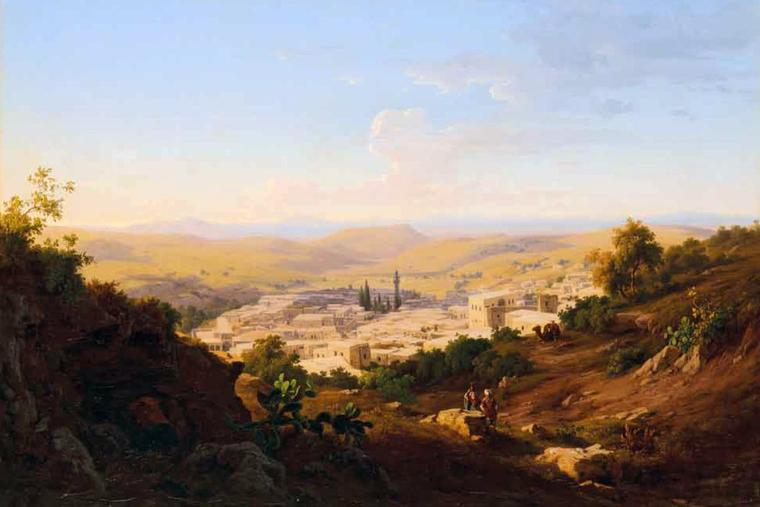
<p>Nazareth was a very small town when Jesus was born. When my wife and I visited there in 2014, our tour guide told us that it was scarcely as large as the parking lot of the Church of the Annunciation there. But it’s been excavated to the time of Jesus. Skeptics have, for many years, asserted that Nazareth didn’t exist at all in his time. Their judgments are premature and erroneous, as usual. Amanda Borschel-Dan, reporter for <i>The Times of Israel</i>, <a href="https://www.timesofisrael.com/listen-what-do-we-know-about-nazareth-in-jesus-time-an-archaeologist-explains/">wrote an article about this topic</a> and the latest archaeology:</p>
<blockquote><p>Nazareth &#8230; as British-Israeli archaeologist Yardenna Alexandre notes … the once small village with huge name recognition existed well before and well after [Jesus’] lifetime. …</p></blockquote>
<blockquote><p>Among her digs, in 2009, Alexandre discovered the first example of a residential building from the time of Jesus. It was found near today’s Church of the Annunciation. … In her report, Alexandre describes the structure as ‘a simple house comprising small rooms and an inner courtyard was inhabited in the late Hellenistic and the Early Roman periods [late 2nd c. BC to early or mid 2nd c. AD].’ …</p></blockquote>
<blockquote><p>Among the artifacts is a coin of Emperor Claudius that was uncovered on the floor of a corridor that led into a three-story pit complex. According to the report, ‘The coin was minted in ‘Akko-Ptolemais in 50–51 CE.</p></blockquote>
<p>David Keys concurs, in his article, <a href="https://www.independent.co.uk/news/science/archaeology/jesus-home-town-nazareth-archaeological-discovery-research-a9470716.html" target="_blank" rel="noopener">“New archaeological evidence from Nazareth reveals religious and political environment in era of Jesus”</a> (<i>Independent</i>):</p>
<blockquote><p>The archaeological investigation revealed that in Nazareth itself, in the middle of the first century AD, anti-Roman rebels created a sizeable network of underground hiding places and tunnels underneath the town — big enough to shelter at least 100 people. …</p></blockquote>
<blockquote><p>The new archaeological investigation — the largest ever carried out into Roman period Nazareth — has revealed that Jesus’s hometown is likely to have been considerably bigger than previously thought. It probably had a population of up to 1,000 (rather than just being a small-to-medium sized village of 100-500, as previously thought).</p></blockquote>
<blockquote><p>‘Our new investigation has transformed archaeological knowledge of Roman Nazareth,’ said Dr. Dark, who has just published the results of his research in a new book <i>Roman-Period and Byzantine Nazareth and its Hinterland</i>. …</p></blockquote>
<blockquote><p>The newly emerging picture of Roman-period Nazareth as a place of substantial religiosity does, however, resonate not only with the emergence of its most famous son, Jesus, but also with the fact that, in the mid-first or second century, it was chosen as the official residence of one of the high priests of the by-then-destroyed Temple in Jerusalem, when all 24 of those Jewish religious leaders were driven into exile in Galilee.</p></blockquote>
<p>See also <a href="https://biblearchaeologyreport.com/2018/08/09/did-first-century-nazareth-exist/" target="_blank" rel="noopener">“Did First-Century Nazareth Exist?”</a> (<i>Bible Archaeology Report</i>) and <a href="https://www.npr.org/templates/story/story.php?storyId=121724812" target="_blank" rel="noopener">“Archaeologists: Jesus-Era House Found In Nazareth”</a> (NPR).</p>
<p><i>The Jerusalem Post</i> published another informative article by Hannah Brown, <a href="https://www.jpost.com/archaeology/have-archaeologists-found-jesuss-childhood-home-in-nazareth-650349" target="_blank" rel="noopener">“Have archaeologists found Jesus’s childhood home in Nazareth?”</a> who writes:</p>
<blockquote><p>The location of the home where Jesus, Mary and Joseph lived in Nazareth when Jesus was a child may have been discovered by Prof. Ken Dark of the University of Reading in England, according to research Dark wrote about in his recently published book, <i>The Sisters of Nazareth Convent: A Roman-period, Byzantine, and Crusader site in central Nazareth</i>, which is available from Routledge Press.</p></blockquote>
<blockquote><p>Dark, who has spent more than a decade studying the first century ruins that are underneath a modern-day convent, said this spot was first suggested as the home of Jesus and his family in the 19th century but that archaeologists in the 1930s did not find the idea credible.</p></blockquote>
<blockquote><p>However, the professor was intrigued and launched a project to explore the site 14 years ago. ‘I didn’t go to Nazareth to find the house of Jesus, I was actually doing a study of the city’s history as a Byzantine Christian pilgrimage center,’ he told the BBC. ‘Nobody could have been more surprised than me.’ …</p></blockquote>
<blockquote><p>‘I haven’t said that this was certainly the ‘house of Jesus,’ just that it was probably the structure believed by Christians from the fourth century at latest to be that house, and that there is no archaeological reason why that identification is necessarily impossible.’</p></blockquote>
<p>The evidence is so strong for the existence of Nazareth during the time of Jesus’ childhood (early 1st century AD), that even the biblical skeptic <a href="https://en.wikipedia.org/wiki/Bart_D._Ehrman" target="_blank" rel="noopener">Bart Ehrman</a>, who denies the divinity of Jesus and asserts that he never claimed to be God, <a href="https://ehrmanblog.org/did-nazareth-exist/">defends it</a> (and rather well at that):</p>
<blockquote><p>There are numerous compelling pieces of archaeological evidence that in fact Nazareth did exist in Jesus’ day, and that like other villages and towns in that part of Galilee, it was built on the hillside, near where the later rock-cut kokh tombs were built. For one thing, archaeologists have excavated a farm connected with the village, and it dates to the time of Jesus. …</p></blockquote>
<blockquote><p>[René] Salm also claims that the pottery found on the site that is dated to the time of Jesus is not really from this period, even though he is not an expert on pottery. Two archaeologists who reply to Salm’s protestations say the following: ‘Salm’s personal evaluation of the pottery … reveals his lack of expertise in the area as well as his lack of serious research in the sources.’ They go on to state: ‘By ignoring or dismissing solid ceramic, numismatic [that is, coins], and literary evidence for Nazareth’s existence during the Late Hellenistic and Early Roman period, it would appear that the analysis which René Salm includes in his review, and his recent book must, in itself, be relegated to the realm of myth.’</p></blockquote></div>
<p><br />
<br /><a href="https://www.ncregister.com/blog/first-century-nazareth-in-archaeology">Source link </a></p>
<p><!-- END THEIA POST SLIDER --></p>

What We Know About Nazareth at the Time of Jesus| National Catholic Register