<p><!-- BEGIN THEIA POST SLIDER --></p>
<p> <br />
</p>
<div>
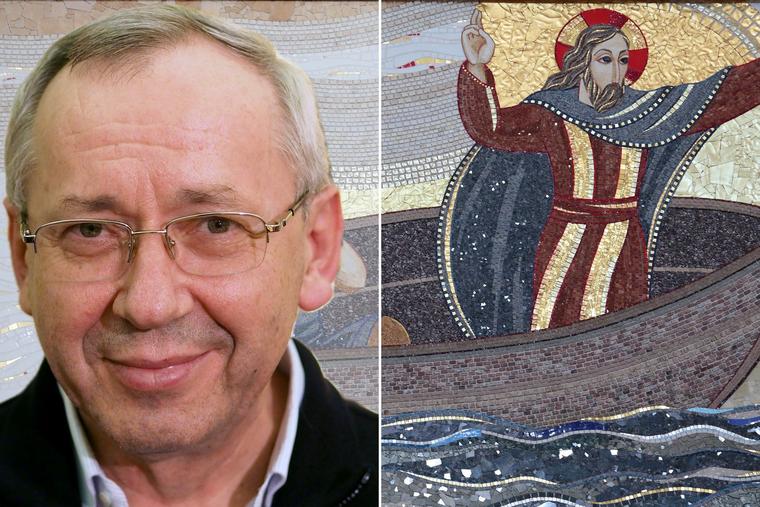
<p>In June 2024, the head of the Vatican communications department, Paolo Ruffini, <a href="https://www.ncregister.com/commentaries/vatican-and-father-rupnik-s-art">vigorously defended</a> his office’s continued use of the artwork of Father Marko Rupnik on the Vatican website. He argued that it was premature to judge Father Rupnik’s guilt regarding the many charges of sexual abuse of consecrated women he faces, and that “removing, deleting, destroying art … is not a Christian response.”</p>
<p>On Monday, Father Rupnik’s artwork <a href="https://ewtn365.sharepoint.com/sites/NCRegisterNewsroom/Shared%20Documents/The%20Big%20Board/Copy%20Ready%20to%20Edit/Vatican%20News%20Removes%20Rupnik%20Art%20From%20Website%7C%20National%20Catholic%20Register">was gone</a> from the Vatican website, without explanation from Ruffini or anyone else. The removal came just days after Pope Leo XIV met with the Pontifical Commission for the Protection of Minors, so the simplest explanation is that the commission asked the Holy Father to cease using the art and Pope Leo agreed. Cardinal Seán O’Malley, president of the commission, had already made that request <a href="https://www.ncregister.com/commentaries/cardinal-o-malley-speaks-clearly-on-father-rupnik-art">publicly</a> last June in response to Ruffini’s remarks.</p>
<p>Under Pope Francis, Father Rupnik’s artwork remained. With a new Pope, a different decision has been made.</p>
<p>While the Vatican courts have not yet managed to hold a trial for Father Rupnik, there is a widespread consensus — based on the claims of dozens of women — that he sexually coerced women in his religious community as part of the process of creating his paintings and mosaics. The term <a href="https://thecatholicherald.com/pope-leo-orders-the-removal-of-rupniks-rape-art-from-vatican-websites/">“rape art”</a> has thus been used to characterize Father Rupnik’s work.</p>
<p>The key issue is whether art can stand alone from the artist. The usual case mentioned in this regard is Caravaggio, guilty of slander and vandalism, a hot temper, and eventually convicted of murder during a duel in Rome, after which he became a fugitive. Yet Caravaggio’s splendid works adorn Italy to this day, and are often used for spiritual reflections.</p>
<p>An immediate response might be that Father Rupnik is not Caravaggio; the world can suffer the loss of Father Rupnik’s art but not the work of one of the greatest painters ever to live. That is the very common rationale by which corruption in junior officials is punished but excused in the more senior ones — as often happens in commerce, academia, politics and the Catholic Church.</p>
<p>A recent, more relevant case might be Cosby, not Caravaggio. Comedian Bill Cosby’s fall provides an apt precedent. </p>
<p>At the height of his career in the 1980s, Cosby was one of the most renowned men in the world who was famous not by virtue of any office, but because of his work. He was neither king nor president nor pope, yet he was widely admired as a skillful comic who worked clean, promoted good values and provided wholesome entertainment for the entire family.</p>
<p>When Cosby was revealed to be a serial sexual predator, drugging numerous women over many years and then sexually assaulting them, it came as a dramatic cultural shock. His television shows, which were staples in syndication, were pulled from the air, and his live shows stopped being booked. </p>
<p>Does that apply to Father Rupnik’s case? There are three aspects to consider: the process, the personage and the penalty.</p>
<h3>The Process</h3>
<p>The allegations that Father Rupnik’s artistic process included sexual exploitation are unusual. The usual case is that the work — the art, the teaching, the business deals — are separate from the dark behavior hidden elsewhere. If Father Rupnik’s works were in fact the fruit of sexual exploitation then the case for removing them is very strong, as the art itself is linked to grave sins and crimes. </p>
<p>It is different than a painting painted with stolen brushes, for it is possible to imagine the same painting with purchased brushes. If Father Rupnik’s creative process itself was corrupted, it is not possible to separate the corruption from the works themselves.</p>
<p>It should be noted that Ruffini’s “premature” objection may apply here; while allegations of “rape art” seem convincing, they have not yet been adjudicated.</p>
<p>Father Rupnik and his artistic studio in Rome were part of a religious community. Thus, the works themselves were something of a ministry and were often presented as such. Priests guilty of sexual abuse are removed from ministry, and the remnants of that ministry — recorded talks, published works — are often no longer circulated. The remnants of Father Rupnik’s ministry are more prominent than most, but it would seem consistent that his monumental mosaics should get the same treatment.</p>
<h3>The Personage</h3>
<p>Can the art be separated from the artist in the mind of a reasonable beholder? It is quite possible to appreciate a Caravaggio without even knowing that he is the painter. Nearly all of the millions of visitors to the Sistine Chapel have no idea who painted the magnificent works on the lateral walls. The art stands separate from the artist.</p>
<p>If Bill Cosby were only the lead writer for his show, it would be easier to separate the message of the show from him. Contrariwise, the show carried his name and he was the leading star. It is impossible to separate the work from the Cosby personage. Hence the cancellation.</p>
<p>Paintings or mosaics are not usually in the Cosby camp. Almost all sacred art is appreciated without anyone knowing the artist. Yet Father Rupnik’s works were so distinctive that it is impossible not to see him in the works; no one makes mosaics in that style, with the elongated faces and dark eyes, one figure melding into the next. A Father Rupnik mosaic makes him present to the beholder in a manner akin to an actor rather than a scriptwriter. That is an argument for giving Father Rupnik the Cosby, rather than Caravaggio, treatment.</p>
<h3>The Penalty</h3>
<p>Father Rupnik’s case also involves a punitive aspect. With those long dead, there is no punishment that can be administered, but for the living, justice includes a punitive aspect. One reason that Cosby’s shows were pulled from the air was that he continued to earn royalties from their broadcast. </p>
<p>Even if the continued display of Father Rupnik’s works does not earn him money now, it can be argued that they reward him with prestige, especially given that they appear at leading shrines around the world. </p>
<p>Usually, penalties are determined by the relevant judicial process, with the judge determining them. Judicial systems discourage private penalties. In Father Rupnik’s case, it is former patrons and clients who will determine whether to penalize him. Can the punitive principle be applied analogously by those who are not party to the official proceedings?</p>
<p>While the Vatican website decision is fresh, other Father Rupnik installations have already been covered over, including at the National Shrine of St. John Paul II in Washington, D.C., as well as at the basilica at the Marian shrine at Lourdes. It is likely that others will follow. </p>
<p>The most important Father Rupnik commission remains in the <a href="https://www.vatican.va/content/dam/vatican/virtualtour/redemptorismater/index-en.html">Apostolic Palace itself</a>. For the 50th anniversary of his priestly ordination in 1996, the cardinals gave Pope John Paul II a monetary gift, which he used to redecorate the Redemptoris Mater chapel. The Holy Father celebrated Masses there for special groups, and it was also used for the Advent and Lent meditations preached to the Pope and the Roman Curia, as well as the annual retreat. </p>
<p>The chapel commission was given to then-Jesuit Father Rupnik, whose work combines Eastern and Western influences — the “two lungs” of which John Paul used to speak. The result was a stunning achievement. The entirety of the walls and ceiling are covered in mosaics with dozens of figures from biblical scenes to 20th-century martyrs. To enter the chapel is to enter the vision of the Book of Revelation. It was the <i>Redemptoris Mater </i>commission that launched Father Rupnik’s reputation on a global scale, leading the most important shrines in the world to enlist him.</p>
<p>What then to do with that work? It cannot be covered over, as the entirety of the chapel is the work. It could be removed. My preferred suggestion would be to leave it as is. </p>
<p>It is not a public chapel. Its spiritual vision remains impressive. Moreover, the perennial temptation in Rome is the corruption of the Church, a reminder of which are those “bad popes” whose images and monuments are found here and there. It is part of ecclesial history and a warning to those currently working there of the temptations, which abound. </p>
<p>It seems to me that Father Rupnik’s work in the Apostolic Palace — in a discreet chapel that is only occasionally used — might serve the same purpose, an apocalyptic reminder that the struggle between good and evil is always present, that it runs through the heart of each disciple — and their pastors.</p>
</p></div>
<p><br />
<br /><a href="https://www.ncregister.com/commentaries/rupnik-cosby-caravaggio">Source link </a></p>
<p><!-- END THEIA POST SLIDER --></p>

When It Comes to Comparisons With Father Rupnik, Think Cosby, not Caravaggio| National Catholic Register