


Father’s Day often invites reflection on the men who helped form us and taught us how to navigate the challenges of life. For many Catholic young adults, that includes not only the fathers who raised them, but also the priests who accompanied them during some of their most formative years.
College and graduate school often coincide with a season of profound transition. Away from home and facing questions about vocations, relationships and the future, young adults navigate newfound freedom alongside new responsibility. In that space, many come to rely on a trusted priest not only for the sacraments, but for guidance and friendship.
For students like Lonán Mooney, 20, that kind of spiritual fatherhood became most visible more than 3,000 miles from home.
A rising junior at Hillsdale College from Ireland, Mooney grew up in a home where family prayer was part of daily life. Arriving in the United States for college, however, meant stepping into a more fragmented spiritual environment. For the first time, she had to navigate faith without the familiarity of home.
“I was kind of lost my freshman year,” she told the Register. “Everyone seemed to have their own spiritual thing going.”
By her second semester, she sought spiritual direction at Hillsdale’s Catholic Society house, the Grotto, with Miles Christi Father Patrick Wainwright.
“I just went in there and poured my heart out,” she said. “He really helped guide me in a way that I had never experienced.”
What stayed with her was not just his counsel, but the way he listened and met her where she was.
Over time, that guidance reframed how she understood her own worth. “Your worth isn’t defined by your grades,” she recalled him saying. “Your worth isn’t defined by what you can do for other people.”
That moment shifted how she carried stress, relationships and identity itself. “I realized I am loved by my Eternal Father,” she said, “and that changed everything.”
Mooney described Father Wainwright as “a spiritual father — holy and reverent, but also deeply human,” offering her a “spiritual haven away from home.”
Inspiring a Vocation
What begins as a sense of being seen often becomes, for others, a question of what kind of life they are being called to.
For Jacob Sadler, 21, a student at the University of Colorado Boulder who will leave college this fall to enter seminary in the Archdiocese of Denver, that question took shape slowly.
When he arrived on campus in 2023, his faith was minimal. “I was going to Sunday Mass, but I wasn’t really practicing much beyond that,” he said.
A turning point came through confession at a campus retreat, where a priest’s attentiveness left a lasting impression. That confession, he noted, sent him on “a huge spiral of really loving the Catholic Church again.”
As he began discerning priesthood, he initially struggled to imagine a life without marriage. But his experience of priests on campus gradually reshaped that imagination. “They’re not just there for sacraments,” he said, “but for everything.”
Figures like Father Chris Considine and Father Peter Srsich, whom he encountered regularly at St. Thomas Aquinas Catholic Center, became part of that constant presence in his life. He recalled conversations after Mass and simple hobbies shared with students, activities that “fathers usually engage in.”
What stood out most was their attentiveness. “They listen more than they talk,” Sadler said. “And they’re really present with you.”
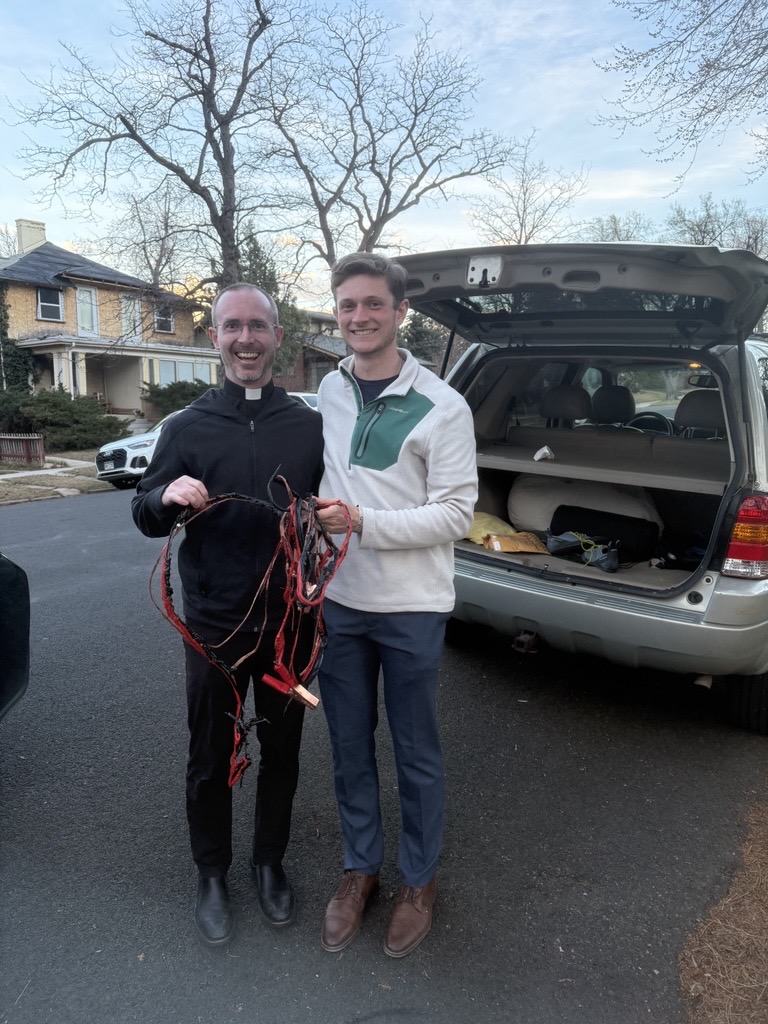
That experience reshaped his understanding of love itself. “They’re your dad, but also your best friend,” he said. “It was that spiritual fatherhood that inspired me to pursue seminary.”
‘A Gentle, Loving Father’
For Lexie Hadjin, a 2025 graduate of the University of Georgia, that understanding of spiritual fatherhood grew through ordinary daily life.
“I always knew I wanted to be involved at the Catholic Center,” the 23-year-old said. “But I wasn’t really thinking much about the priests themselves.”
That changed as priests became more present in daily student life — not only at Mass, but at meals and informal gatherings. “They actually wanted to know us,” she noted.
She highlighted Father Michael Bremer, who now serves as her spiritual director as she works as a Christ in the City missionary.
“He’s very relationship-oriented,” she said. “I think I just needed a gentle, loving father to show me who God is.”
One moment stood out during her sophomore year, when a traffic misunderstanding escalated until she arrived at the Catholic Center. Father Bremer spoke with a police officer on her behalf.
“He always had this steady presence,” she noted.
Bit by bit, his repeated reminder that “everything is an excuse for the Father to love you through it” became central to her worldview.
“At first I didn’t understand it,” she said. “But now, because of Father Michael, I see everything as a gift.”
Guided Back to Faith
That sense of accompaniment was also central to Annie Ortega’s experience during law school.
Ortega, a 27-year-old attorney and 2025 graduate of Notre Dame Law School, said her return to Catholicism unfolded slowly over the course of her time there.
Raised Catholic but uncertain in practice, she arrived still wrestling with belief. “I wasn’t sure if I was still Catholic or even wanted to be,” she said.
A turning point came through Father Patrick Reidy, an associate professor of law at Notre Dame, who became a steady presence in her discernment.
“He became a friend and a guide,” she said. “I could ask him anything.”
What stood out, Ortega emphasized, was not only his clarity “in never sugarcoating anything” but also his “gentle nature.”
Their conversations ranged from doctrinal questions to personal doubt. “He just kept walking with me through it,” she said.
“Eventually, something shifted,” she added. “Through Father Pat, I realized the Lord knew my heart.”
Shortly after, she went to confession and received Communion for the first time in nearly a decade at a Mass where she knew Father Reidy would be the one distributing the Eucharist.
“My life will never be the same after that year of our conversations,” Ortega said. “It feels like God placed Father Pat in my life when I needed his guidance most.”
‘They Saved My Life’
José Freire Nunes, a 32-year-old Ph.D. candidate at The Catholic University of America and celibate lay member of Opus Dei, told the Register that his understanding of priestly fatherhood emerged through conversion and spiritual direction.
Originally from São Paulo, Brazil, he entered deeper reflection after the suicide of a friend during law school. “I started asking more questions,” he said. “What is my purpose in life? Does life even have meaning?”
That search led him to spiritual direction with priests in São Paulo, where he first encountered community and sustained accompaniment.
“It was not only someone providing me with information,” he noted, “but someone who was caring for me as a person and exercising a kind of spiritual fatherhood.”
He continues to find guidance in Opus Dei priests and in the priests at his school, who accompany him in his intellectual and spiritual development.
Nunes described priests as “uniquely positioned to offer clarity” in moments of uncertainty, forming a “moral compass.”
And in a culture of competing voices, that clarity matters. “If the priests don’t fill that gap, someone else will,” he said.
Looking back on the priests who have shaped his life, he said simply, “They saved my life.”
Just a Text Away
Speaking with these young adults reminded me of my own college priest, Father Rhett Williams, chaplain to the University of South Carolina at St. Thomas More Catholic Church.
I’ve never been someone who opens up easily, even with close friends. Most people only see what I choose to show. But with Father Williams, that didn’t hold. He usually knew when something was off, even when I hadn’t said much at all.
My last semester especially, I was juggling extracurriculars, figuring out my post-grad path and a family illness back home that I kept to myself. In Father Williams’ office, I didn’t have to sort out that messiness before speaking. I could just sit down and pour out my heart, sometimes through tears, and he would listen and ask the kinds of questions that slowly helped things come into focus.
In his presence — whether in conversation or in the joyful way he celebrated the sacraments — I encountered a priest who was never rushed, even when his days were full, and who reflected Christ in making people feel truly seen and loved without needing many words.
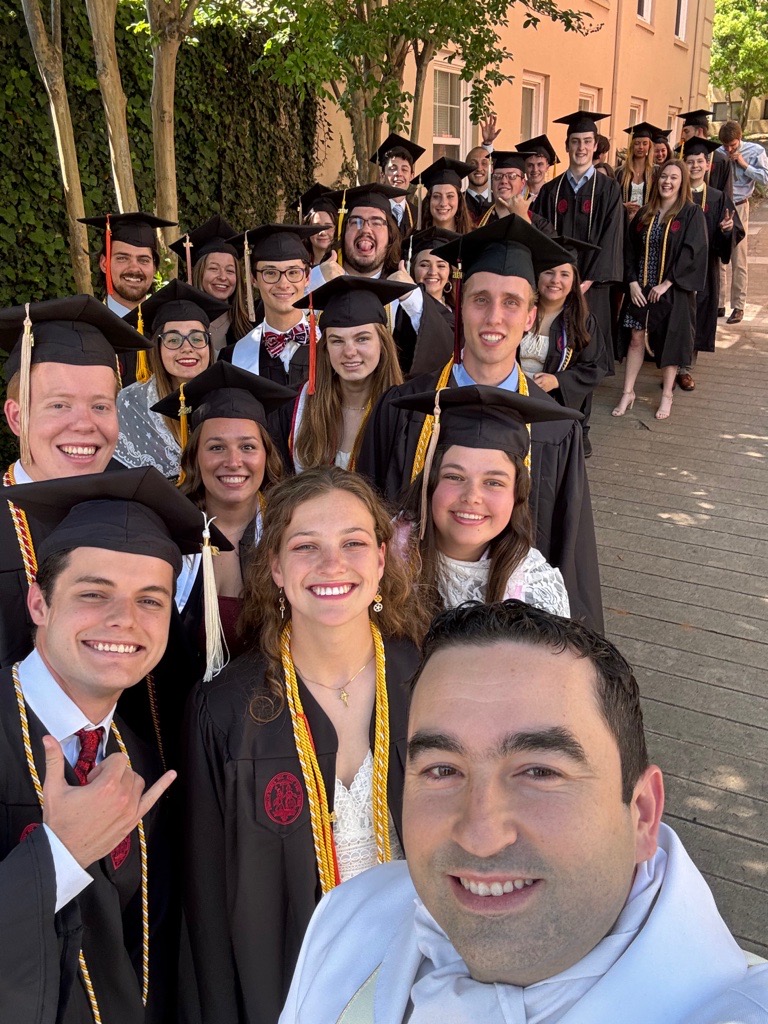
Even two years later, I know he’s always just a text away if I ever need someone to talk to.
To him, and to all priests who show up in the small, steady ways as spiritual fathers — Happy Father’s Day!