<p><!-- BEGIN THEIA POST SLIDER --></p>
<p> <br />
</p>
<div>
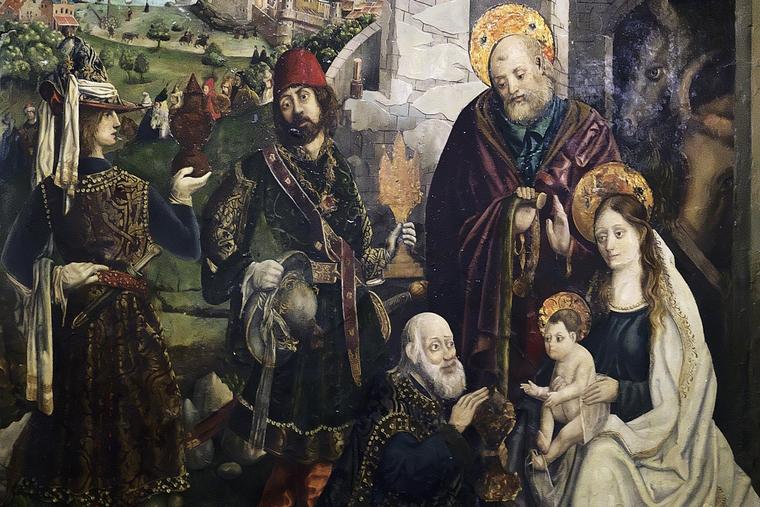
<p>Part of the Nativity story, the Three Kings show that Jesus came for Gentiles as well as Jews. Let’s take a closer look at who they are.</p>
</p></div>
<div>
<p>“We three kings of orient are/Bearing gifts we traverse afar/Field and fountain/Moor and mountain/Following yonder star,” begins the timeless 1857 carol sung on the Feast of the Epiphany.</p>
<p>Who were these three kings? Where might they have come from? Did they, like the shepherds in Luke’s gospel, make “known the saying which had been told them concerning this child; and all who heard it wondered at what the shepherds told them” (2:17-18). Turning to the experts, we learn much about the Wise Men, starting with the prolific writer Jesuit Father Francis X. Weiser, an Austrian priest from Vienna who came to the United States in 1938 and wrote the monumental <i>Handbook of</i> <i>Christian Feasts and Customs</i> in 1952.</p>
<p>Although known quite early through Matthew’s Gospel, the Three Kings, also known as the Magi or Wise Men, were “called ‘saints’ for the first time in the writings of Archbishop Hildebert of Tours (1133). By the 12th century, the “Epiphany acquired the popular name of ‘Feast of the Three Holy Kings’ in most countries of Europe.”</p>
<p>According to Father Weiser, the Magi “were highly esteemed priestly scholars devoting themselves not only to religion but also to the study of natural sciences, medicine, mathematics, and astronomy.” In some places they served on the king’s council.</p>
<p>Where did this trio travel from? St. Matthew gives a general idea when he calls them “wise men from the east” (Matthew 2:1).</p>
<p>“Speaking in modern terms,” Father Weiser notes, “it could have been from any one of the countries of Arabia, Iraq, Iran, Afghanistan, or India. It has never been exactly determined from which of these countries they came.”</p>
<p>Very early in the Christian era the Wise Men began being called “kings,” a tradition that spread commonly by the end of the sixth century. The basis for this came from Scripture. For starters, Psalm 72 (10-11) says, “May the kings of Tarshish and of the isles render him tribute, may the kings of Sheba and Seba bring gifts! May all kings fall down before him, all nations serve him!”</p>
<p>And Isaiah (60:3-6) says, “And nations shall come to your light, and kings to the brightness of your rising … the wealth of the nations shall come to you. A multitude of camels shall cover you, the young camels of Midian and Ephah; all those from Sheba shall come. They shall bring gold and frankincense, and shall proclaim the praise of the Lord.”</p>
<p>Father Weiser points out that since the Gospel does not give the number of Wise Men, as the Wise Men tradition spread, the Western Church settled on three as their number, likely based on the three gifts of gold, frankincense and myrrh. He adds that another possible reason “was the early legend that they represented all humanity in its three great races. Thus one of them was pictured as a member of the black race, and this choice seemed to be confirmed by the Bible in Psalm 67:32 (Douay-Rheims Bible): “Ambassadors shall come out of Egypt: Ethiopia shall soon stretch out her hands to God.”</p>
<p><i>Butler’s Lives of the Saints</i> also confirms that this trio is “represented as three in some of the oldest catacomb paintings” although there are a few exceptions likely to conform to “artistic symmetry.” Major figures like Origen and St. Leo take the number of three for granted.</p>
<h3>Naming the Three Kings</h3>
<p>Melchior, Caspar, Balthasar. The Three Kings or Magi. The book <i>Collectanea et Flores</i> attributed to St. Bede the Venerable records an early legend of their names that describes Melchior as an older man offering the gold; Caspar (sometimes Gaspar) as young and offering the incense; and Balthasar, having black complexion and offering the myrrh.</p>
<p>Again, with the number, origin and identification as kings comes another hint from <i>Butler’s</i> <i>Saints</i>. While early sculptures of them depicted the three wearing Phrygian caps (worn by people like the Persians and Medes), beginning in the eighth century Christian art regularly presented them wearing crowns — hence, the Three Kings.</p>
<h3>After Their Nativity Visit</h3>
<p>The Cologne Cathedral in Germany offers information on these three Wise Men, including how they “returned to their country” and “announced to their people the good news of the incarnation of the Son of God. They held in high honor the mountain where the star first appeared to them. They built a town there, which they called Siegberg, and on the top of the mountain they built a chapel with the image of the baby Jesus marked with the cross.” The cathedral credits this description to the 1521 <i>Breviarium Coloniense.</i></p>
<p>According to Father Weiser, an old legend said “that when many years had passed the Magi were visited by St. Thomas the Apostle, who, after instructing them in Christianity, baptized them. They were then ordained to the priesthood and made bishops. It is said that once more the Star of Bethlehem appeared to them and reunited them toward the end of their lives.”</p>
<p>Similarly, the <i>Breviarium Coloniense</i> also describes how “they were tireless in the practice of works of virtue and godliness until the apostle Thomas came to that region to preach the doctrine of Jesus Christ. They joined him and received Holy Orders from him. And because they were men of choice, Thomas also ordained them bishops and entrusted the peoples of the East to their pastoral care.” One major source with much information along these lines and one of the most detailed accounts came from the Carmelite Friar John of Hildesheim in his 14th-century <i>History of the Three Kings.</i></p>
<h3>And Today</h3>
<p>These three kings eventually made their way to Germany.</p>
<p>First, their bones were discovered in Persia by St. Helena who brought them to Constantinople. In the fifth century they were transferred to Milan. In 1164 Emperor Frederick Barbarossa got them from the Archbishop of Milan to transfer them to Archbishop Rainald von Dassel in Cologne, Germany. Since then, the Cologne Cathedral has been a major pilgrimage site with a shrine that Butler calls “one of the finest examples of the craft of the medieval metal worker.”</p>
<p>Over the centuries countless pilgrims have traveled, and continue to travel, to venerate the relics of the Three Kings whom St. Augustine described as “the first of the pagans to recognize the divine nature of Christ.”</p>
</p></div>
<p><br />
<br /><a href="https://www.ncregister.com/blog/who-were-those-kings-and-where-are-they-now">Source link </a></p>
<p><!-- END THEIA POST SLIDER --></p>

Who Were Those Kings and Where Are They Now?| National Catholic Register