<p><!-- BEGIN THEIA POST SLIDER --></p>
<p> <br />
</p>
<div>
<p>God became angry with Moses because Moses didn’t follow his instructions, and because Moses gave himself the glory rather than giving it to God</p>
</p></div>
<div>
<p>In my book, <a href="https://www.patheos.com/blogs/davearmstrong/2023/01/books-by-dave-armstrong-the-word-set-in-stone.html" target="_blank" rel="noopener"><i>The Word Set in Stone: How Archaeology, Science, and History Back Up the Bible</i></a>, I contended that there is a verified natural explanation for water coming out of the rocks in the Sinai Peninsula, and that it need not necessarily have been miraculous. I think many people casually assume that these events were miraculous, as I did myself, until I researched the material I wrote about in my book. I’d like to examine the issue a bit more closely. Here are the passages about Moses drawing water from rocks:</p>
<ul>
<li><b>Exodus 17:6 (RSV):</b> “Behold, I will stand before you there on the rock at Horeb; and you shall strike the rock, and water shall come out of it, that the people may drink.” And Moses did so, in the sight of the elders of Israel.</li>
<li><b>Numbers 20:7-12: </b>And the LORD said to Moses, “Take the rod, and assemble the congregation, you and Aaron your brother, and tell the rock before their eyes to yield its water; so you shall bring water out of the rock for them; so you shall give drink to the congregation and their cattle.” And Moses took the rod from before the LORD, as he commanded him. And Moses and Aaron gathered the assembly together before the rock, and he said to them, “Hear now, you rebels; shall we bring forth water for you out of this rock?” And Moses lifted his hand and struck the rock with his rod twice; and water came forth abundantly, and the congregation drank, and their cattle. And the LORD said to Moses and Aaron, “Because you did not believe in me, to sanctify me in the eyes of the people of Israel, therefore you shall not bring this assembly into the land which I have given them.”</li>
<li><b>Deuteronomy 8:14-15:</b> … the LORD your God … who led you through the great and terrible wilderness, with its fiery serpents and scorpions and thirsty ground where there was no water, who brought you water out of the flinty rock,</li>
<li><b>Nehemiah 9:15:</b> Thou didst give them bread from heaven for their hunger and bring forth water for them from the rock for their thirst …</li>
<li><b>Psalm 78:16, 20:</b> He made streams come out of the rock, and caused waters to flow down like rivers. … He smote the rock so that water gushed out and streams overflowed. …</li>
<li><b>Psalm 105:41:</b> He opened the rock, and water gushed forth; it flowed through the desert like a river.</li>
<li><b>Psalm 114:8: </b>… who turns the rock into a pool of water, the flint into a spring of water.</li>
<li><b>Isaiah 48:21:</b> They thirsted not when he led them through the deserts; he made water flow for them from the rock; he cleft the rock and the water gushed out.</li>
</ul>
<p>I think it’s certainly possible to interpret these events as supernatural — and I hasten to add that I have no hostility to miracles — but the exegesis of these texts does not absolutely <i>require</i> a supernatural explanation, and is entirely compatible with the explanation I have proffered.</p>
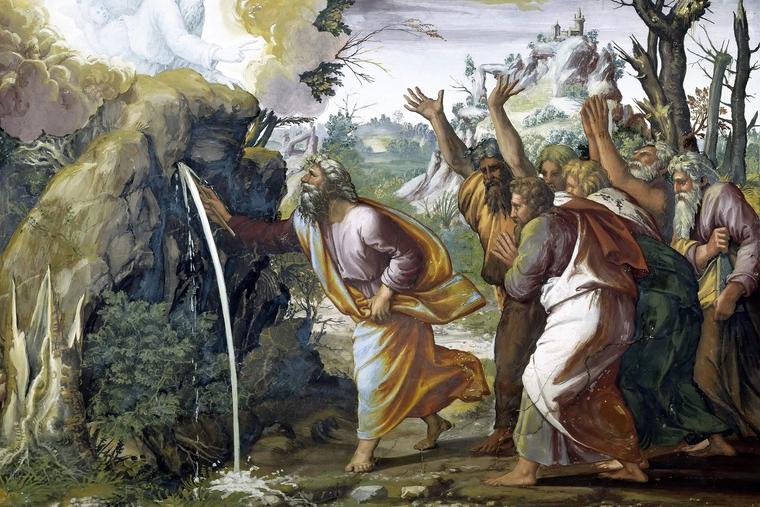
<p>God became angry with Moses (Numbers 20:7-12) because, first, Moses didn’t follow his instructions, which were to “<i>tell</i> the rock before their eyes to yield its water” as opposed to striking the rock — and second, because he gave himself the glory rather than giving it to God, who had led him to the place where water would come out (“shall <i>we</i> bring forth water for you?”).</p>
<p>A “physical” supernatural explanation isn’t required because the land they were in had water within its rocks, which has been proven by science and simple observation.</p>
<p>It can still be regarded as supernatural, however, in the sense that God led Moses to places (e.g., Horeb: Exodus 17:6) where God knew that the water was naturally present in the pores of the rocks. It could also be the case when Moses merely spoke to the rock, that God intended to either supernaturally cause it to come out at that instant, or knew (knowing everything) that it was going to come out (naturally) at the time Moses spoke to the rock, and in that particular place.</p>
<p>Moses hitting the rock twice in anger exhibited a disbelief in God, who would have made the water gush forth when Moses simply spoke to the rock. Hitting it not just once but twice was in effect making a statement: “I am doing this merely of my own power, and can do it anywhere I like,” whereas the truth was that God was leading him to the right places. It wasn’t just Moses picking any old rock that he pleased and striking it. In other words, even though water <i>can</i> be found in rocks in the Sinai Peninsula, it’s not in absolutely <i>every rock</i> in every <i>place</i>.</p>
<p>The passages about God causing it sound like he supernaturally caused it to happen (in the physical sense) but it’s not required because in the Bible, we often observe multiple causation, with God as the primary cause and persons as secondary causes; as his agents, so to speak. Thus, the last six passages above that state that God brought the water out of the rock have to be understood in light of the first two, where he used Moses as the agent for his purpose and showed him where to draw the water. This is how they are easily and logically harmonized.</p>
<p>In a similar way, there are many passages saying that “God hardened Pharaoh’s heart” and several others that say that Pharaoh hardened his own heart<i>. </i><a href="https://www.patheos.com/blogs/davearmstrong/2017/01/god-hardening-hearts-interpret.html" target="_blank" rel="noopener">Both are true, in different senses</a>. In a literal sense, Pharaoh did it. In a different sense, God did it by allowing it to happen in his Providence by virtue of man’s free will, which in this instance was accomplishing God’s purpose (to free the Hebrews from slavery).</p>
</p></div>
<p><br />
<br /><a href="https://www.ncregister.com/blog/why-did-god-get-angry-at-moses-for-striking-the-rock">Source link </a></p>
<p><!-- END THEIA POST SLIDER --></p>

Why Did God Get Angry at Moses for Striking the Rock?| National Catholic Register