<p><!-- BEGIN THEIA POST SLIDER --></p>
<p> <br />
</p>
<div>
<p>While in university, I would drink every Thursday night with Norm Peterson. Millions of people did, the <i>Cheers</i> character whose name everybody did know. </p>
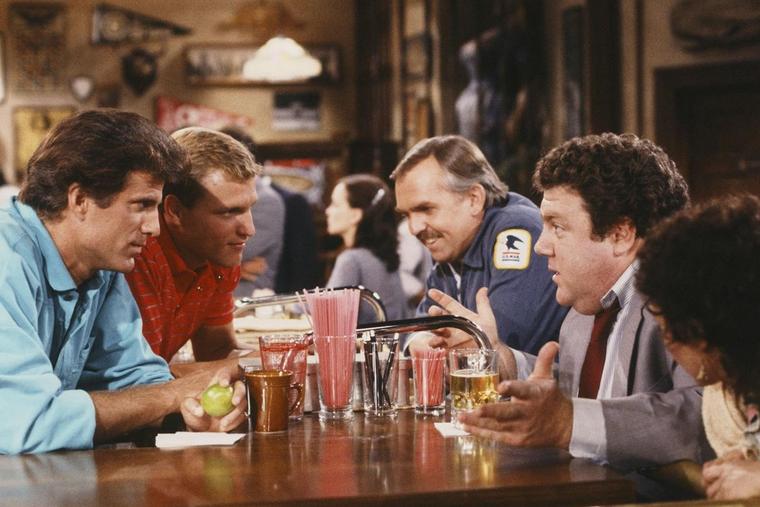
<p>When George Wendt, the actor who played Norm, died recently, people of a certain generation remembered a comfortable, if not inspiring, presence. Norm had a job he didn’t like (accounting) and a wife he avoided (Vera), but he did have friends in a neighborhood pub (Cheers) in Boston where everybody did know his name.</p>
<p>“Norm!” the entire bar would hail Peterson as he ambled in and headed directly for his stool at the end of the bar, where he would drink until closing time. Norm had precious little to offer, really, except one thing that was in demand in the early 1980s, and is even more desperately needed now: that he knew the people at Cheers and was known by them.</p>
<p>For 11 years (1982-1993), <i>Cheers</i> was one of the most popular shows on TV. Wendt died on the 32nd anniversary of the show’s final episode, a cultural event at that time, a time when watching TV meant watching together at a certain time in a certain place, not unlike sitting in a bar requires being there at a certain time in a certain place.</p>
<p>As undergraduates in the early 1990s, we would crowd into the campus pub on Thursday nights at Queen’s University in Kingston, Ontario — arriving well ahead of time to get a seat. A few minutes before nine, an enormous television cabinet (no flat screens then) would be rolled in, and the packed crowd would quiet down to watch the cold open of <i>Cheers</i>. The quiet would not last long, as the theme composed by Gary Portnoy specifically for the show would start, and everyone would sing together.</p>
<p>“Making your way in the world today/ Takes everything you’ve got/ Taking a break from all your worries/ Sure would help a lot,” it began. “Wouldn’t you like to get away?”</p>
<p>Then the rousing chorus: “Sometimes you wanna go where everybody knows your name/ And they’re always glad you came/ You want to be where you can see/<br />Our troubles are all the same/ You want to be where everybody knows your name.”</p>
<p>And the one character whose name everybody knew, on screen and at home, was Norm. We would shout it a split second before the cast did: “Norm!”</p>
<p>In the 1980s, NBC had a formidable Thursday night lineup. There was <i>The Cosby Show </i>at 8 p.m., and <i>Family Ties</i> at 8:30, both shows that depicted America as it would like to be — united, loving, educated, prosperous, idealistic. Then came <i>Cheers</i>, and with it came an uneasy sense of America as it actually was — and was becoming. </p>
<p>It was set in a bar, not a home, and neither the proprietors not the patrons were particularly successful in life or love. Most of the episodes were about mistakes, mishaps, misfortune. The characters were lovable losers, and because they were lovable, the audience was not inclined to think of them as losers. They were a sort of <i>via negativa </i>of human flourishing; each of them illustrated how not to thrive and pursue happiness. </p>
<p>Norm had more than the others — a stable job and an enduring marriage. He wore a jacket and tie each day; not well, rather rumpled, but he wore them. He had, though, given up on life, content with surviving rather than thriving. Satisfying his appetites for food and drink came to limit his horizon. He had at least the quality of fidelity — faithful to his wife, to his friends, to his bar. He no longer dreamed of what life might be, but he did maintain what his life was — his job, his friends, his bar.</p>
<p><i>Cheers </i>in the 1980s signaled what everyone now worries about, a culture that offers fewer roots. At the bar, there was some rootedness; the patrons found there a place and a name. </p>
<p>The show was shot on a studio lot in California, with exterior shots filmed at the Bull &; Finch Pub in Boston — now renamed Cheers Boston. It was vitally important that there be an actual location where Norm and the others would gather — the whole point was that there was a place where everybody was glad you came. There had to be a place to come to. </p>
<p>Fans of the show would visit the Bull &; Finch in Boston — and even last week a memorial was held there for Wendt. Norm was a fictional character in a bar that didn’t exist, but the consolation offered by <i>Cheers </i>required there to be a real place with a real stool upon which Norm would really sit.</p>
<p>The erosion of common life and common spaces has been chronicled for decades now — even the famed British pub has declined. It has already been 25 years since Robert Putnam’s <i>Bowling Alone</i> (2000) drew serious attention to the attenuation of American associations and their gathering places — bowling alleys, veterans’ hall, fraternal associations, union meetings and neighborhood bars.</p>
<p>Part of the uptick observed in certain religious congregations is driven by the awareness that we are meant to be together, not living near others, but living together. We are meant to be assembled — the word “church” comes from the Greek for “assembly.” Assembling in church is better than the bar, but better the bar than not at all.</p>
<p>Today, Norm might just as well head home, retreat to his man cave and pass the night away watching streaming services, listening to podcasts and drinking alone. In the digital world, nobody knows your name and no one cares if you came — just if you clicked “like” or “subscribe.” It’s a lonely place, and there are feverish attempts to make the online world more human, to make meetings online closer facsimiles of meetings in the flesh. </p>
<p>Norm Peterson brought his considerable flesh — “all four cheeks and a couple of chins,” as he endearingly put it — to the end of the bar at Cheers. George Wendt has died, but millions of Norms live on, looking for places where at least some people know your name. </p>
<p>Raise a beer to Wendt and all the Norms. Cheers!</p>
</p></div>
<p><br />
<br /><a href="https://www.ncregister.com/commentaries/george-wendt-the-call-of-cheers-to-cultivate-community">Source link </a></p>
<p><!-- END THEIA POST SLIDER --></p>

Why George Wendt’s ‘Cheers’ Character Still Resonates in a Lonely World| National Catholic Register