<p><!-- BEGIN THEIA POST SLIDER --></p>
<p> <br />
</p>
<div>
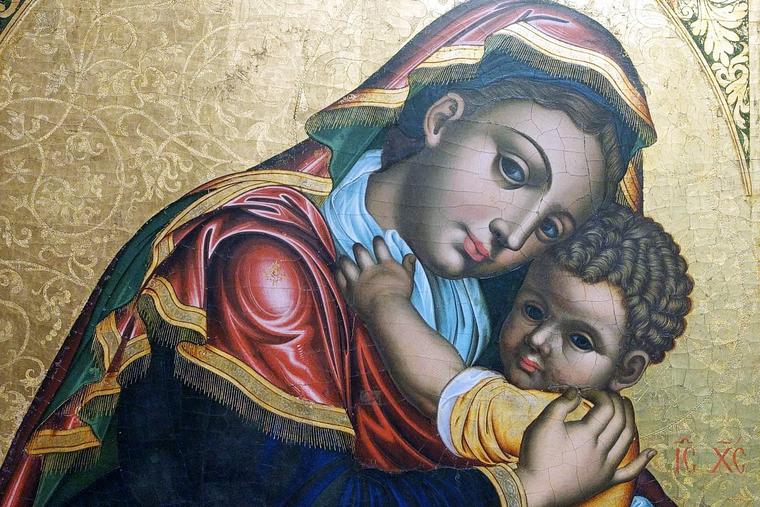
<p>The Akathist inspires us to contemplate the mysteries of the Christian faith and find solace in the protective embrace of the Mother of God.</p>
</p></div>
<div>
<p>In 626, Constantinople was under siege. Sasanian, Avar and Slavic forces were attacking the city. This attack was just one of many in a war that had been going on since A.D. 602.</p>
<p>The bombardment was continuous, and yet, the faithful Christians within the walls had high spirits. In large part, this was due to the example of the Patriarch of the city at the time, Patriarch Sergius. According to legend, the siege ended when, one night, Patriarch Sergius led a litany of prayer to the Theotokos and processed around the city with the Hodegetria — an icon of the Mother of God — and just before the final assault, right after he had completed the service, a massive storm came and crushed the invading fleet on the Bosphorus. The victory was immediately credited to the Theotokos, and that night, the whole city spent the night in prayer.</p>
<p>The prayer they are said to have sung is now known to us as the Akathist of the Mother of God. The word <i>akathist</i> is a Greek word that means “no sitting.” The lack of sitting or rest is meant to be a reminder of when Our Lady helped save those in their time of need and the joy with which they spent the night singing her praises — the people of Constantinople were so excited they could not sit. In addition to all this, the Akathist Hymn is also said to have been written by one man a little over half a century before. The supposed author is St. Romanos the Hymnographer.</p>
<p>St. Romanos himself has a magnificent story. As a young deacon in Constantinople, St. Romanos was assigned to lead the all-night vigil for the Feast of Our Lord’s Nativity. As one version of the story goes, he read the verses so poorly that another reader had to take his place, and some of the other clergy mocked him for this. Exhausted and humiliated, he sat down in one of the choir stalls and fell asleep. In the dream, the Mother of God appeared to him with a scroll in her hand and compelled St. Romanos to eat the scroll (a similar scene to what we read in Ezekiel 3:1-15). Once he had eaten the scroll, he woke up with a jolt and was filled with God’s grace and, after receiving the blessing of the Patriarch, ascended the ambo and chanted a newly created song of the Nativity. This hymn is beautiful, and its profound theology and orthodox teaching are manifest. Likewise, such theology and beauty can also be found in the Akathist to the Theotokos, which St. Romanos originally wrote for the Feast of the Annunciation.</p>
<p>Today, Eastern Christian Churches all over the world sing the Akathist Hymn on the first five Fridays in Lent (here is a good <a href="https://www.youtube.com/watch?v=K2IYzQ2Ava4">recording</a>). The Hymn follows a Greek alphabet acrostic format, with stanzas alternating between long and short forms. Each short stanza concludes with the chant “Alleluia,” while each longer stanza concludes with the refrain: “Rejoice, O Bride Unwedded.” The groupings of longer and shorter stanzas are organized into 13 <i>oikoi</i>, which means “households” in Greek.</p>
<p>The hymn’s <i>oikoi</i> are divided into four groups following four distinct themes: the Annunciation, the Nativity, Jesus Christ and the Theotokos. The first <i>oikoi</i> on the Annunciation detail the Annunciation to the Virgin Mary by the angel, with an account of Mary’s astonishment, the visitation to Elizabeth, and Joseph’s doubts regarding her purity. The subsequent <i>oikoi</i> narrates Christ’s birth, the adoration of the Shepherds and Magi, the flight to Egypt, and the encounter with St. Simeon in the Temple. In the third group of <i>oikoi</i>, the hymn shifts focus to the world’s renewal through Christ’s advent, highlighting the angels’ and wise men’s wonder at the Incarnation of God’s Son. The fourth and final <i>oikoi</i> offers a poetic and rhetorical tribute to the Virgin Mary, adorned with beautiful prayers, beseeching her acceptance of the poetic offering and intercession for humanity’s salvation from earthly sin.</p>
<p>Each word is packed with scriptural and theological meaning. Here are just some of the beautiful words:</p>
<p>From Oikos 3, we sing, “Rejoice, O branch of an Unfading Sprout,” and from Oikos 5, “Rejoice, Mother of the Unsetting Star.” Or, as a doctoral student, here is a personal favorite of mine from Oikos 9:</p>
<blockquote><p>Rejoice, thou who showest philosophers to be fools:<br />Rejoice, thou who exposest the learned as irrational!<br />Rejoice, for the clever critics have become foolish:<br />Rejoice, for the writers of myths have faded away!<br />Rejoice, thou who didst rend the webs of the Athenians:<br />Rejoice, thou who didst fill the nets of the fishermen!</p></blockquote>
<p>The Akathist Hymn to the Theotokos is a profound testament to the enduring spirit of faith and devotion within Eastern Christian traditions. Its genesis, intertwined with the historical siege of Constantinople and the mystical experiences of St. Romanos the Hymnographer, reflects the deep-seated belief in divine intervention and the intercessory power of the Virgin Mary. In fact, St. Romanos and Our Lady’s intercession are so intertwined that he stands in the center of most icons depicting the protection of the Theotokos — an icon that comes when Mary visited a Church and spread her veil over the congregation, symbolizing her protection, also known as the Pokrov icons.</p>
<p>In any case, we should note that the Akathist, through its intricate structure and rich theological imagery, can inspire us to contemplate the mysteries of the Christian faith and find solace in the protective embrace of the Mother of God. As we sing its verses, we participate in a timeless tradition that honors the sacred bond between God and man, reaffirming the presence of Jesus Christ. As we journey through this season of Lent — and more importantly, as we are wayfarers traveling through this temporal earth — we can look to the Theotokos for help in our time of need. </p>
</p></div>
<p><br />
<br /><a href="https://www.ncregister.com/blog/cassella-akathist-hymn">Source link </a></p>
<p><!-- END THEIA POST SLIDER --></p>

Why Our Lady Loves the Akathist Hymn| National Catholic Register