


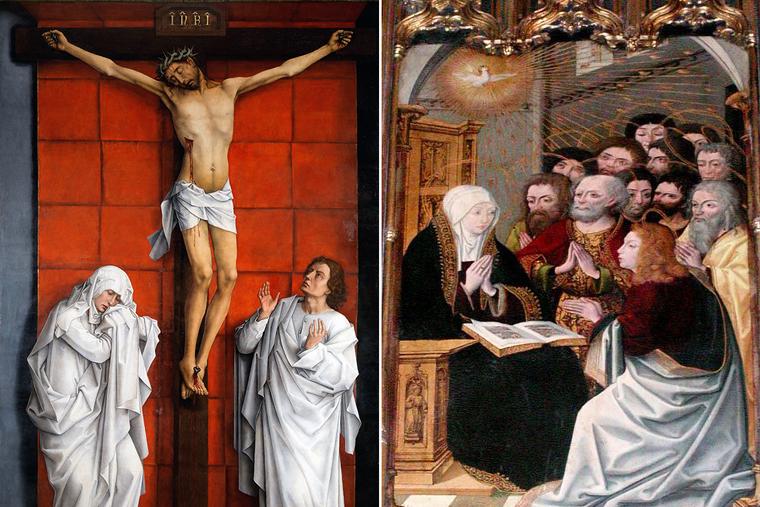
SAINTS & ART: Two masterpieces, centuries apart, reflect a theological insight centuries old: Mary was given not only to John, but to the entire Church.
June 9 is the Memorial of Mary, Mother of the Church. As liturgical feasts go, it’s very recent: Pope Francis only added it to the calendar in 2018, on the Monday after Pentecost. In some ways, it offers a small cushion to the liturgical calendar because, with Pentecost, the Easter season comes to an end. Pentecost used to have its own octave but, in the name of cleanly closing the “50 Days” of Easter, the 1969 calendar reform eliminated that octave, instead returning the liturgical calendar immediately to “ordinary time.”
The focus on Mary as “Mother of the Church” is something both ancient and new. It is new inasmuch as its liturgical memorial is relatively recent. It is also a vision that Vatican II and the postconciliar Church emphasized. The Dogmatic Constitution on the Church Lumen gentium concludes with a chapter on “The Blessed Virgin Mary, Mother of God, in the Mystery of Christ and the Church.”
Even there, however, it helps to know something of the history. Lumen gentium, which treats the Church and its members, was something of a lightning rod in various theological debates, especially about ecclesiology (that branch of theology dealing with the Church). Vatican II has been called an “ecclesiological council” because much of its focus was on the Church, e.g., how she understands itself, how she relates to the modern world, etc. In one sense, Vatican II was intended to complete Vatican I — the Council that defined papal infallibility — in order to “balance” it. Vatican I was interrupted by the Franco-Prussian War of 1870 and never formally adjourned until just before Vatican II. Because of that interruption, theologians argued that its focus on the papacy was somewhat uneven: should we talk about the nature of papal teaching in abstraction from how it fits within the larger Church and her mission? Vatican II sought to strike that balance.
The first draft of what would become Lumen gentium was also ecclesiologically very traditional: it started with the hierarchy. And that document got sent back to be rewritten, because we become a member of the Church by Baptism, not Holy Orders. If you examine Lumen gentium (start with no. 9), you’ll see it begins with the Church as “the People of God” and only later moves on to ecclesiastical office.
Similarly, there were some bishops at Vatican II who wanted to write a separate document entirely on the Blessed Virgin Mary. One of the conciliar compromises, relevant to today’s memorial, is that the Council ultimately chose not to produce a separate Marian document but to attach its teaching to Lumen gentium, discussing Mary’s unique role as a member of the Church.
This, too, is a contemporary theological perspective. Mariology (the theology of Mary), even not long before the Council, tended to focus on what was unique about Our Lady, discussing her particular “privileges,” such as being conceived without sin (Immaculate Conception) and taken body and soul to heaven (Assumption). Those privileges are true, but modern Mariology wants to examine them slightly differently, from the perspective of Mary as “first disciple.” Mary was the first and best example of following Christ. In that, she illustrates what being a member — the “most beloved mother” (no. 53) — of the Church means. Pope St. Paul VI formally designated her as “Mother of the Church” in his 1968 Credo of the People of God.
That’s what’s new about this title. But its roots go back to the Bible, specifically to two episodes: Good Friday and Pentecost.
As he was dying, Jesus entrusted his mother to St. John, the only one of the apostles to stand by him at the foot of the cross. “Son, behold your mother,” “Woman, behold your son” (John 19:26-27). The Church always understood that passage not merely as Jesus making “last will and testament” provision for custodial care of his next-of-kin. It was giving her, who literally gave him to the world, to the Church — to all who would be sons [and daughters] in the Son through adoption.
At his Ascension, Jesus instructed his Apostles to wait in Jerusalem for an indeterminate period for the outpouring of his Spirit which came, 10 days later, at Pentecost. Pentecost is traditionally called “the birthday of the Church” because, empowered by the Holy Spirit, the Apostles burst out of their Upper Room to engage men and women, first in the adjacent streets of Jerusalem but ultimately — in today’s parlance, at the peripheries of the world. And it has always been the tradition that Mary was present in that Upper Room. Did she need to go out into the streets to engage inhabitants of “Pontus and Asia, Phrygia and Pamphylia” (Acts 2:9-10)? No, because she had already been proclaiming “the greatness of the Lord” (Luke 1:46) 33 years earlier in another periphery: Ein Karem.
If I were to suggest art to depict this feast, I would offer two paintings: Rogier van der Weyden’s “Christ on the Cross with Mary and John” (in the Royal Monastery of San Lorenzo de El Escorial, near Madrid) and the Altarpiece of Capparosso in Pamplona Cathedral, Spain. The two works are about 50 years apart (van der Weyden, ca. 1460, in the Netherlandish Renaissance style; Pamplona, c. 1507).
Both paintings depict the Scriptural events I focused on regarding Mary as Mother of the Church. I chose van der Weyden’s painting for three reasons:
- Jesus is already dead. He has been pierced. As the Preface for the Sacred Heart (also celebrated this month) reminds us, “from his side flowed blood and water, the fountain of sacramental life in the Church.”
- Mary and John are alone here, i.e., not with the usual accompaniment of Mary Magdalene and/or other women. Thus, the dramatis personae involved in Jesus’ entrusting his mother to the Church through an Apostle and they alone are here.
- Mary and John are in stark white, not usual colors for them (particularly at the crucifixion) but reminders to us that — while Mary did not require it but was saved by prevenient grace — the Church’s sons and daughters “have washed their robes and made them white in the blood of the lamb” (Revelation 7:14), since the Church’s fundamental mission is reconciliation of sinners and communion with God.
I chose the Caparosso altarpiece also for four reasons:
- Pentecost paintings usually either depict only the Apostles with the Holy Spirit or the Apostles with Mary with the Holy Spirit, as this painting does.
- Most depictions of the Apostles with Mary place Our Lady in the center, the Apostles gathered around her. Here, she is presented almost as their first teacher since she is already the first disciple.
- While Acts 2 speaks of the Holy Spirit coming in tongues of flame, the altarpiece shows him as a dove surrounded by flame. That, and his position above Mary, also alludes to the Annunciation, the moment Mary became the Church’s first tabernacle and monstrance.
- John (in front with red hair) is in the foreground, opposite Our Lady, again connecting these two with the adoption scene at Calvary in John 19.
A final comment: I also wanted to highlight these two great works of classical art for the edification of Vatican officials who, apparently until two days ago, were hard pressed to find art other than Marko Rupnik’s to represent today’s celebration.