<p><!-- BEGIN THEIA POST SLIDER --></p>
<p> <br />
</p>
<div>
<p>It might seem something of a jump that we’ve gone from the beginning of Lent to Palm Sunday in one week. But — unless your parish has adult catechumens preparing for Baptism at the Easter Vigil (in which case there will be particular prayers, blessings, and dismissals for them after the Sunday homily) — the <a href="https://www.ncregister.com/blog/to-easter-through-the-liturgy-parts-of-the-mass">Masses</a> of Lent will largely resemble Masses that Catholics experience throughout the year. It’s only with Holy Week, starting with Palm Sunday, that the liturgy begins regularly to demonstrate unique features, and it’s those we want to discuss.</p>
<p>First of all, while we speak of “Holy Week” it’s <i>not </i>the most important feature of these final days of Lent and the coming of the Paschal Triduum. The term, in fact, can be misleading. “Holy Week” actually spans two different liturgical seasons: Lent and the Paschal Triduum. Palm Sunday as well as Monday, Tuesday, Wednesday and most of Thursday are part of Lent. The period from the Evening Mass of the Lord’s Supper on Holy Thursday through Evening Prayer II (Vespers) on Easter Sunday night is the Paschal or Easter Triduum, “the Great Three Days.” The Paschal Triduum is the most important period of the Church’s entire liturgical year. The term “Holy Week” can be misleading if it leads to us thinking of the Paschal Triduum as just another “part” of Lent. It absolutely is not!</p>
<p>Now, back to Palm Sunday. If you look at your missal, the day actually has a longer title. It’s “Palm Sunday of the Lord’s Passion.” There’s a reason for that.</p>
<p>It’s also unusual that, on Palm Sunday, you’ll hear <i>two </i>Gospels. There’s a reason for that, too.</p>
<p>The differences start with the start of Mass. Unlike most Masses, where the celebrant enters the church and processes to the altar, the Mass on Palm Sunday of the Lord’s Passion almost always begins with a more extended rite. In fact, the priest has three options: a “procession,” a “solemn entrance” and a “simple entrance.” </p>
<p>The “procession” usually begins with the priest and the faithful at some point outside the church where the Mass will be celebrated, which then moves in procession with palms to that point. The “solemn entrance” begins at the church itself, rather than some point beyond the church, though it enters the church with a solemn procession. The “simple entrance” appears to begin much like an ordinary Mass.</p>
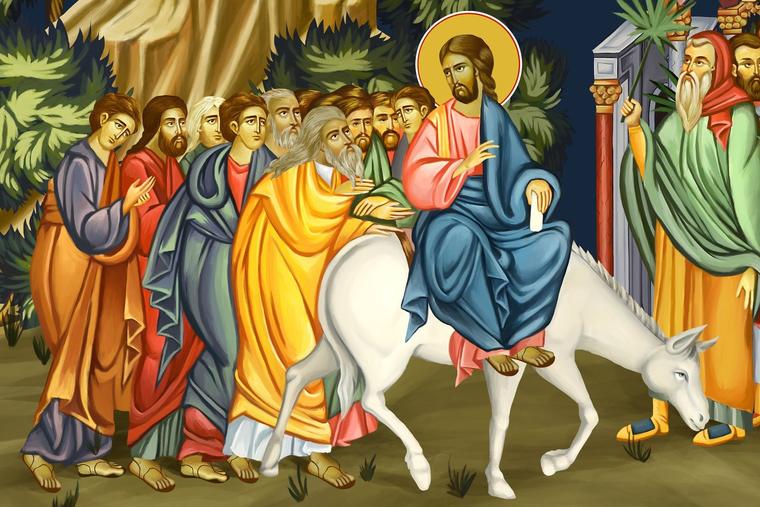
<p>The procession and solemn entrance both involve the blessing of palms. The priest reminds the congregation that they have been preparing throughout Lent to accompany the Lord through his Passion, Death and Resurrection, and now we stand on the immediate threshold of those events. The priest then blesses the palms and the priest and people can process with them. The Gospel account of Jesus’ entrance to Jerusalem is read.</p>
<p>If the Procession or Solemn entrance is used, these ceremonies substitute for much of what in a typical Mass is called the “introductory rites.” The priest, upon arriving at the altar, usually begins with the Collect.</p>
<p>In the Palm Sunday Liturgy of the Word, the Gospel will always be the Lord’s Passion according to one of the Synoptics (Matthew, Mark or Luke). This year, it’s Mark, the shortest Passion narrative. Because Jesus’ Passion, Death and Resurrection is the central mystery of Christianity, the Gospel writers devote proportionately greater attention to those events, hence, the length of the Passion narratives. It is also a tradition that the Passion narrative is divided into spoken parts, usually one for Christ (always the priest), one for particularly important remarks by speakers other than Christ (a reader), one for the crowds (which includes, and therefore is spoken by us, the congregation), and one for the narrator.</p>
<p>The basic lines of the Passion narratives are the same in the three Synoptic Gospels (as well as in John), but the sacred writers also choose to emphasize different events and to accentuate different themes. That’s because each had his own audience, to which he was speaking in particular ways. Matthew, for example, was speaking to Jewish converts to Christianity and so frequently peppers his text with references to the Old Testament, in order to demonstrate that Jesus is the fulfillment of what Israel was expecting. </p>
<p>These are the primary differences between the liturgy as experienced on “Palm Sunday of the Lord’s Passion” and the other Sundays of the year. Once again that title, and — once again — why the two Gospels?</p>
<p>That goes back in history. Remember that, in antiquity, our modern means of communication did not exist. There were no printing presses, no email. While, early on, the liturgy of Rome was the measure for Christians, it’s also true that liturgical practices developed locally, especially in the great patriarchal sees (Rome, Alexandria, Antioch, Jerusalem and Constantinople). </p>
<p>Because of its proximity to Easter, the Sunday before Easter first and foremost focused on the Lord’s Passion. That was central. That’s why the Gospel in the “usual” place in Mass is the Passion narrative. Before the 1970 liturgical reform in the Catholic Church, for example, it was the Passion according to Matthew.</p>
<p>But, early on, the Church in Jerusalem took advantage of the fact that the geographical places where Jesus’ Passion, Death and Resurrection took place were right there. With a regular influx of pilgrims to the Holy City, they wanted to celebrate not just where things happened but the broader historical record. </p>
<p>Egeria was a Christian woman from western Europe who made a pilgrimage to Jerusalem sometime between AD 381-84. She wrote a detailed account of what she saw and did in terms of worship in Jerusalem. From Egeria we learn that, already in her day, pilgrims would gather in the afternoon of what we call Palm Sunday to proceed in procession with palms, retracing Jesus’ actions and steps. As one liturgical scholar notes, the fact this happened in the afternoon suggests it was an “add-on” rather than the original main focus of that Sunday.</p>
<p>But the tradition persisted — and spread. We see the term “Palm Sunday” already by AD 600, and the practice of palm processions made its way into Europe. The pope’s liturgy for that Sunday focused on the Passion. The Roman liturgy tended to be “conservative” in the sense of preserving its traditions, but the pope over time eventually came to distribute palms used in processions. </p>
<p>The fact of these two foci, however, persisted. They eventually came to co-exist, with the tradition of the procession with palms to the church or cathedral eventually turning into the opening rites we now see in Palm Sunday’s Mass. It recalls when the procession arrived at the place where Mass was to be celebrated, and the actions explained in the light of the Gospel of Christ’s entry to Jerusalem. But the focus on the Passion remained, enshrined in the “main” Gospel of the day. This twofold nature of the day is also reflected in its official title: “Palm Sunday of the Lord’s Passion.”</p>
<p>As various liturgical historians point out, over time the popular procession came to be taken over by the clergy so that, in recent centuries, the procession in or around the church was a priestly affair with the congregation as spectators. An important change occurred, however, in the 1950s. Nourished by the research of liturgical scholars from the 1920s-50s “going back to the sources,” i.e., to the earliest patterns of Christian liturgical practice, Pope Pius XII initiated a number of reforms of the Holy Week which recovered some of the rites that had fallen into eclipse. One of them was the recovery of the Palm Sunday procession, restored to a degree in the 1955 reform and certainly encouraged today as a result of the 1970 reform. It recovered what the Church in Jerusalem — the place where this all happened — was doing at least in the fourth century.</p>
<p>That’s how Palm Sunday of the Lord’s Passion acquired the shape we know today. The next liturgy meriting our attention: Holy Thursday’s Evening Mass of the Lord’s Supper.</p>
</p></div>
<p><br />
<br /><a href="https://www.ncregister.com/blog/palm-sunday-to-easter-through-the-liturgy">Source link </a></p>
<p><!-- END THEIA POST SLIDER --></p>

Why the Palm Procession, and Why Two Gospels?| National Catholic Register