<p><!-- BEGIN THEIA POST SLIDER --></p>
<p> <br />
</p>
<div>
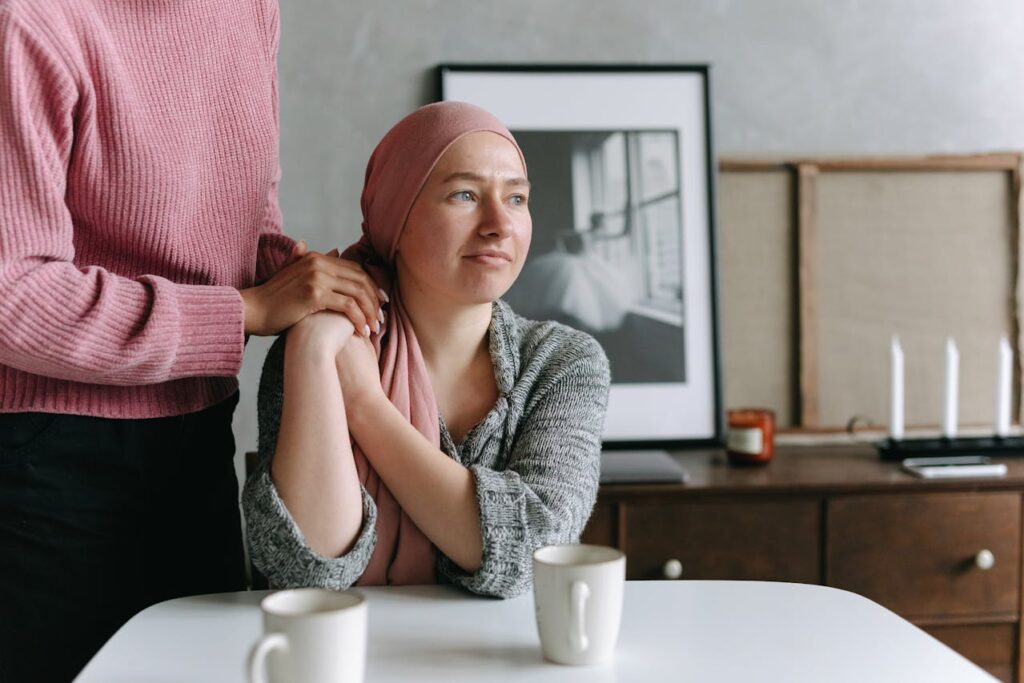
<p>Cancer is a life-altering diagnosis that not only comes with physical challenges but also emotional hurdles. Feelings of anxiety, fear, and stress can emerge after a diagnosis, which can make it hard to <a href="https://www.talkspace.com/blog/how-to-cope-with-cancer-diagnosis/">cope with a diagnosis</a> and make it even more difficult to manage ongoing treatment. There’s no “right” way to feel when you have cancer, and you may experience a wide range of emotions that fluctuate daily. Your mental well-being can play a significant role during this time. By incorporating effective strategies to help you find calm during and after cancer treatment, you can improve your quality of life and enhance treatment outcomes. </p>
<h2>Why Does Mental Health Matter When You Have Cancer?</h2>
<p>Your habits, routines, and relationships can often change after a cancer diagnosis. These sudden shifts can be disorienting and overwhelming, yet the emotional impact is often overlooked. <a href="https://pmc.ncbi.nlm.nih.gov/articles/PMC10540791/">Data shows</a> that over half of patients with cancer feel a disconnect between the attention given to their emotional needs versus their physical needs, despite being at a <a href="https://pmc.ncbi.nlm.nih.gov/articles/PMC7214708/">higher risk</a> of mental health conditions, including anxiety and depression. </p>
<p>While managing physical symptoms and side effects of cancer typically takes center stage, <a href="https://pmc.ncbi.nlm.nih.gov/articles/PMC10540791/">integrating mental health interventions</a> can enhance treatment outcomes and improve quality of life, treatment adherence, and survival rates. A multidisciplinary approach that takes emotional well-being into consideration is a crucial part of a comprehensive cancer treatment plan. </p>
<p>Managing emotional well-being is deeply personal. What works for one person may not work for another. Some may find comfort in sharing their experiences with a support group or online community. Others may prefer to process their emotions privately through <a href="https://www.talkspace.com/blog/journaling-for-mental-health/">journaling</a> or creative expression. Exploring different therapeutic options is part of the process.</p>
<h2>The Benefits of Mindfulness</h2>
<p>If you’re unsure of where and how to start, one tool that can help is mindfulness. <a href="https://pmc.ncbi.nlm.nih.gov/articles/PMC6371675/">Mindfulness has been shown</a> to lessen pain, anxiety, fatigue, and improve quality of life for people with cancer. It’s an accessible and nonpharmacological modality that’s often used and recommended in integrative oncology. </p>
<p>What exactly is mindfulness? <a href="https://outcomes4me.com/webinar/ask-the-expert-what-is-integrative-oncology/?utm_source=Talkspace&;utm_medium=blog&;utm_campaign=Partnership">Integrative Oncologist and Hematologist Dr. Krisstina Gowin says</a>, “Mindfulness is a type of mindful awareness. It’s a type of meditation, breathing technique, or mind-body practice. Essentially, it’s non-judgmental awareness, so being aware of your breath, how your body feels in space, how your feet are contacting the floor, and how your body is contacting your chair. You’re aware of your emotional and mental landscape and thoughts. Things will come in, thoughts will float in and out. You’re just watching them and naming them nonjudgmentally.” </p>
<p>Mindfulness covers a wide range of strategies. <a href="https://www.cancer.org/cancer/survivorship/coping/practice-mindfulness-and-relaxation.html">Below are some techniques</a> that allow the mind and body to relax and be present:</p>
<ul>
<li>Meditation</li>
<li>Breathwork</li>
<li>Guided imagery </li>
<li>Progressive muscle relaxation</li>
<li>Meditative movement like Tai Chi or yoga</li>
<li>Journaling </li>
</ul>
<h2>How Does Mindfulness Work?</h2>
<p><a href="https://pmc.ncbi.nlm.nih.gov/articles/PMC6371675/">Research suggests</a> that by drawing attention away from pain and stress, mindfulness can lessen pain severity and enhance pain tolerance when patients are actively focused on something else, like their breath. </p>
<p>According to Dr. Gowin, mindfulness may also work by addressing the stress response. Stress releases cortisol, epinephrine, and norepinephrine, and mindfulness can be an effective tool to calm those stress hormones. <a href="https://outcomes4me.com/webinar/ask-the-expert-what-is-integrative-oncology/?utm_source=Talkspace&;utm_medium=blog&;utm_campaign=Partnership">She says</a>, “Mindfulness helps to cool the inflammation, decrease stress, and change the environment in the bloodstream, which then changes the environment around cancer cells. Inflammation is one of those central things we really want to modulate when we’re thinking about cancer and its pathogenesis, propagation, and metastasis.”</p>
<h2>Mental Health After Cancer Treatment</h2>
<p>Adjusting to life after cancer treatment can bring its own unique set of challenges. Fear of recurrence, body image, financial toxicity, and other changes are all factors that can contribute to anxiety and stress <a href="https://www.cancer.gov/news-events/cancer-currents-blog/2020/cancer-survivors-managing-anxiety-distress">in survivorship</a>. For some, coming to terms with changes in friendships and other connections can be the most profound. Support groups, counseling, exercise, and mindfulness are effective ways to cope with the emotional effects at this stage.</p>
<h2>Tools to Support Your Mental Health</h2>
<p>Whether you’re newly diagnosed, in active treatment, navigating survivorship, or helping someone else who is, it’s essential to prioritize your mental well-being along with your physical health. There’s no one-size-fits-all, which is why we encourage you to explore different tools and approaches that resonate with you.</p>
<p>Resources like support groups, in-person or <a data-wpil="url" href="https://www.talkspace.com/online-therapy/">online therapy</a>, journaling, and different apps or tools can make all the difference in supporting your mental health while you’re dealing with cancer. </p>
<p>Apps like <a href="https://downloadoutcomes4me.onelink.me/2NyW/rkh4yl94">Outcomes4Me</a> can help bridge the gap in care by offering resources that focus on both the body and mind. The app is integrated with the NCCN Guidelines® to provide you with the latest treatment updates relevant to your diagnosis. It can provide a summary of your health records so you can feel more in control of your care and have better discussions with your care team.</p>
<p>Outcomes4Me includes a journaling feature, symptom tracker, and daily mood tracker to help you reflect on how you’re feeling over time. These features can be powerful tools to recognize emotional patterns and communicate your needs to your care team. The app also includes a supportive community where you can connect with others going through similar experiences, providing a holistic approach to cancer care.</p>
<p>Sources:</p>
<ol>
<li>Mental Health and Distress. American Cancer Society. Accessed April 25, 2025. <a href="https://www.cancer.org/cancer/managing-cancer/side-effects/emotional-mood-changes.html">https://www.cancer.org/cancer/managing-cancer/side-effects/emotional-mood-changes.html</a></li>
<li>Fernando A, Tokell M, Ishak Y, Love J, Klammer M, Koh M. Mental health needs in cancer – a call for change. <em>Future Healthc J</em>. 2023;10(2):112-116. doi:10.7861/fhj.2023-0059</li>
<li>Caruso R, Breitbart W. Mental health care in oncology. Contemporary perspective on the psychosocial burden of cancer and evidence-based interventions. <em>Epidemiol Psychiatr Sci</em>. 2020;29:e86. Published 2020 Jan 9. doi:10.1017/S2045796019000866</li>
<li>Ngamkham S, Holden JE, Smith EL. A Systematic Review: Mindfulness Intervention for Cancer-Related Pain. <em>Asia Pac J Oncol Nurs</em>. 2019;6(2):161-169. doi:10.4103/apjon.apjon_67_18</li>
<li>Ask the expert: What is integrative oncology? Outcomes4Me. March 24, 2025. Accessed April 24, 2025. <a href="https://outcomes4me.com/webinar/ask-the-expert-what-is-integrative-oncology/">https://outcomes4me.com/webinar/ask-the-expert-what-is-integrative-oncology/</a></li>
<li>Practice mindfulness and relaxation. American Cancer Society. Accessed April 25, 2025. <a href="https://www.cancer.org/cancer/survivorship/coping/practice-mindfulness-and-relaxation.html">https://www.cancer.org/cancer/survivorship/coping/practice-mindfulness-and-relaxation.html</a></li>
<li>Managing anxiety and distress in cancer survivors. National Cancer Institute. April 30, 2020. Accessed April 25, 2025. <a href="https://www.cancer.gov/news-events/cancer-currents-blog/2020/cancer-survivors-managing-anxiety-distress">https://www.cancer.gov/news-events/cancer-currents-blog/2020/cancer-survivors-managing-anxiety-distress</a></li>
</ol>
<div class="code-block code-block-9 ai-track" data-ai="WzksMCwiQ0YgYWZ0ZXItcG9zdCBpbmplY3Rpb24iLCIiLDFd" style="margin: 8px 0; clear: both;">
<div class="editorial-statement" style="margin:25px 0 30px; border-top: 1px solid #eee; padding-top: 25px;"><em></p>
<p>Talkspace articles are written by experienced <a href="https://www.talkspace.com/blog/talkspace-council-of-experts-meet/">mental health-wellness contributors</a>; they are grounded in scientific research and evidence-based practices. Articles are extensively reviewed by our team of clinical experts (therapists and psychiatrists of various specialties) to ensure content is accurate and on par with current industry standards.</p>
<p>Our goal at Talkspace is to provide the most up-to-date, valuable, and objective information on mental health-related topics in order to help readers make informed decisions.</p>
<p>Articles contain trusted third-party sources that are either directly linked to in the text or listed at the bottom to take readers directly to the source.</p>
<p></em></div>
</div>
<p><!-- CONTENT END 1 --></p></div>
<p><br />
<br /><a href="https://www.talkspace.com/blog/cancer-mental-health-tools/">Source link </a></p>
<p><!-- END THEIA POST SLIDER --></p>

Cancer & Mental Health | Talkspace