<p><!-- BEGIN THEIA POST SLIDER --></p>
<p> <br />
</p>
<div>
<p>Teasing has almost entirely negative connotations these days. It is the word evoked by sullen-faced parents to describe a misfortune befallen their child: “Jimmy is being<em> teased</em> at school.” It is largely associated with bullying. It is thought of as a form of expression that divides.</p>
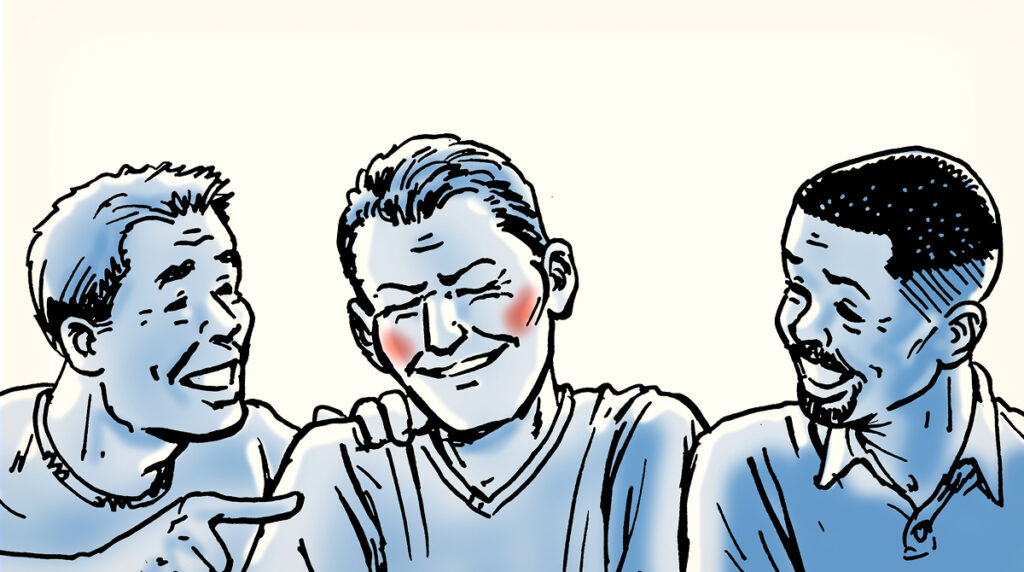
<p>Yet teasing has in fact long functioned to bring people <em>together</em> — <a href="https://www.artofmanliness.com/articles/manly-honor-part-i-what-is-honor/">especially in honor cultures</a>, and especially among men. It is an act full of paradoxes: at its best, it both stings, and strengthens; affirms hierarchy, and levels it; promotes conformity, and autonomy; it makes a man sensitive to shame, but not <em>too</em> sensitive. Indeed, as Carlin Barton writes in <a href="https://amzn.to/2lyloRv"><em>Roman Honor</em></a>: “teasing and mild shaming are among the most important socializing mechanisms of society.”</p>
<p>Below we’ll unpack how teasing produces these benefits, as well as the necessary conditions for teasing to function as a healthy form of “aggressive nurturing” that builds bonds, rather than a destructive force that weakens them.</p>
<h3>Teasing as a Prompt for Personal Improvement</h3>
<p>Just as we do teasing these days, we tend to think of shame in a wholly negative way, believing that all forms of it are bad, and that no one should ever be shamed.</p>
<p>Yet shame can be an incredibly potent prompt towards positive behavior.</p>
<p>While it is unhealthy to feel shame because of things one cannot help, or are undeserving of a shameful response, <a href="https://www.artofmanliness.com/articles/shame/">it is healthy to feel a prick of abashment</a> in falling short of the honorable standards of society, your family, and yourself.</p>
<p>The trick with shame is the dosage: too much shame becomes toxic, debilitates, while a little shame spurs to action.</p>
<p>Healthy teasing delivers shame in the right, mild dose.</p>
<p>The word teasing comes from older words for pulling apart strands — which is why we still use the phrase “tease out.” Healthy vocalized teasing surfaces truths about someone’s foibles, but does so in a playful, good-natured way. Delivered right, a man is not crushed by it, does not feel the need to become angrily defensive; he laughs in the moment, but still hears the underlying message in the joke. Because he doesn’t feel attacked directly, <a href="https://www.artofmanliness.com/articles/want-people-to-hear-your-message-let-them-overhear-it/">he has the space to process that message</a>, and decide how to improve the area in which he was ribbed.</p>
<h3>Teasing as Training in Self-Control</h3>
<blockquote>
<p>Against a large part of the frictions and irritations and clashing of temperaments incident to participation in a community life, a certain toughening of the mental hide is a better protection than the law could ever be. —Calvert Magruder, legal scholar</p>
</blockquote>
<p>It is often thought the male code of emotional stoicism — of keeping a stiff upper lip — developed for unknown, arbitrary reasons. But it directly arose from <a href="https://www.artofmanliness.com/character/behavior/the-3-ps-of-manhood-protect/">men’s universal, timeless role as protectors</a>. In the heat of battle, breaking down, falling apart — giving way to either paralyzing panic or heedless rage — would sabotage the outcome of the fight, and endanger the lives of one’s comrades.</p>
<p>For this reason, young men in every culture, in every time, were given challenges that developed and tested their self-control. Teasing constituted one of these “trials.” For example, <a href="https://www.artofmanliness.com/articles/the-spartan-way-brotherhood-is-born-in-breaking-bread/">much ribbing took place as part of the ancient Spartans’ practice of <em>syssitia</em></a> — nightly dinners; the older warriors would pointedly kid each other, and call young men over to the table to endure some teasing from the group.</p>
<p>The idea behind this tradition was simple: if you couldn’t endure a little razzing from your friends, how could you maintain your composure in the face of humiliations from your enemies? Teasing from their comrades desensitized and inured young men to the taunts and insults of strangers and foes.</p>
<h3>Teasing as a Solidifier of Group Bonds </h3>
<blockquote>
<p>Good teasing was like being naked together in the baths or the gym — it expressed a willingness to be bound to one another. —Carlin Barton<em> </em></p>
</blockquote>
<p>We typically think of teasing as a one-way interaction: the teaser is the actor; the teased is a passive recipient (or even victim). And this is in fact the dynamic that exists in the case of unhealthy teasing.</p>
<p>But healthy teasing operates within a two-way, reciprocal relationship which builds mutual trust.</p>
<p>Teasing acts like a form of mild hazing (yet another word for which we moderns have trouble imagining positive connotations). It often reinforces an explicit or implicit pecking order. Members of a group come to trust someone more when he acknowledges this hierarchy, and demonstrates his commitment to the group and loyalty to their standards, by accepting teasing, and feeling shame for the failures such ribbing indirectly point to.</p>
<p>The teased shows that he trusts other members of the group, by exposing his weaknesses in the first place. He trusts that the others may play with these vulnerabilities, but will not mishandle them in a way that seriously wounds — that they will joke, but not take their jokes too far. The teaser proves himself worthy of this trust by demonstrating this restraint; “I could destroy you with my words — I know which buttons to press — but I won’t.”</p>
<p>As part of this mutual dance, Barton observes, the teased gave a part of himself, while the teaser held that part as a kind of loan; the teaser took part of someone’s humanness as “a trust that they needed to treasure and guard and give back.” In this way, “Allowing someone to tease you was like opening your house to a guest; if the teaser accepted your hospitality as a gift, then you, the person teased, were the richer for it.”</p>
<p>Richer, because healthy teasing always requires a phase of reintegration. That is, teasing temporarily separates the teased from the group, but this slight separation is followed by behaviors on the part of the group which reincorporate him back. The message is: “We’re aware of your flaws, but don’t mind. We recognize your foibles, but like you anyway. You may have fallen short, but you’re still one of us.”</p>
<p>Healthy teasing then, rather than being ostracizing in nature, makes one feel both more known, and more accepted. The teased experience the liberation of having one’s shameful weaknesses seen, yet indulged. What can sound like an insult, really says, “Hey, you’re all right.”</p>
<p>Teasing is not only a two-way street for building mutual trust, but one in which the direction the “traffic” moves isn’t fixed.</p>
<p>To Barton’s observation that “teasing and mild shaming are among the most important socializing mechanisms of society,” is added the important caveat:<em> “provided that trust is there and that the teaser is prepared to exchange roles with the teased</em>.” Sometimes it’s someone else who messes up and gets razzed, and sometimes it’s you; and you can’t be willing to dish it, but not take it. Even in hierarchical groups, it’s a sign of mutual trust, and deference on the part of superiors, when teasing can be given both up and down; the officer can tease his men, and they can tease him back; the teacher can tease his students, and they can tease him in return.</p>
<p>Those who have missed the fundamental reciprocity of teasing — <a href="https://www.artofmanliness.com/articles/of-men-and-nicknames/">including the giving of seemingly insulting nicknames</a> — have often found its central place in male socialization to be bewildering, if not toxically boorish. Yet amidst the trading of good-natured barbs, real camaraderie is born.</p>
<p>As Barton puts it, “When reassurance and reintegration are part of the process, teasing and mild shaming are not only forms of communication, they are forms of communion.”</p>
<h3>Teasing as a Strengthener of Autonomy</h3>
<blockquote>
<p>Modern Westerners are afraid of the emotions of shame and intolerant of expressing them; as a result, the fear of shame intensifies the experience of shame. Modern Westerners become ashamed of feeling ashamed and thus are swept into a spiral of shame. —Carlin Barton</p>
</blockquote>
<p>The ironic thing about learning to take teasing is that while it signals one’s longing to be accepted and willingness to conform to a group, it also strengthens one’s ability to deviate from collective opinion.</p>
<p>As mentioned above, teasing is training in managing shame, so that it isn’t experienced as overwhelming.</p>
<p>Those who cannot handle even mild shaming, who<em> do</em> experience it as overwhelming, are more willing to do whatever it takes to avoid that feeling — including conforming at any cost. They can readily be, as Barton puts it, “shamed into acting shamefully.”</p>
<p>Ironically, those most prone to acute shame, and thus to conformity, are also the least able to recognize this fact, as they cannot handle the shame of being overly sensitive to shame.</p>
<p>This was demonstrated in <a href="https://en.wikipedia.org/wiki/Asch_conformity_experiments">the famous experiments of Solomon Asch</a>, in which participants in a group were asked to judge the length of certain lines, and were influenced to pick the wrong answer by study confederates who were planted in the group and intentionally gave incorrect answers. Yet, Barton writes, when the study’s actual participants were told they had been swayed by the confederates, they tended to respond with vehement denial:</p>
<blockquote>
<p>Asch emphasized . . . that those who had most frequently succumbed to the pressure to blend invisibly into the group were precisely the ones who, when confronted with the purpose of the test, were likely to deny or radically underestimate the extent of their collaboration and exaggerate their independence. <strong>In other words, those excessively sensitive to shame were, paradoxically, those most likely to deny that they felt ashamed at all and to insist on their autonomy</strong>. . . . Those who could not bear the shame of exclusion also could not bear the shame of inadequacy implied by their collusion. It was clear both from Asch’s experiment and the subsequent interviews with the subjects that <strong>those who most feared and rejected the emotion of shame were least capable of acting in accordance with their own will</strong>.</p>
</blockquote>
<p>Being able to tolerate and feel comfortable with a little shame actually leads to greater autonomy. And this inoculation effect is created well through learning how to take a little teasing.</p>
<h3><u>Why We Flee Teasing</u></h3>
<blockquote>
<p>One who cannot trust cannot endure shame. —Carlin Barton</p>
</blockquote>
<p>If teasing can have such healthy, pro-social effects, why do we so flee it these days?</p>
<p>Most fundamentally, it is because we lack the mutual trust that healthy teasing requires.</p>
<p>We do not feel able to presume upon the goodwill of others.</p>
<p>The cycle of mistrust begins with the fact that we try to cover up our weaknesses as much as possible. We mediate our lives through social media, in which we only present carefully curated versions of ourselves. We have less of the kind of intimate, face-to-face relationships where we can let our guard down and show <em>all</em> the sides of ourselves. Because we keep our flaws hidden, we feel more psychic stress, <em>more </em>shame around them.</p>
<p>Thus, if someone does tease us, they’re more likely than not to be in our out-group, to not have earned the privilege of joking about our foibles, nor possess the deference to pull back instead of going for the jugular; we thus unsurprisingly experience these barbs as genuine insults, rather than affectionate ribbing. It’s drive-by teasing, that isn’t followed by affectionate “reassurance and reintegration.” Hence, our association of teasing with asocial bullying.</p>
<p>Even if it’s an intimate of ours doing the teasing, our weaknesses are so weighted with shame, so foreign to the light of day, that their surfacing feels excessively painful. We cringe to hear our terrible secrets exposed, even in a light-hearted way. Rather than taking the kidding as a sign of trust, we interpret it as a sign of animosity. We are wounded, defensive, angry.</p>
<p>At the same time, the reciprocity of teasing is thwarted, because if we tease this teaser in return, they react the very same way!</p>
<p>In place of the elastic bonds of mutual trust, we have the brittle ones of mutual suspicion. Rather than swapping playful admonishments, <a href="https://www.artofmanliness.com/articles/does-stoicism-extinguish-the-fire-of-life/">we each set a stony, stoic face to one another</a>: “I don’t care what anyone thinks of me.”</p>
<p>Yet while this distance, these ego protections, guard us against the potential sting of teasing, the refining scorch of shame, they deny us the relief that comes from dropping the pretense of perfection, the release of having one’s frailties spoken out loud — only to be followed by mirthful laughter, and an arm around the shoulder.</p>
<hr/>
<p><em>With our archives now 4,000+ articles deep, we’ve decided to republish a classic piece each Sunday to help our newer readers discover some of the best, evergreen gems from the past. This article was originally published in July 2019.</em></p>
</div>
<p><br />
<br /><a href="https://www.artofmanliness.com/character/self-improvement/why-teasing-is-good-for-society-and-for-the-soul/">Source link </a></p>
<p><!-- END THEIA POST SLIDER --></p>

Good-Natured Teasing — Its Surprising Benefits