<p><!-- BEGIN THEIA POST SLIDER --></p>
<p> <br />
</p>
<div>
<p><span style="font-weight: 400;">If you’ve been following AoM long enough, you know I like philosophy. I’ve written about philosophy on the site and talked to lots of philosophers on the podcast. </span></p>
<p><span style="font-weight: 400;">Philosophy isn’t some esoteric practice for me. It’s practical. I turn to philosophy to figure out how to live a good and meaningful life. </span></p>
<p><span style="font-weight: 400;">But it’s also just fun. For me, at least. I enjoy seeing how humans from thousands of years ago tried to get their bearings in the world compared to humans living today. When you read, study, and talk about philosophy, you’re taking part in a conversation that’s been going on for millennia. And conversation is fun. I love a good conversation. </span></p>
<p><span style="font-weight: 400;">To take part in any conversation, especially the millennia-long great conversation that’s been going on between philosophers, you need to have a basic understanding of what’s been talked about prior to you joining the chat. It’s no fun to be in a conversation where people make inside jokes or drop references that go over your head. The latter (and, actually, sometimes the former!) happens a lot in philosophy. Philosophers are always referencing other philosophers who came before them.</span></p>
<p><span style="font-weight: 400;">While you can and should read the primary texts of great philosophical works, many of these primary texts can be confusing and overwhelming. Sometimes it helps to have a guide to break things down for you a bit and help you get a handle on an idea. </span></p>
<p><span style="font-weight: 400;">I ran into this issue a few years ago. I was reading Aristotle’s </span><a href="https://amzn.to/39lYIgk"><i><span style="font-weight: 400;">Metaphysics</span></i></a><span style="font-weight: 400;"> and was having trouble wrapping my head around forms and substance and actualities and whatnot. I read some supplementary books by professors on the topic but didn’t find them particularly clarifying. They were pretty muddled and dense. I was talking to a college professor friend of mine about my wrestle with Aristotle, and he told me he had a book that might help. </span></p>
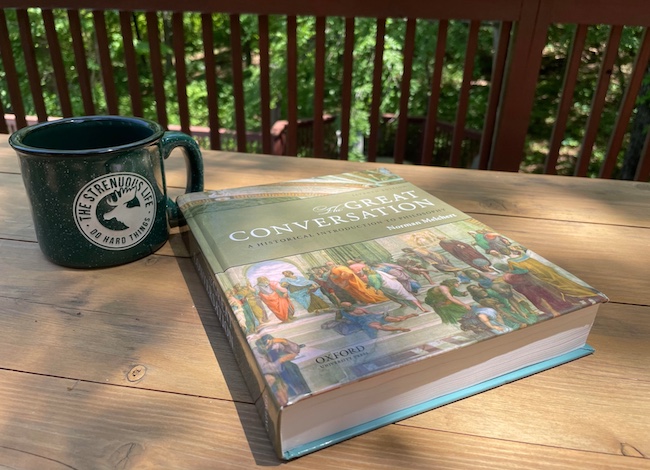
<p><span style="font-weight: 400;">The next time I saw him, he lent me his copy of a textbook called </span><a href="https://amzn.to/37E651W"><i><span style="font-weight: 400;">The Great Conversation: A Historical Introduction to Philosophy </span></i></a><span style="font-weight: 400;">by Norman Melchert.</span> <span style="font-weight: 400;">He bookmarked the section about Aristotle’s </span><i><span style="font-weight: 400;">Metaphysics</span></i><span style="font-weight: 400;">. </span></p>
<p><span style="font-weight: 400;">I read it and immediately saw the light. No joke. </span></p>
<p><span style="font-weight: 400;">The way Professor Melchert laid things out allowed me to finally get a better grasp of the relation between forms and substance. I was able to turn back to </span><i><span style="font-weight: 400;">Metaphysics </span></i><span style="font-weight: 400;">and read the text with greater understanding. Even those secondary source books I had originally turned to for guidance started to make more sense. </span></p>
<p><span style="font-weight: 400;">I gave my friend his book back and immediately bought a copy for myself.</span></p>
<p><span style="font-weight: 400;">It’s</span> <span style="font-weight: 400;">a textbook, so it’s expensive. I paid $80 on Amazon for a used edition. </span></p>
<p><span style="font-weight: 400;">But man, totally worth the investment. </span></p>
<p><i><span style="font-weight: 400;">The Great Conversation</span></i><span style="font-weight: 400;"> is the most approachable yet comprehensive book on philosophy I’ve come across. Melchert does a fantastic job summarizing the big ideas in history’s different schools of thinking, but does so without dumbing things down. He also covers pretty much everything, ranging from the pre-Socratics and going all the way up to the postmodernists. And he effectively shows how all of these schools of philosophy built on the previous ones. You’re able to get a birds-eye view of the great conversation of humanity.</span></p>
<p><span style="font-weight: 400;">I’ve found myself cracking open </span><i><span style="font-weight: 400;">The Great Conversation</span></i><span style="font-weight: 400;"> again and again over the past few years. For example, I’ve been on a Kierkegaard kick this past year. The Danish philosopher is notoriously difficult to understand sometimes. When I’ve gotten stuck on some parts in </span><a href="https://amzn.to/3PklEg8"><i><span style="font-weight: 400;">The Sickness Unto Death</span></i></a><span style="font-weight: 400;">, I go to the section on Kierkegaard in </span><i><span style="font-weight: 400;">The Great Conversation</span></i><span style="font-weight: 400;"> and get some much-needed clarification. </span></p>
<p><span style="font-weight: 400;">Several months ago, a book group I belong to was reading some Heidegger — another notoriously hard-to-understand philosopher. </span></p>
<p><span style="font-weight: 400;">“Being is always the Being of an entity.” </span></p>
<p><span style="font-weight: 400;">What in the heck does that mean?!</span></p>
<p><span style="font-weight: 400;">Well, in his chapter about Heidegger, Professor Melchert offers a rough idea that will get you going in the right direction, so you can better grapple with that statement. </span></p>
<p><span style="font-weight: 400;">Heck, when I’m bored, I’ll open the book and read a random section. I’ve even taken it to the bathroom to read during my daily constitutional. Pooping and philosophizing. I think Galen would approve.</span></p>
<p><span style="font-weight: 400;">Having a copy of this book is like having access to a really smart, friendly, non-condescending philosophy professor in your home.</span></p>
<p><span style="font-weight: 400;">If you enjoy philosophy or would like to know more about it, I can’t recommend </span><a href="https://amzn.to/37E651W"><i><span style="font-weight: 400;">The Great Conversation</span></i></a><span style="font-weight: 400;"> enough. One of the best book investments I’ve made. </span></p>
<hr/>
<p><em>With our archives 4,000 articles deep, we’ve decided to republish a classic piece each Sunday to help our newer readers discover some of the best, evergreen gems from the past. This article was originally published in March 2022.</em></p>
</div>
<p><br />
<br /><a href="https://www.artofmanliness.com/living/reading/the-great-conversation-philosophy-textbook/">Source link </a></p>
<p><!-- END THEIA POST SLIDER --></p>

The Philosophy Textbook Every Man Should Own