<p><!-- BEGIN THEIA POST SLIDER --></p>
<p> <br />
</p>
<div>
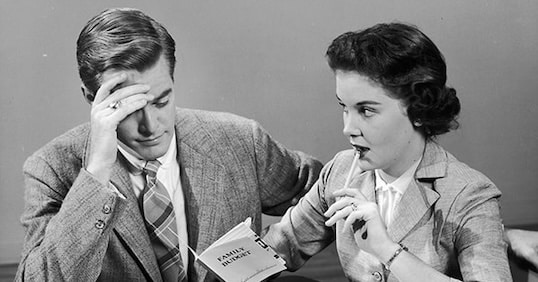
<p>Ask any marriage counselor what couples fight about most, and money will be at or near the top of the list. Research backs up clinical experience: disagreements over finances are one of the strongest predictors of marital conflict, chronic stress, and divorce.</p>
<p>Now take that already-volatile subject and add this to the mix: it pains one spouse to open their wallet, while the other spends with reckless abandon. One’s a tightwad; the other’s a spendthrift.</p>
<p>How do you handle a marriage where one of you hates spending money, while the other loves to splurge?</p>
<p>Scott Rick, a behavioral scientist, has spent his career studying this dynamic, and in his book <em><a href="https://amzn.to/3QnT2YL">Tightwads and Spendthrifts</a></em>, he shares research-backed advice on how to navigate this relational rift.</p>
<h3 id="h.envblzdmfjub">The Spendthrift-Tightwad Scale</h3>
<p>Rick’s developed something he calls the Spendthrift-Tightwad scale. It’s a spectrum, and where you land on it depends on how much spending money pains you.</p>
<p>Based on his studies, Rick estimates that about half of people reside in what he calls the “unconflicted middle.” Spending pains them enough to keep them from buying random stuff they see on Instagram, but not so much that their toes are poking through worn-out shoes. These folks don’t have much problem being too tight or too loose with the purse strings. If that describes both you and your spouse, count your blessings, stop reading, and go enjoy your reasonably priced lives.</p>
<p>But as to the other half of the population, about 25% land on the tightwad side of the scale, and 25% on the spendthrift side. Let’s take a look at what’s going on with these folks.</p>
<h3 id="h.1q425ahnk7q6">Tightwads: Spending Money Hurts</h3>
<p>For tightwads, shelling out money for an optional purchase hurts. Literally. In fMRI studies, when shoppers saw a price their brain judged as too high, their insula lit up — the same patch of cortex that fires when you stub your toe. Buying plane tickets and stepping on a Lego run on some of the same neural circuitry for tightwads, which is why they’re so tightfisted. Spending feels bad. They don’t want to feel bad. So they don’t spend.</p>
<p>Sometimes tightwads gussy up their tightwadness by saying they’re just frugal. But Rick’s research shows there’s a difference between frugality and tightwadness. Frugal people get a kick out of saving — a little glow of satisfaction when they make their resources stretch and find new uses for old paper towel tubes. Tightwads don’t enjoy saving money. They just hate spending.</p>
<p>“Well,” they’ll say, “I’ve just got a lot of self-control.” Rick actually classifies extreme tightwaddery as a <em>failure</em> of self-control: the tightwad can’t override an irrational feeling of distress in order to make a purchase that would objectively improve their life.</p>
<p>So what turns someone into a tightwad?</p>
<p>It’s not about how much money is in their bank account. Rick has found plenty of incredibly rich people who can’t bring themselves to spend because it pains them so much.</p>
<p>Some tightwads are born — they just have a natural disposition to find spending unpleasant. Thank your ancestors for that. But many are made. Rick finds the disposition is common among people who grew up poor or in financially unstable circumstances. Because of their upbringing, they got keyed in early to the dangers of spending. They eventually get to a better place financially, but their brains don’t get the memo. They keep living as if they were poor, convinced their stable finances could collapse next Tuesday. Rick calls this “post-broke-ness stress disorder.”</p>
<p>On paper, tightwads look great. High savings, no consumer debt, good credit. But Rick’s research finds they’re measurably less happy than people in the middle of the spectrum, because all that security gets purchased with deprivation. The tightwad skips the family vacation because airfare hurts too much, never goes out to eat or to the movies, and takes cold showers because it’s too expensive to get the boiler fixed. </p>
<h3 id="h.d1hi1ii07pgs">Spendthrifts: Spending Money Doesn’t Hurt</h3>
<p>Spendthrifts have the opposite problem: they don’t feel enough pain when they spend. Their psychological alarm over spending too much either goes off too quietly or too late. While the tightwad’s spending brake is stuck on, somebody cut the spendthrift’s brake lines entirely.</p>
<p>And the modern retail environment couldn’t be better designed to take advantage of someone without brakes. Spending used to take effort — you had to drive to the store, stand in a checkout line, and hand a cashier actual bills. Now Shopify keeps your card on file so buying a kayak takes about as much effort as liking a TikTok video, and if the kayak feels a little pricey, a Buy Now, Pay Later service will helpfully chop it into four installments so small you barely register them. Spendthrifts can do their damage from the couch, the carpool line, or even the toilet.</p>
<p>How do people become spendthrifts? Women are statistically a little more likely to be spendthrifts, but it’s a disposition that can be found in either sex. And like with tightwads, income isn’t the determining factor — plenty of broke people spend money they don’t have via credit cards and Buy Now, Pay Later services.</p>
<p>It seems some people are just wired this way; it’s a personality thing. But upbringing plays a role too. Rick finds spendthrifts often grew up in households where the parents spent freely and never set limits. Nobody ever told them “we can’t afford that,” so they never developed the sense that money runs out.</p>
<p>Being a spendthrift has its perks. Spendthrifts say yes to the last-minute lake trip, pick up the check at dinner, and buy the good seats instead of the nosebleeds. While the tightwad sits at home in their hole-ridden sweater, the spendthrift is out making memories. Yet Rick’s research finds they aren’t any happier. They carry a lot of credit card debt, save next to nothing for retirement, and feel plenty of pain about their spending — it just shows up after the purchase instead of before it. The spendthrift knows they have a problem and hates that they can’t get a handle on it. That makes them feel bad, so they buy something to cheer themselves up. Wash. Rinse. Repeat.</p>
<h3 id="h.76f2wdair3zq">Why Tightwads and Spendthrifts Usually End Up Together</h3>
<p>You’d think tightwads would marry tightwads and spendthrifts would marry spendthrifts. They don’t. Rick found that tightwads and spendthrifts are actually more likely to marry their opposites.</p>
<p>The reason is that neither type likes their own tendency.</p>
<p>Tightwads are wound tight by their inability to enjoy themselves, so when, say, a guy meets a lady who orders the appetizer <em>and</em> the dessert without a second thought, he finds it exciting. This gal knows how to live! The spendthrift, meanwhile, is stressed by her own spending chaos, so the tightwad’s stability is appealing. During courtship, each one is the other’s comforting counterbalance.</p>
<p>But then they get married, buy a house, and have to decide whether the Fast Pass at Disneyland is worth it. The traits that drew them together start to grate. His “stability” becomes controlling and joyless. Her “spontaneity” becomes reckless and irresponsible. And because every major life decision — housing, kids, retirement — runs through money, they end up having the same fight over and over.</p>
<p>But there is hope! Tightwads and spendthrifts can have a more harmonious marital money life if they do a few research-backed things. Here’s what Rick recommends.</p>
<h3 id="h.9xy5z6l1vezx">Set Up “Translucent” Finances</h3>
<p>Most financial advice for married couples recommends complete transparency. Both spouses should see exactly what the other spends. Anything less is “financial infidelity.”</p>
<p>Rick says that for a tightwad-spendthrift couple, this is terrible advice. The tightwad gets a line-by-line readout of every latte, every throw pillow, every scented candle his wife buys, and he’s going to have a discussion about it. She starts to feel like she’s living with an auditor. Pretty soon you’re having your fourth argument of the month over a $7 purchase, and the marriage feels less like a romance and more like the relationship you have with Bill in accounting going over your expenses.</p>
<p>Rick recommends something he calls, only half-jokingly, a “money-laundering device.” All income goes into a joint account. Everything that keeps the household afloat comes out of it: the mortgage, the utilities, the insurance, the kids’ braces, the food. Then every month, a fixed, equal chunk of fun money gets automatically dropped into each spouse’s own account, theirs to spend however they want. No questions asked, no receipts required. One spouse can blow their whole allowance on a new wardrobe; the other can let theirs pile up to be swum around in like Scrooge McDuck.</p>
<p>Rick calls this “translucency”: transparency where it matters, privacy where it doesn’t. The spendthrift gets to splurge without the fights; the tightwad has fewer accounting audits eating up their bandwidth.</p>
<h3 id="h.klsd9qammr2k">What About Big Financial Decisions?</h3>
<p>The allowance handles the day-to-day piddly stuff, but marriage still serves up big-ticket decisions you have to make together. New car or keep nursing the ’07 Honda Element along? Staycation or take the family to Yosemite?</p>
<p>Rick says the answer to these kinds of questions should be determined by what kind of purchase is being decided on.</p>
<p>With material stuff — a new car, a kitchen remodel — he recommends having the tightwad’s vote carry more weight. Happiness research shows that material upgrades don’t always deliver lasting satisfaction, thanks to a phenomenon called hedonic adaptation. The remodeled kitchen thrills you for about six months, and then the new granite countertops are just . . . the countertops. The tightwad’s reluctance, irrational as it can be, happens to point in the right direction here, so let his foot stay on the brake.</p>
<p>With experiences — vacations, concerts, and the like — let the spendthrift take the wheel. The joy of these doesn’t wear off the way material purchases do, because they turn into memories and stories the family draws on for decades. The spendthrift will book the trip the tightwad would’ve talked himself out of. Twenty years from now, nobody will remember what it cost. They’ll just remember the time Dad laughed like a little kid going down a snow-covered mountain on an inner tube.</p>
<p>If you’re the tightwad, here’s a trick for actually enjoying the trips your spouse springs for: pre-pay everything you can. Book the all-inclusive. When the whole thing is paid off in one lump sum before you leave, you take your hit once, instead of wincing through every menu and excursion price for a week.</p>
<h3 id="h.hp8odb2qoai4">Nudge Yourself Toward the Middle</h3>
<p>You can also work to move toward the middle of the scale.</p>
<p>If you’re a spendthrift, add friction back into your spending. Rick suggests deleting your saved card info from Amazon and other retail sites. Having to get up and find the physical card every time you want to buy something can squelch the impulse-buy itch. Creating a “short budget” helps too; instead of a monthly budget, create a weekly one. Having a cap on your spending in the short term can make economic trade-offs feel more concrete.</p>
<p>If you’re a tightwad, take friction out. Reframing expenditures as investments seems to blunt the pain of spending. A vacation becomes an investment in your family, a good mattress an investment in your health, an upgraded wardrobe an investment in your career.</p>
<h3 id="h.7v5qvd97hfej">Accepting Who You Are and Working With What You’ve Got</h3>
<p>It helps to remember that your wife isn’t splurging out of malice, and you aren’t pinching pennies out of selfishness. You’re just two people with differently wired brains bumping up against each other. Rick’s research suggests that while you can nudge yourself closer to the middle, you probably can’t turn your spouse into a different kind of spender, and you can’t fully rewire yourself either. So work with what you’ve got. Set up your accounts and your decision-making so your differences stop colliding every day.</p>
<p>And when her spending does drive you crazy, remember that her spontaneity, her free and easy way with money, was part of what attracted you to her in the first place; <a href="https://www.artofmanliness.com/social/dating/how-to-accept-your-partners-flaws/">it’s just one side of the same coin of character</a>, and the other side still delights you.</p>
</div>
<p><br />
<br /><a href="https://www.artofmanliness.com/finance/money/tightwads-and-spendthrifts/">Source link </a></p>
<p><!-- END THEIA POST SLIDER --></p>

The Tightwad-Spendthrift Marriage: How to Stop Fighting About Money