<p><!-- BEGIN THEIA POST SLIDER --></p>
<p> <br />
</p>
<div style="position:relative" data-narration-container="true">
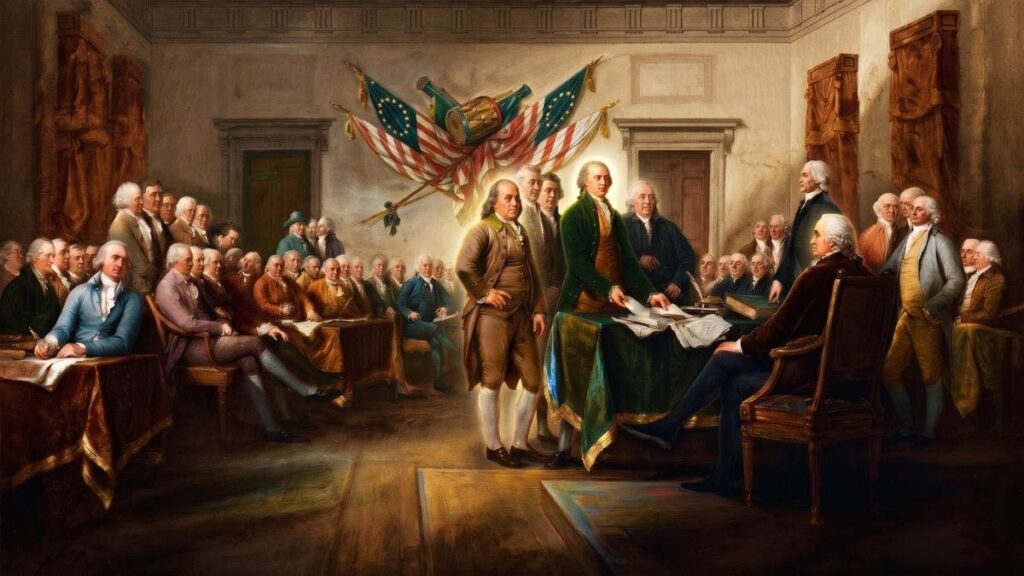
<p>When we talk about the Founding Fathers, we’re usually just talking about the Big Five: George Washington, John Adams, Thomas Jefferson, James Madison, and Alexander Hamilton.</p>
<p>Of course, these men deserve our veneration. But Jefferson, Madison, and Washington are synonymous with the Declaration of Independence, Constitution, and presidency, respectively. Adams and Hamilton both have award-winning Broadway musicals and popular 20th century biographies that keep them top of mind.</p>
<p>But what of the other Founders, the men who thought, fought, and wrote this country into existence? In honor of America’s 250th birthday, The Daily Wire asked lawmakers, writers, and historians to draft a new Founding Father starting lineup. The only rule: they couldn’t choose one of the Big Five. Here are their picks.</p>
<h3><strong>Mike Johnson, Speaker of the House of Representatives</strong></h3>
<p>Frederick Muhlenberg was elected to serve as the very first Speaker of the U.S. House of Representatives by the First Congress in 1789, and was the first signer of the Bill of Rights. An ordained Lutheran minister, Pennsylvania delegate to the Continental Congress, and former 3rd Speaker of the Pennsylvania House of Representatives, he was well prepared to accept the great privilege and challenge of leading and establishing a brand new institution.</p>
<p>Shepherding our great deliberative body through its formative days was no small task and required tremendous vision, skill, and patience. Muhlenberg was up to the task, and effectively crafted the rules, procedures, and protocols of Congress while actively serving in it. Because he and his colleagues had to travel treacherous or nonexistent roads on horseback, he was forced to delay the first meeting of Congress by a month until a quorum was reached. In August 1789, he cast the deciding vote for the location of the nation’s new capital.</p>
<p>While the speakership has changed considerably since Muhlenberg wielded the gavel, his efforts to construct a Congress capable of governing itself, debating openly, and exercising a check on the other branches of government were essential. As we celebrate America’s 250th, we do well to remember the wisdom and invaluable contributions of our founders and the unsung heroes who set our nation on its course to become the greatest in history.</p>
<h3>Ben Shapiro, editor emeritus, The Daily Wire</h3>
<p>Robert Morris was the greatest entrepreneur of the Founding generation. He bet his entire fortune — the largest in the country — on the riskiest startup the world has ever seen: the United States of America itself. Morris lived out the saying “freedom isn’t free”: you can proclaim your self-evident truths, but if you can’t pay your army, the British win.</p>
<p>Morris had every reason in the world to sit the Revolution out, hedge his bets, and stay rich. Instead, he became one of only two men to sign the Declaration of Independence, Articles of Confederation, and the Constitution. Morris risked it all because he understood the American experiment was worth more than his own fortune, or even his own life. That’s not a businessman’s calculation. That’s closer to love than anything else.</p>
<h4><a href="https://www.dailywire.com/episode/ben-shapiro-show-mini-doc-robert-morris?utm_campaign=founding&;utm_medium=email&;utm_source=iterable&;utm_content=email_blast_creative00098_na" target="_blank" rel="noopener">WATCH: BEN SHAPIRO ON ROBERT MORRIS</a></h4>
<h3>Dr. Ben Carson, president, American Cornerstone Institute</h3>
<p>George Mason doesn’t come off the bench; he’s a starter. Mason’s thinking about liberty and the best way to structure government had an outsized impact on the Founding. To take just one example, the Virginia Declaration of Rights might be the most important but least appreciated document from the time. Too few Americans have even heard of that document. If you have never read it, take a minute and do it now; you’ll see that it was basically the first draft of both the Declaration of Independence and the Bill of Rights. True, Mason did not support the Constitution, but his objections to the Constitution — based on concern about too powerful a federal government — seem prescient given how much power Washington has aggregated for itself. George Mason isn’t the B-team; he should be talked about in the same breath as the other giants of the Founding.</p>
<h3><b>Dr. Larry P. Arnn, president, Hillsdale College</b></h3>
<p>You could no more put together an alternative starting five for the American Founding than you could for the 1991 championship Chicago Bulls. But if asked what secondary founders deserve attention, Benjamin Rush and Robert Morris come to mind. Rush, a Philadelphia physician, was a leading opponent of slavery and a great advocate of education in addition to being an ardent revolutionary. Morris, a wealthy Philadelphia merchant, took on the impossible job of Superintendent of Finance during the Revolution and played a critical role in getting arms to American troops in the field. But these men themselves recognized the superiority of those on the starting team. Rush said of Washington, “There is not a king in Europe that would not look like a valet de chambre by his side.” Morris, when asked by Washington to serve as the country’s first treasury secretary, declined and recommended Hamilton.</p>
<h4><a href="https://www.dailywire.com/news/could-donald-trump-finally-dismantle-the-deep-state-ronald-pestritto-thinks-so" target="_blank" rel="noopener">READ MORE: HILLSDALE PROFESSOR EXPLAINS HOW DONALD TRUMP COULD KILL THE DEEP STATE</a></h4>
<h3><b>Daniel McCarthy, distinguished fellow in conservative thought at the Heritage Foundation</b></h3>
<p>No one can replace the greatest of our Founding Fathers, but if we lost all record of them tomorrow, we might try to approximate the effect of their ideas and sensibilities in combination by looking to James Otis and Samuel Adams in place of Jefferson; Robert Morris, who was Washington’s first choice for Treasury secretary, in place of Hamilton; Roger Sherman, a wise constitutionalist, in Madison’s or John Adams’s stead; and James Wilson instead of Benjamin Franklin to supply some Pennsylvania principle. No one can compare to Washington, but John Marshall might occupy the place of a great Virginian profoundly committed to the Union. These less appreciated figures would give us a strong sense of our founding, though they would also remind us of what we were missing without the most renowned names available.</p>
<h3><b>Richard Brookhiser, author, The Hero Returns: Lafayette and the Legacy of Revolution</b></h3>
<p>For all the brilliance of the founders, not many of them understood economics. Tench Coxe, a Philadelphia merchant, did. He assembled facts and figures for Alexander Hamilton’s “Report on Manufactures,” and might have filled his shoes had Hamilton not existed. He later became a supporter of Thomas Jefferson, so he was also adroit politically. Nathanael Greene was also widely acknowledged for his military brilliance, losing every battle he fought against Cornwallis in the Carolinas yet driving him to Virginia and ultimate defeat at Yorktown. Georgia awarded Greene a plantation for his services, where he died of heat stroke after the war. Had he lived he might have made an excellent Secretary of War.</p>
<h3><b>Troy Senik, author, A Man Of Iron: The Turbulent Life And Improbable Presidency of Grover Cleveland</b></h3>
<p>Because he didn’t sign the Declaration of Independence, John Dickinson is always portrayed as a coward, the jittery man blind to the glory of the moment. The irony is that he walked into the Second Continental Congress arguably the most prominent advocate for colonial rights in America.</p>
<p>Dickinson did not oppose independence. He opposed declaring it before the preconditions for sustaining it were in place. No foreign alliance had been secured. The Articles of Confederation were nowhere near complete. The military situation was uncertain at best. His argument was methodical, not ideological: do these things first, then declare.</p>
<p>What happened next proved him right about virtually everything save the final outcome. The country barely survived the early days of the war, and only through a sequence of events so improbable that it would have been folly to plan for them. Had things gone south, Dickinson would have been remembered as Cassandra. Instead, he became a footnote in a story he helped write.</p>
<p>John Dickinson knew he was destroying his reputation by resisting the rush to declare independence. But he did so anyway because he believed the country’s long-term survival mattered more than the passions of the moment. It’s a sober patriotism to ask the questions nobody wants to hear rather than to give the hosannahs that everyone expects. Dickinson asked those questions, was overruled, and was later proven right. What had he done in the interim? Put on a uniform and fought for the cause anyway.</p>
<p>We could use more cowards like that.</p>
<h3><b>Brian Anderson, editor-in-chief, City Journal</b></h3>
<p>That’s easy: If Washington, Jefferson, Madison, Adams, and Hamilton were unavailable, my first draft pick would be James Wilson. One of the Constitution’s principal architects but now less well-known than the Big Five, Wilson argued that America’s liberties rest on more than individual rights; they also grow out of a moral order discoverable through reason and grounded in natural law.</p>
<p>Big themes: Rights and duties are inseparable, liberty means self-government rather than license, and political authority flows directly from the people because all persons are naturally equal before that higher law. Wilson offers a distinctly American synthesis of natural rights, civic responsibility, and constitutional self-government that in my view deserves renewed attention.</p>
<h3>Ryan Williams, president, the Claremont Institute</h3>
<p>John Quincy Adams was only 11 years old when the Declaration of Independence was signed, but he would go on to a long career as senator, Secretary of State, Minister to Great Britain, Prussia, and Russia, and finally, president. After Washington’s peerless inaugural example, JQA remains, to this day, <em>the</em> greatest foreign policy strategist and diplomat of American history. For a continued restoration of a truly America First foreign policy, all roads lead through JQA.</p>
<h4><a href="https://www.dailywire.com/news/the-editor-of-the-most-popular-edition-of-the-federalist-thinks-its-more-important-than-ever" target="_blank" rel="noopener">READ MORE: THE CLAREMONT INSTITUTE’S CHARLES KESLER ON WHY THE FEDERALIST PAPERS MATTER</a></h4>
<h3><b>Daniel Gullotta, assistant professor at the Ohio State University’s Salmon P. Chase Center for Civics, Culture, and Society</b></h3>
<p>While I’m sad most people don’t know who Gouverneur Morris is, it’s a lot of fun telling people who he was. Just mentioning he had a peg leg usually gets people’s attention. But his role in the Constitution, crafting the opening “We the People,” is something people should know just as commonly as they know Jefferson was the drafter of the Declaration. He was also arguably the most anti-slavery Founding Father (just read some of his speeches during the compromise debates). He also refused to leave France during the Reign of Terror while serving as our minister, despite the danger. Then there’s the crazy way he died, trying to clear a urinary blockage with a piece of whalebone from his wife’s corset. I know everyone says this person or that person needs a movie or miniseries, but come on, there’s just no part of his life that isn’t compelling.</p>
<h3><b>Mark Helprin, author, “Elegy In Blue”</b></h3>
<p>We’re sorely in need of Benjamin Franklin, maybe a few dozen of him, to correct the abysmal ignorance and inexperience of today’s “Yutes,” who know virtually nothing and yet are powered by the energy of the young and destined to run the zoo. And it is a zoo. Franklin made use of his long experience and inherent brilliance to take under his wing Adams, Jefferson, and a lot of others, guiding them with practical and long-lasting results. Maybe I say this about the younger generations because I’m in my 80th year and am falling prey to chasing them off the lawn. But, really, they can hardly speak English, the girls’ speech sounds like frying eggs, and they know so little that they buzz around communism and fascism like moths around a flame. You know what happens with moths and flames.</p>
<h4><a href="https://www.dailywire.com/news/he-turned-the-royals-into-a-joke-his-take-on-america-is-anything-but?trueLinkId=75JIYEMEAhD1KHqlEouqVfPC%2Fc5LDaS1niXzcEeobct2bv%2FJcUHC%2BLs8PvnWg1HDBGj%2FUEf2tfG%2B%2BQqbHoPtag%3D%3D&;trueLinkTs=1782577908&;trueLinkExpiry=43200" target="_blank" rel="noopener">READ MORE: A CONVERSATION WITH MARK HELPRIN, AMERICA’S GREATEST LIVING WRITER.</a></h4>
<h3><b>Brenda Hafera, Assistant Director and Research Fellow, B. Kenneth Simon Center for American Studies</b></h3>
<p>Mercy Otis Warren was an exceptional woman who contributed to the founding of an exceptional nation. A staunch republican, she depicted the happenings in her native Boston through plays and poems intended to drum up support for the patriot cause. The list of her correspondence was a “Who’s Who” of the Founding generation, including John and Abigail Adams, George Washington, and Thomas Jefferson, enabling her to write the only Anti-Federalist account of the War of Independence. That opus, along with her thoughtful and uncompromising defense of the importance of morals and manners, justly earned her the designation, “The Conscience of the American Revolution.”</p>
<h3><b>Anastasia Boden, Director of Constitutional Scholarship at Pacific Legal Foundation and the host of the In Dissent podcast</b></h3>
<p>James Wilson has largely been forgotten. He deserves better. Wilson’s argument that the people, not the government, are sovereign justified not only rejecting Parliament’s taxes but breaking with Britain altogether. A Scottish immigrant steeped in the Scottish Enlightenment, Wilson helped popularize the radical idea that the people — not kings or Parliament — are the ultimate source of political authority and are fully capable of governing themselves. Wilson also played a leading role in shaping <a href="https://podcasts.apple.com/us/podcast/we-can-sue-the-government-right/id1896779544?i=1000772988868" target="_blank" rel="noopener">Article II of the Constitution</a>, strengthening the presidency with the counterintuitive goal of protecting liberty. In an era of debates over democracy, federal power, and constitutional government, few Founders have more to teach us.</p>
<h3><b>James Patterson, author, “Why Postliberalism Failed”</b></h3>
<p>The Founders we admire today were stark personalities and prolific writers, men who overshadowed impressive figures we tend to forget. One is John Witherspoon, the only member of clergy to sign the Declaration of Independence and teacher to James Madison, who gave both a religious and intellectual heft to the Revolutionary cause. As a Catholic, I have to recommend Charles Carroll of Carrollton, the only Catholic to sign the Declaration of Independence, a major financier of the Revolution, and a fierce advocate for republican politics and religious liberty. And then there’s Roger Sherman, who was something of an unsung workhorse from the start of the Revolution through the early Republic years. He opposed slavery, and he was the chief author of the Connecticut Compromise that gave us the bicameral Congress we have today.</p>
</div>
<p><br />
<br /><a href="https://www.dailywire.com/news/14-lawmakers-writers-and-historians-pick-their-favorite-forgotten-founding-fathers">Source link </a></p>
<p><!-- END THEIA POST SLIDER --></p>

14 Lawmakers, Writers, And Historians Pick Their Favorite Forgotten Founding Fathers