


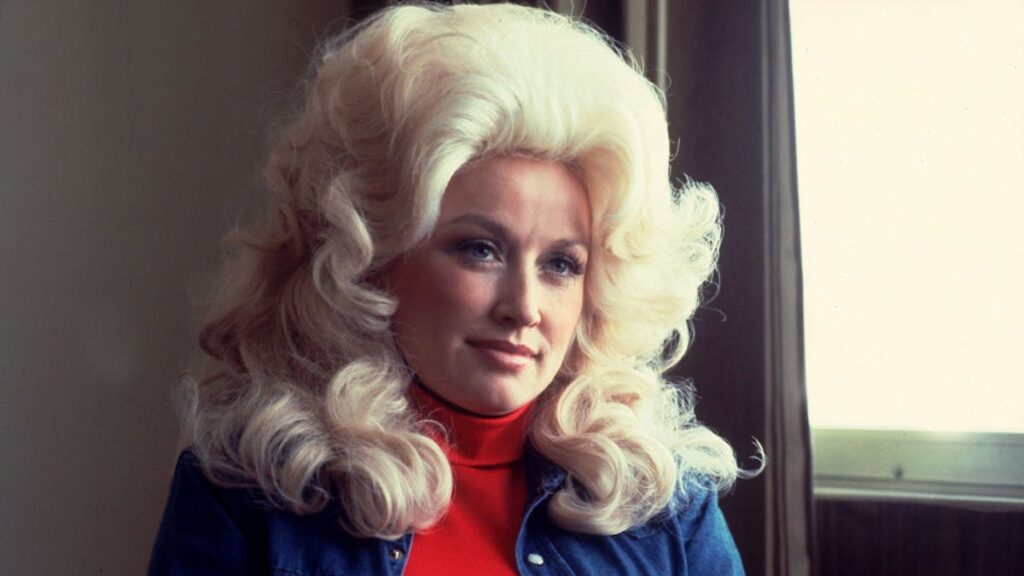
Throughout her career, Dolly Parton famously took pains to avoid becoming anyone’s political mascot.
In 2018, after ABC’s David Wright tried to get her to compare Donald Trump to the lecherous boss in “9 to 5,” she refused with classic Southern sass. “I don’t do politics,” she said. “I’m not getting into any of that because I have a lot of fans out there, and I don’t want to offend anybody. … You can ask, but I might still tell you where to stick it.”
When she faced backlash for including a duet with the openly MAGA Kid Rock on her 2023 album “Rockstar,” Parton declined to distance herself, telling The Hollywood Reporter, “Hey, just because I love you don’t mean I don’t love Kid Rock.” She further called cancel culture unequivocally “terrible.”
At times, she even risked an awkward public moment rather than allow anyone to infer her political leanings.
At the 2017 Emmy Awards, her co-presenters Lily Tomlin and Jane Fonda earned predictable cheers from the celebrities in the audience by calling Trump a “sexist, egotistical, lying, hypocritical bigot.” Dolly didn’t just refuse to participate; she made it clear to everyone watching that she was refusing. After the red meat had been tossed and Tomlin was about to announce the nominees, Dolly somewhat clumsily interrupted the flow of the program to quip that her former co-stars must have still been talking about the villain of their 1980 film. Then she made a slightly off-color joke about what might be in her gift bag. Better that than allow the world to assume she was in agreement with the two leftist actresses.
She declined the Presidential Medal of Freedom three times — twice under Trump because of her husband’s illness and the pandemic. The third time she said no, it was to Biden because, having declined Trump, she did not want any incorrect assumptions about her views if she accepted from a Democrat.
In fact, Dolly was a master at rejecting the media’s ploy of pressuring a celebrity to make a political statement so they could celebrate the star’s agreement with the Left or threaten their career if they failed to offer it. When the New York Times asked about Hillary Clinton during the 2016 presidential election, Dolly mildly opined that Clinton was qualified and said she would “be behind her” if she won. Legacy outlets across the country immediately proclaimed Dolly’s endorsement. They were left with egg on their faces the next day, however, when Dolly clarified that no, she was not endorsing anyone. She didn’t know who she was voting for, and the Times had taken her comment “out of context.”
Dolly’s reasons for remaining nonpartisan may have been good horse sense from a business standpoint (she often said she wanted Republican fans as much as Democrats), but it was also clearly a principled stand from a scrappy Southerner who wished there were less rancor and division in our world and did not want to contribute to it.
Although President Trump is not always known for respecting what should be a non-partisan occasion, he honored Dolly’s wishes. Before ordering U.S. flags to fly at half-staff for a week in her honor, he simply acknowledged the truth that there has “never been anyone like her, and never will.” Nor has any other high-profile Republican tried to claim the Queen of Country as a closet conservative either.
If only that were the case for the Democrats.
Despite Dolly’s consistent stance that she “hate[d] politics” and did not want to be seen as political, major figures on the Left could not wait even 24 hours after her death before claiming her as a member of their tribe and dishonoring her chosen legacy. And in doing so, they are distorting and outright lying about Dolly’s record.
Not a racial agitator
Nowhere has the selective quoting been more shameless than around Dolly’s comments on black lives, which every legacy outlet from NPR to the BBC insists signaled political allegiance. But a closer look at the context of the famous quote proves she intended nothing of the kind.
In August 2020, at the height of the George Floyd protests, Billboard pressed her on the topic for a cover story. What she gave them was a general statement of common decency. “I do understand people having to make themselves known, and felt, and seen,” she said. “And of course black lives matter. Do we think our little white asses are the only ones that matter? No.” But then Dolly finished with a remark that might have gotten her canceled were she less beloved: “Everybody matters.”
The fact that this last sentence was conveniently dropped from their headlines and pull quotes is not a small detail. It is exactly the sentiment that, when expressed by less lofty people than Dolly Parton, earned the extreme ire of BLM activists and their media allies. They considered the expression “all lives matter” a rebuke of identity politics, a signal of refusal to join their cause, a sign you were a member of the oppressor class, even if you claimed to care about individual black lives.
Saving Country Music dug into the story at the time and found that Billboard itself had edited “everybody matters” out of the comment, leaving the impression that Dolly had signed onto the platform of a controversial, Marxist political movement when she’d done nothing of the kind. When Billboard (which never fails to try to force musicians to make political pledges) asked her a second time in less than six months what she thought of the Black Lives Matter movement, her response was even more general. “I love everybody,” she said. “And, of course, black lives matter. We all matter. We’re all God’s children.”
Hardly a raised black power fist.
As Saving Country Music noted, “Dolly Parton’s supposed statement of vehement support for an expressly political movement was in truth a rather pedestrian comment made in passing, literally 25 paragraphs into a much more wide-encompassing 33-paragraph Billboard cover story.”
The same selective framing shows up around her 2018 decision to rename Dixie Stampede, her long-running dinner theater attraction. The fiction now being told is that Dolly took a brave political stand against Confederate iconography. But that is not how she described it. When Billboard asked directly why she made the change, she was blunt: it wasn’t some deeply held political conviction, but business concerns that drove it. “When they said ‘Dixie’ was an offensive word, I thought, ‘Well, I don’t want to offend anybody. This is a business. We’ll just call it ‘The Stampede.’”
Much like Michael Jordan’s famous “Republicans buy sneakers, too” line, Dolly was making it clear that as a kind person, she did not want to unnecessarily hurt feelings, nor did she want to lose potential customers. A businesswoman so sharp she once faced down Elvis Presley and Colonel Tom Parker and won, she herself said the name change was simply about good business.
Not a feminist
Before Dolly had been gone 24 hours, the National Organization for Women declared that “Dolly Parton defined feminism.” A strange statement, given that Dolly herself rejected the label not just once but consistently and stridently over more than 50 years.
The first time was to Rolling Stone in 1980. But it was a question she faced regularly and one she always answered the same way. Even in 2019 at the height of the MeToo movement, the host of the hit podcast “Dolly Parton’s America” admitted that when he asked the icon directly if she considered herself a feminist, she “shot that right down.”
“No, I do not. I love men,” she replied with hilarious frankness. She elaborated that the way she conducted her life and her career spoke for itself. “I don’t think of it as being feminist,” she said. “It’s not a label I have to put on myself.”
When The Hollywood Reporter asked her only three years ago why women remain underrepresented on the business side of the music industry, she was clear her position had not changed. Though obviously a question designed to elicit a grievance statement, she refused to offer up pablum about structural barriers or discrimination and instead provided a commonsense lesson on initiative. “A lot of that’s the girls’ fault,” she said. “Sometimes they don’t push it. They don’t push themselves. They don’t just step right up and say, ‘Well, hey, now,’ especially if it’s an artist that’s got the power to say, ‘I’m going to be involved in this’… But I think sometimes you have to kind of step up and make them believe that you can do it.”
While NOW’s abject refusal to respect how Dolly referred to herself is offensive, it pales in comparison to the insult outlets like the New York Post and the Washington Post have offered by framing her inability to have children as a deliberate rejection of motherhood in favor of career.
The beloved singer’s death had barely been announced when the Washington Post trotted out a column titled “Why it matters that Dolly Parton wasn’t a mother,” and BBC World helped push the false narrative further by sharing it with its own massive following. Though the author briefly mentions that Dolly “tried unsuccessfully to get pregnant,” the rest of the piece insists that she was an example of “voluntary childlessness” and “proof that a person could be an advocate and friend for children while personally choosing against parenting.”
What the Post attempts to avoid is that Dolly could not have children. In 1984, she was diagnosed with severe endometriosis and underwent a partial hysterectomy that made pregnancy impossible. She discussed the loss with the “Today” Show as far back as 1987, saying, “I can’t have children physically. I love children.” But it was clear even then that she was determined to find the blessing in her grief. “I don’t know that it also wasn’t God’s will, you know, for me not to have kids,” she said. “I mean, I try to look at things in a way that I can put them in a proper place because somebody has to be out there doing something to entertain other people’s children.”
When she spoke about it again in 2018, she seemed more willing to reveal the pain behind the girlish laugh, saying that the hysterectomy that rendered her infertile sent her into a deep depression. “It was a really bad time,” she said. “Sometimes God just has to smack you down. He was almost saying, ‘Sit your pretty little ass down because we have to deal with some stuff!’”
The following year, on another episode of “Dolly Parton’s America,” she admitted that around that period in the 1980s she considered suicide, saying, “I got overweight, and I was going through the change of life, I was having a lot of female problems.” She later added it caused her to wrestle with her faith. “I was having some serious conversations with God during that time,” she said. “Everything was just confusing to me, and I was just angry, and I was hurt, and I was unhappy, and so I just said, ‘You’re going to have to get me some answers, or I’m getting out of here. And then we’ll both deal with it.’”
While the Post frames Dolly as a “hero in child-free circles” for “publicly recognizing the choice to not parent as a valid and rewarding one,” in 2023 Dolly told Saga Magazine, “If I’d had kids, I’d have stayed home with them, I’m sure, and worried myself to death about them.” Far from discussing motherhood as a lesser calling she was glad to skip, she said the opposite, making it clear to an honest person that providence prevented her from having children, not choice. “I always say God didn’t let me have children so that all kids could be mine,” she said.
The fact that Dolly searched for the silver linings of childlessness with grace does not excuse cynically and falsely co-opting her story for feminist messaging when it was clear in life she wanted no part of that agenda. That she instead became a mother to millions of children through Imagination Library is a beautiful outcome. But Dolly never framed it as “empowerment.” She framed it as making the best of a sad situation.
Not a socialist
Of every claim being pasted onto Dolly’s biography now that she’s not here to refute it, this is the one she most directly and repeatedly denied in her own words. The Democratic Socialists of America, the Communist Party USA, and U.S. Senate candidate Abdul El-Sayed have all rushed to frame her as a fellow friend of Karl Marx, an entertainer whose biggest hit (“9 to 5”) was secretly a call to seize the means of production from the bourgeoisie rather than, in Dolly’s own description, a fun song about a bad boss.
Here is what Dolly actually said in 1980 when asked if the film was meant to send a “message”:
Not really. It’s about women, but there’s women and men in the office. I’m the executive secretary to the boss, and he’s a real turd. … So actually, a lot of people thought it was just going to be women’s lib; I wouldn’t have been involved if I’d thought it was gonna be a sermon of some sort. Not that I’m not for rights for everybody, I’m just sayin’ I didn’t want to get involved in a political thing. It’s just a funny, funny show. I think it’s very obvious what it’s sayin’. It’s mostly about this boss and these three women—not bosses in general or the plight of secretaries.
That is about as direct a refutation as a songwriter or actress can give. She wrote a song about one specific tyrant of a boss and three specific women who outsmarted him. She did not write a treatise on capital and labor.
That didn’t stop menswear-blogger-turned-political-influencer Derek Guy from defending attempts to claim “9 to 5” as a “communist anthem.”
He zeroed in on the song’s closing couplet — “It’s a rich man’s game no matter what they call it, and you spend your life puttin’ money in his wallet” — to argue the line “suggests that the business owner is appropriating some level of value that the worker has created. That could be interpreted as Marx’s labor theory of value.”
While Guy admitted that Parton wasn’t a Marxist or communist personally, his verbose literary analysis of lines like, “barely gettin’ by, it’s all takin’ and no givin’” (which, he said, address “uneven power between labor and capital”) still doesn’t survive contact with the woman who wrote the song and who told us exactly what those lines meant and what they didn’t.
Reading Marx’s theory of surplus value into two lines of a lousy boss jeremiad is the kind of interpretive reach that could be performed on virtually any pop song ever written about a paycheck not stretching far enough. “Take This Job and Shove It” and half of Merle Haggard’s catalog would qualify as socialist under the same test. A menswear critic finding Marxist class theory embedded in a rhinestone country song is not just projection; it’s dishonoring to the woman who insisted again and again that she intended no such propaganda with either her song or her participation in the film. Which leads one to ask if the Left is only willing to “believe women” when it comes to sexual allegations.
Dolly Parton was a woman who tapped her long acrylic fingernails together on a movie set to find a rhythm that became the basis of one of the best-selling songs in history. She then used the proceeds to build a business empire estimated at around $650 million that supports roughly 23,000 jobs in her impoverished home region of Appalachia. She didn’t lift up herself or her community through collective ownership or a workers’ revolution, but by making the most of every opportunity the free market offered her. She got there by refusing to hand Elvis Presley’s manager half the publishing rights to “I Will Always Love You” when he demanded them as the price of securing a recording from the King of Rock and Roll. Instead, she walked and kept her royalties. That decision alone, made by a woman who grew up in a one-room shack with 11 siblings, tells you more about what Dolly believed about ownership than any lyric ever will.
A woman who fought that hard to keep what was hers, who, though charitable, still died with hundreds of millions of dollars in the bank, is not secretly cheering for a system built on the abolition of private property. Her success is the single best rebuttal the CPUSA, the DSA, and Menswear Guy could have accidentally chosen for themselves.
Not even an LGBTQ activist
Dolly loved her LGBTQ fans, and without question, they loved her back. That is not in dispute and never has been. What is being manufactured in the days since her death, however, is the idea that this affection amounted to political lobbying on her part.
The media has made great hay out of her alleged 2016 opposition to North Carolina’s so-called bathroom bill, but a closer look at the incident actually underlines Dolly’s continued refusal to be drafted into a political campaign.
Pressed to comment on legislation to bar men from women’s public restrooms and vice versa, she offered the minimum sentiment required to be left unharassed, capped with her typical one-liner. “I think everybody should be treated with respect. I don’t judge people, and I try not to get too caught up in the controversy of things. I hope that everybody gets a chance to be who and what they are,” she said, just before puncturing any inferred political weight by adding, “I just know if I have to pee, I’m going to pee. I don’t care where it’s going to be.”
She did not join Bruce Springsteen, PayPal, and the NBA in announcing a boycott of the state, nor did she criticize its political leadership. She tossed the media their pinch of incense and moved on, precisely the way she handled every other attempt to drag her into a political fight.
In 2023, when her home state of Tennessee passed a law that banned drag performances in public and in front of children, Dolly did not offer a known word against it. In fact, she made comments that, once again, might have come in for a cancel cycle if uttered by any lesser celeb.
“Well, what I always say, ‘I just want everybody to be treated good. I try not to get into the politics of everything,’” she said when the Hollywood Reporter pressured her to make a statement on the bill. “I try to get into the human element of it. I have some of everybody in my own immediate family and in my circle of employees. I’ve got transgender people. I’ve got gays. I’ve got lesbians. I’ve got drunks. I’ve got drug addicts — all within my own family. I know and love them all, and I do not judge.”
Many a conservative commentator has been roasted for daring to compare gays and lesbians to drunks and drug addicts.
It is also worth noting what Dolly did not do.
Over the course of her life, she gave away tens of millions of dollars to disaster relief, literacy programs, medical research, and other charities as nonpartisan as they come. Yet there is no record of her writing a single check to an explicitly LGBTQ organization.
This is not to say that Dolly Parton did not morally affirm homosexual and transgender behaviors and identities. From her decision to write a generic “be authentic” ballad for the film “Transamerica” to her willingness to accept an award from GLAAD and lend her voice to a Human Rights Campaign album, it seems clear that she did. But she had every opportunity to embrace the LGBTQ movement as a movement in the final stretch of her career. She didn’t.
Not your mascot: why Dolly matters
Why fact-check any of this? Why write one of the longest articles of my career about the views of a now-deceased country singer?
Because the alternative is letting the Left’s version of Dolly stand unopposed, and the version they’re building not only erases the real woman; it erases the reality that a person can be adored by the entire country not in spite of staying out of the political fray but because of it.
That is the real target. President Trump is right that we are unlikely to see another celebrity as adored as Dolly, not because the culture stopped producing talented, lovable people, but because Hollywood no longer tolerates stars who won’t signal overt leftism.
Democrats wouldn’t even spare Dolly’s beloved children’s charity from their culture war in the immediate wake of her death. Before her body was even cold, headlines from Raw Story to the New Republic blared some variation of “Republicans cut funding for Dolly Parton’s child reading program,” pointing to Indiana and Missouri slashing their state matches for the Imagination Library.
What those same articles buried, and what the viral tweets sharing them left out entirely, is that Indiana and Missouri are only half the story. Maine let its funding match lapse too under a Democratic governor and a Democratic-controlled legislature that has run the state for seven years. Washington’s Democratic-controlled legislature and Democratic governor Bob Ferguson zeroed out the program’s state match in 2025 and declined to restore it in 2026, even as the state’s overall budget grew by billions.
It’s funny that none of the outrage about the supposed Republican defunding of the Imagination Library was brought up before Dolly’s death, when she herself might have pointed out it was a bipartisan issue.
Plenty of aspects of Dolly’s personal life and commentary coded right-wing as well. She spoke warmly of the success America allowed her and on multiple occasions shared her enthusiasm for exercising her right to bear arms, saying, “I do feel safer when I have a gun… I feel that if a woman is out by herself, she should have a way to protect herself.” Nor was exercising the Second Amendment hypothetical for her. She once told late-night host Conan O’Brien about an occasion in New York City when she was compelled to draw it.
I have seen no conservative outlet or Republican leaders trying to turn these statements into proof that she was one of theirs. No one is building op-eds around these stories to claim Dolly was quietly MAGA. Because to do so would not be merely dishonest, but grossly disrespectful of her and how she defined herself and her work.
Yet that is exactly what the Democrats are doing.
The deadliest feature of leftism is its totalizing ambition. Nothing is allowed to be non-political in their quest for power, and that includes Dolly Parton, despite how often she insisted on being taken on non-political terms. It is the nature of socialism and leftism more broadly to claim every institution, every artist, every beloved public figure for itself, because a culture is not fully theirs until nothing is permitted to stand outside it. That is why they wanted control of the classroom, the newsroom, the writers’ room. And it is why, now that she can no longer correct them, they want Dolly’s legacy too.
We need artists willing to be unifying, non-political figures precisely because so few of them are left. And the only way to keep that possible is to protect the reputations and legacies of those willing to take slings, arrows, and constant media hectoring to give us entertainment we can all enjoy. We must insist, loudly, that Dolly Parton was exactly what she said she was — an entertainer who loved everyone and refused to be relegated to a political box.
If conservatives ever hope to live in an America that is not hopelessly politicized again, they cannot let this rewriting of her history (and, by extension, American musical history) stand.
***
Megan Basham is a reporter for The Daily Wire and a frequent contributor to Morning Wire. In her previous role as an entertainment editor and podcast co-host for World Magazine, she interviewed numerous A-list celebrities. She has also written for The Wall Street Journal, National Review, and Townhall. Her book, “Beside Every Successful Man,” was published by Random House.