<p><!-- BEGIN THEIA POST SLIDER --></p>
<p> <br />
</p>
<div>
<p>The spirit of St. John Bosco pervades a school dedicated to ‘whole person’ Catholic formation.</p>
</p></div>
<div>
<p>A small Catholic high school in northeastern Pennsylvania is transforming young lives through its embrace of St. John Bosco’s “whole person” approach to education.</p>
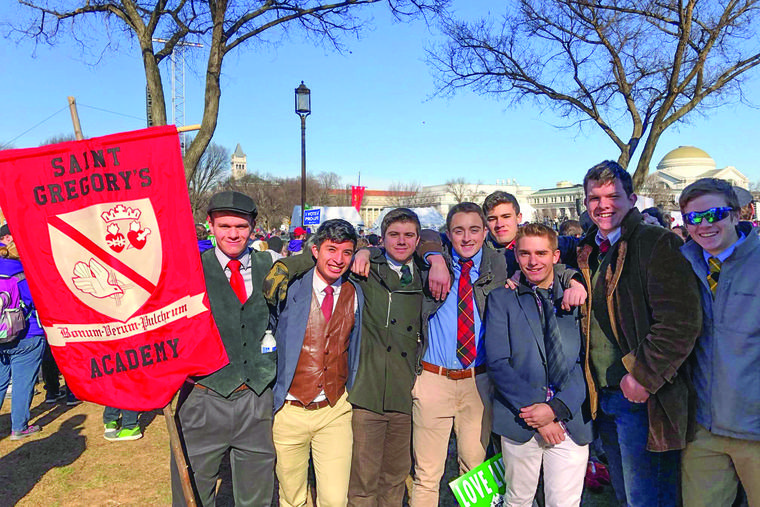
<p>With a total enrollment of 60 students, <a href="https://gregorythegreatacademy.org/">St. Gregory the Great Academy</a> in Elmhurst Township, Pennsylvania, has a short list of alumni, but its impact on the lives of its graduates is profound.</p>
<p>The all-boys St. Gregory Academy was “re-founded” in 2012 after the original institution was forced to close for financial reasons. But today the privately funded academy offers a strongly Catholic education to students ages 14 to 18 from about 25 different U.S. states.</p>
<p>It is a full boarding school, where students live in dormitories in a rural setting. In addition to a classical educational curriculum, students each morning tend to farm chores such as cultivation and tending to animals. They also dedicate at least one day per week to hands-on skills such as carpentry, leatherworking and food preparation.</p>
<p>The academy property sits on 200 acres, with a large, century-old 70,000-square-foot building that was once used as a Byzantine orphanage. In addition to the dormitories, the site features two houses, a defunct water tower and a Gothic barn.</p>
<p>The school’s assistant headmaster, Sean Fitzpatrick, has been involved with the school and its predecessor for nearly 25 years. “I always had my eye on St. Gregory’s as a place where I had found happiness and real belonging,” Fitzpatrick, a graduate of Thomas Aquinas College in Santa Paula, California, told the Register.</p>
<p>Fitzpatrick highlighted four principles central to the St. Gregory Academy’s mission:</p>
<ul>
<li>Children are happier without smartphones and video games;</li>
<li>Teaching, as Salesian founder St. John Bosco emphasized, is a form of friendship;</li>
<li>Education should form the whole person — body and soul, nature and supernature, healthiness and holiness — shaping a man “in full” in the direction of a saint; and</li>
<li>Education is best achieved when it’s exciting, enchanting, captivating and enlivened by the muses.</li>
</ul>
<p>St. John Bosco’s influence in the life of the school is pervasive. Teachers and “dorm fathers” at St. Gregory look to the greater good of their students with St. Bosco’s “Preventive System,” which holds that love, guidance and prevention are more effective in promoting discipline than the fear of punishment.</p>
<p>St. Gregory Academy extols “technological poverty” to help students avoid distraction from social-media influences and focus on “primary things.” Students attending the academy must forego cellphones, laptops and even televisions for the duration of the academic year.</p>
<p>The school’s emphasis on the muses — advocating faith-inspired literature, poetry, art, music and sculpture to cultivate a “Catholic imagination” — is an especially appealing notion to literary-minded Catholic educators.</p>
<p>As the academy’s calendar suggests, “great poets and artists have the gift of seeing things with fresh eyes, of experiencing them as they really are. We believe that everyone has this ability, but it tends to become crusted over, especially in our artificial, technological world.” To this end, the school makes more use of what might be termed “primary sources” in studying literature and poetry, and it encourages students to become creators, rather than consumers.</p>
<p>Fitzpatrick says the academy provides a nurturing, faith-supporting environment that fosters growth and maturity.</p>
<p>“What we offer is geared as a next step in maturation, and that wing-spreading … and to look to friends and mentors for formation in rites of passage that are often missing in our insulated society.”</p>
<p><i>Michael Mastromatteo is a writer, educator and book reviewer from Toronto.</i></p>
</p></div>
<p><br />
<br /><a href="https://www.ncregister.com/blog/4-things-a-catholic-educator-wants-you-to-know">Source link </a></p>
<p><!-- END THEIA POST SLIDER --></p>

4 Things a Catholic Educator Wants You to Know| National Catholic Register