<p><!-- BEGIN THEIA POST SLIDER --></p>
<p> <br />
</p>
<div>
<p><i>Editor’s note: This article was originally delivered as the keynote address at a Feb. 20-21 conference held at Christendom College on the theme </i><a href="https://www.christendom.edu/2026/02/27/christendom-welcomes-leading-historians-for-eternity-in-time-conference/"><i>“Eternity in Time: Thinking With the Church Through History.”</i></a><i> It has been edited for length and clarity.</i></p>
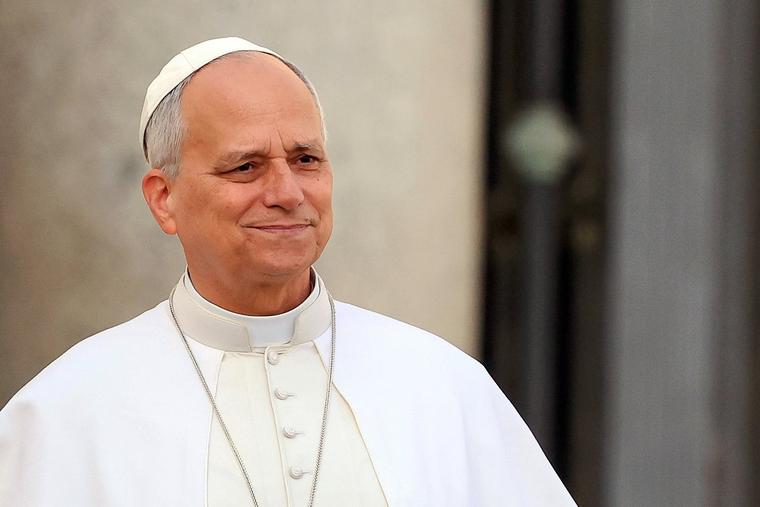
<p>What did Pope Leo XIV mean when, in the early days of his pontificate, he called on us to be “made restless by history,” and what does it reveal about his broader vision as leader of the universal Church? </p>
<p>On May 8, 2025, the world was shocked by the election of the first U.S.-born pope. In addition to being an American, Leo is an Augustinian, a member of a community that follows St. Augustine of Hippo’s rule of life and looks to him for inspiration. At his first appearance on the balcony overlooking St. Peter’s Square, Pope Leo proclaimed: </p>
<blockquote><p>‘I am an Augustinian, a son of St. Augustine.’ And then, quoting St. Augustine, he said, ‘<i>With you</i> I am a Christian, and <i>for you</i> I am a bishop.’</p></blockquote>
<p><b> </b></p>
<h3>Made Restless by History</h3>
<p>Ten days later, in his <a href="https://www.vatican.va/content/leo-xiv/en/homilies/2025/documents/20250509-messa-cardinali.html">first homily</a>, Leo began where he had left off — with St. Augustine. He spoke an oft-quoted line — perhaps the most familiar of all of Augustine’s writings: “You have made us for yourself, O Lord, and our hearts are restless until they rest in you.”</p>
<p>Taken from the beginning of his <i>Confessions</i>, this quotation accompanies the story of the saint’s long restlessness — an inner turbulence that he tried to still through intellectual pursuits, pleasure-seeking and ambition, but which was never calmed until he turned to God. </p>
<p>In this first homily, Pope Leo invited members of the Church to embrace and learn from restlessness. He concluded the homily with these words:</p>
<blockquote><p>With the light and the strength of the Holy Spirit, let us build a Church founded on God’s love, a sign of unity, a missionary Church that opens its arms to the world, proclaims the word, allows itself to be <i>made</i> <i>restless by history</i>, and becomes a leaven of harmony for humanity.</p></blockquote>
<p><i>Made</i> <i>restless by history? </i>This stopped me in my tracks. What did Pope Leo mean? Is this the restlessness of which Augustine spoke, or is it different? And how can restlessness be applied to the study of history, history’s place in the Church’s self-understanding, and the role of historians in communicating the truths of history?</p>
<p>A starting point for answering these questions is to consider two of Pope Leo’s chief influences: St. Augustine of Hippo and Pope Leo XIII. In embracing his Augustinian identity and choosing his papal name, Leo XIV claims both. </p>
<p> </p>
<h3>The Fruitful Tension of History</h3>
<p>When Pope Leo XIV chose his name, he invoked the memory of his late-19th- and early-20th-century predecessor, Leo XIII. In his first days as pontiff, Leo XIV repeatedly returned to his predecessor’s example, particularly regarding the social question and Leo XIII’s promulgation of the encyclical letter <a href="https://www.vatican.va/content/leo-xiii/en/encyclicals/documents/hf_l-xiii_enc_15051891_rerum-novarum.html"><i>Rerum Novarum</i></a><i> </i>— literally titled, “On New Things.” Considering today’s “new things,” especially the challenges posed by artificial intelligence, Leo XIV suggests that we look to the example of his Leonine predecessor. </p>
<p>Leo XIV’s call for the Church to be “made restless by history” may echo his predecessor’s encounter with the turbulent “new things” of industrialization. Leo XIII responded to a restless world with creative engagement, offering a Christian response to philosophy, politics and economics. Though restlessness is often viewed negatively, it can be a source of fruitfulness — as it was for Augustine and Leo XIII. As Leo XIV conceives it, restlessness offers the Church a path toward self-examination and transformation. </p>
<p>When Pope Leo spoke on June 14, 2025, via <a href="https://www.vatican.va/content/leo-xiv/en/messages/pont-messages/2025/documents/20250614-videomessaggio-giovani.html">a video address</a> to the 30,000 people gathered in a Chicago stadium to celebrate his election, he again quoted St. Augustine: “Our hearts are restless until they rest in you,” and he reflected, “Restlessness is not a bad thing. … We shouldn’t look for ways to put out the fire, to eliminate or even numb ourselves to the tensions that we feel, the difficulties that we experience. We should rather get in touch with our own hearts and recognize that God can work in our lives, through our lives.”</p>
<p>How then is the Church made restless by history? </p>
<p>For Leo XIV, allowing the Church to be made restless by history acknowledges that the Church remains a pilgrim until its journey is concluded. As Augustine saw Christians as inhabiting the “in between” space after the Incarnation and before the Second Coming, Leo XIV speaks of the historical sciences as helping situate the Church “within the tension between time and eternity.” This tension, he argues, can be productive, especially as it can help the Church — in the words of Leo — “assess its wounds, read its signs, and be touched by its history.”</p>
<p><b> </b></p>
<h3>A Christ-Centered Vision of History</h3>
<p>Pope Leo XIV’s historical understanding is still emerging, but looking to St. Augustine and his papal namesake offers some insights into how the present Holy Father might invite contemporary historians to engage the Church’s past. Augustine and Leo argued for a Christ-centered reading of history. In our own time, this is not a given — even from Catholic and Christian scholars. There remain disagreements over the meaning of history: What we study, how we study it, and why it is important. It has always been so. </p>
<p>In the face of many divergent ideas about the focal point of history, Leo XIV, too, understands history as Christ-centered, which, like Augustine’s theology of history, takes seriously God’s action in time. Every history operates from some framework. And each historian makes choices about what to include, what to overlook, and how to speak of historical events and actors — and for the Catholic historian, how to speak of the Church.</p>
<p>In these first months of his papacy, Leo XIV has mentioned history on several occasions, including in his recent letter on the centenary of the founding of the Pontifical Institute of Christian Archaeology. Here, the marks of Augustine and Leo XIII are unmistakable. In the introduction to his letter, Pope Leo XIV calls history “a vital foundation” for Christians. And in an Augustinian key, he writes: “Indeed, we journey through life in the concrete realm of history, which is the same setting for the unfolding of the mystery of salvation.” </p>
<p>Like Augustine, he emphasizes that “faith is not separate from the world, but rather a part of it. It is not against history, but embedded within it.” Drawing on themes found in <i>The City of God</i>, Leo wrote that studying the past “illustrates how Christianity has progressively developed over time in the face of new challenges, conflicts and crises, in moments of darkness as well as of splendor.” </p>
<p>These foster a more accurate understanding of humanity and the Church’s place within it: “These insights help theology to lay aside idealized or linear visions of the past and thus enter into the truth of reality, which entails both greatness and limitation, holiness and fragility, continuity and rupture. It is precisely in this real, palpable history — often riddled with contradictions — that God chose to make himself known.”</p>
<h3>Truth, Sources and the Historian’s Task</h3>
<p>In a nod to Leo XIII’s concern for historical truth and the sources that communicate that truth, the current Holy Father wrote, “At its most authentic core, the Christian faith is historical, grounded in specific events, faces, gestures and words spoken in a particular language, era and environment.” In this, Leo XIV joins Augustinian theology to Leo XIII’s method, combining a Christ-centered vision of history with attention to evidence. Using the example of archaeology, Leo XIV noted that it “reminds us that God chose to speak in a human language, to walk the earth and to inhabit places, houses, synagogues and streets.” For the archaeologist, as well as the historian, “even the smallest piece of evidence deserves attention,” “every detail has value,” and “nothing can be discarded.” </p>
<p>Leo XIV envisions an approach to the past that is outward-facing. Just as Leo XIII was open to the outside world and made access to the Vatican archives a statement of that commitment, Leo XIV sees history as a means of uniting humanity and speaking to “those who are distant, to nonbelievers, and to those who question the meaning of life.” History has the potential to “offer a common language, a shared foundation, and a reconciled memory.”</p>
<p>History can assist the Church’s self-reflection, even on the most uncomfortable history: its own failings. Following in the same manner as his predecessors, especially John Paul II, Benedict XVI and Francis, who each apologized for Christians’ lack of fidelity to the Gospel, Pope Leo seeks to continue efforts at reconciliation. Reconciling, even if it is difficult, even if it makes us restless, is part of history and should be acknowledged.</p>
<p>We have much to learn from St. Augustine, Leo XIII, and now our current Holy Father: that all of history’s meaning is bound up in the mystery of salvation; that historical research demands an open, careful, source-based approach; and that what is expected of historians is an honest truth-seeking that does not shy away from difficult topics. Together, they help guide our engagement with what Leo XIV calls the “fruitful tension between time and eternity.”</p>
<p>Our hearts can be restless; so can our history. But that restlessness, when directed toward honest engagement with the past, can lead toward deeper insight, stronger faith and renewed hope. This is the gift that Augustine, Leo XIII and Leo XIV can offer to historians, scholars and the Church. </p>
<p> </p>
<p><i>Father David Endres is a priest of the Archdiocese of Cincinnati. He is the academic dean and professor of Church history and historical theology at Mount St. Mary’s Seminary and School of Theology (The Athenaeum of Ohio) in Cincinnati. He serves as editor of the scholarly quarterly, </i>U.S. Catholic Historian<i>, and has published widely on topics in Catholic history.</i></p>
</p></div>
<p><br />
<br /><a href="https://www.ncregister.com/commentaries/leo-xiv-church-made-restless-by-history">Source link </a></p>
<p><!-- END THEIA POST SLIDER --></p>

A Church ‘Made Restless by History’| National Catholic Register