<p><!-- BEGIN THEIA POST SLIDER --></p>
<p> <br />
</p>
<div>
<p>The Liturgy of the Hours, <i>lectio divina</i> and the study and practice of the Rule, are at the heart of the Benedictine oblate’s spiritual life.</p>
<p>As devotees of the Office know, there are many options for praying them. The Benedictine Monastic Diurnal is the gold standard, following the Holy Father Benedict’s layout as a one-week psalter. (This does not include Matins, which requires a separate book and is long enough to be impractical outside of monastic life.)</p>
<p>The four-volume Liturgy of the Hours, and its smaller siblings <i>Christian Prayer</i> and <i>Shorter Christian Prayer</i>, have been the primary authorized breviaries in America for decades now. They’ve been in the process of revision to conform more fully to the Latin text, and it seems like the new edition is always two years away.</p>
<p>The Liturgy of the Hours is fine and, indeed, excellent in some respects. I happen to like the Grail Psalms at the heart of its four-week psalter. What they lack in elevated language they gain in a natural, flowing sprung rhythm. The mutation of Matins into the Office of Readings is perhaps a little too much of a compromise, but there’s no denying its remarkable selection of scriptural and patristic writings, which make it a wonderful repository of spiritual writing.</p>
<p>But there are problems. Some of the language tends to flatness, with changes to collects and prayers that were simply unwarranted and capricious. Most intolerably, it is not a complete psalter. The exclusion of various imprecatory psalms and portions of psalms deemed offensive to modern sensibilities is a defacement of the Holy Word, and underlying it is the notion that God somehow got it wrong when he inspired the psalmists. In total, three entire psalms and verses of 20 others were excised from the word of God. The General Instruction claims:</p>
<blockquote><p>The reason for the omission is a certain psychological difficulty, even though the psalms of imprecation are in fact used as prayer in the New Testament, for example, Revelation 6:10, and in no sense to encourage the use of curses.</p></blockquote>
<h3>The English-Language Tradition</h3>
<p>The treasure chest of the faith, however, is vast. Thanks to Pope Benedict XVI and his <i>Anglicanorum coetibus</i>, a jewel of the English language — the prayer tradition assumed by the Anglican church in the Reformation — is now part of the Catholic faith. One of the goals of Benedict in both <i>Anglicanorum coetibus</i> and <i>Summorum Pontificum</i> was to elevate the liturgical language of the faith with an infusion of traditional forms, without losing sight of the goals of the Second Vatican Council. The resulting Anglican-use Ordinariate has not experienced the growth that was hoped for, but the injection of their <i>Divine Worship</i> texts — <i>The Missal</i> and <i>Daily Office</i> — shows that English-language liturgical prayer can have a beauty and depth often missing from newer texts.</p>
<p>The Daily Office is the Liturgy of the Hours for the Ordinariate, approved by the Catholic bishops for use by the faithful. Unlike some of the translations of Latin breviaries, it has deeper roots in the English language, stretching back almost a thousand years to elements of the Sarum Use, and developing at what was arguably the high point of English literature. That tradition also includes Reformation figures, and is grounded in the <a href="https://en.wikipedia.org/wiki/Book_of_Common_Prayer_(1662)">1662 revision of the Coverdale psalter</a>, so caution was certainly warranted.</p>
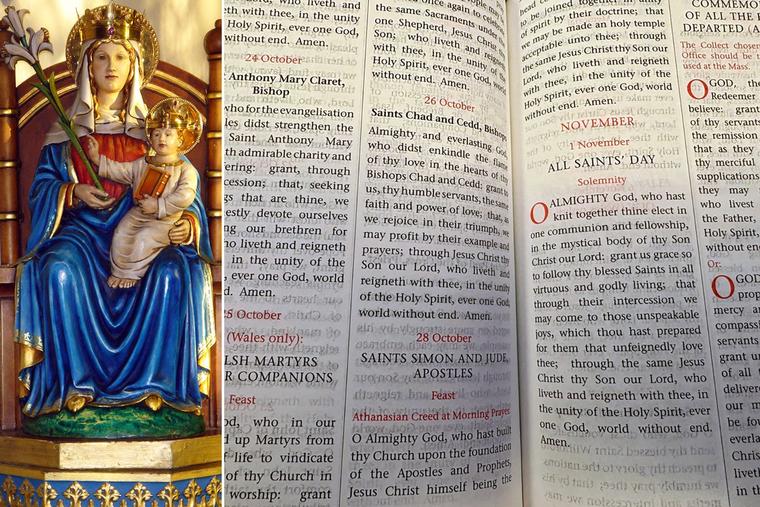
<p>The results, however, have been quite thoroughly excellent, even if the publications didn’t always live up to the content. <i>The Customary of Our Lady of Walsingham</i> provided an adequate interim effort, but the <i>Divine Worship: Daily Office: North American Edition</i> put out by Newman House Press sold out quickly and was marred by errors. The Catholic Truth Society, on the other hand, knocked it out of the park with <i>Divine Worship: Daily Office: Commonwealth Edition</i>. Beautifully printed and bound (with an eye-watering price to match: about $100 with shipping to the U.S.), it is a lovely example of what this remarkable form of liturgical prayer has to offer. Meanwhile, those looking for just an online version can find the office at <a href="http://prayer.covert.org/">prayer.covert.org</a>.</p>
<h3>The Division of Hours</h3>
<p>The cardinal hours are called Matins and Evensong, and correlate roughly to Lauds combined with the Office of Readings and Vespers with elements of Compline (specifically, the Nunc Dimittis). Psalm 119, the longest psalm, is spread out over Prime, Terce, Sext and None, while Compline itself is longer than the Liturgy of the Hours version.</p>
<p>At its heart is a psalter comprised of every psalm, in order, divided between morning and evening over 30 days, with Day 30 repeating for months with 31 days. The Coverdale psalter uses 17th-century English to great effect, and any arcane language is easily sorted out. Each psalm and canticle has its Latin title, meaning there’s more Latin in the Anglican use than in the Latin Rite. To take an example at random, here is the opening of Psalm 19 (<i>Caeli enarrant</i>):</p>
<blockquote><p>The heavens declare the glory of God:<br />and the firmament showeth his handiwork.<br />One day telleth another:<br />and one night certifieth another.<br />There is neither speech nor language:<br />but their voices are heard among them.<br />Their sound is gone out into all lands:<br />and their words into the ends of the world.</p></blockquote>
<p>Each cardinal hour also has two scriptural readings, called lessons, separated by a canticle. These use the Second Catholic Edition of the Revised Standard Version, and include large sections from the Deuterocanonicals. The scriptural readings are more substantial than those of the Office of Readings, but the lack of patristic writings is keenly felt.</p>
<p>There are optional canticles for days when the Te Deum isn’t said, as well as optional readings, collects, antiphons and various psalm choices for solemnities and feasts. The calendar observes contemporary saints (John XXIII is included) but counts time in the Anglican method using Sundays after Epiphany and Trinity rather than Ordinary Time. Ember Days are observed, and a number of days use more traditional English names, such as Whitsunday for Pentecost.</p>
<p>The breviary edition from the Catholic Truth Society is jammed with content. In addition to all the commons, offices and prayers, there are litanies, Marian anthems, the Itinerary, blessings, benediction and more. The hymn selection is a bit lean, but at more than 2,000 pages they’ve done as much as they can with one volume. It’s actually a bit overwhelming.</p>
<p>The structure of the hours favors corporate worship with a verse/response structure to introductory and closing prayers, but it works fine for those praying alone or simply using it as a devotional. The high degree of modularity is both one of its difficulties and its appeals. There are numerous choices, and certain portions are either optional or can be swapped out for something else. Since the CTS version is a Commonwealth Edition, Americans will want to replace the prayers for the king in the suffrages with the U.S. version “O Lord save the state.” Other optional prayers for the president and civil authorities can be taken from the U.S. version, which can be found at <a href="http://prayer.covert.org">prayer.covert.org</a> in its entirety for those who want an online, free option.</p>
<p>The Divine Office is approved for use by Catholics, but whether or not it satisfies the obligation of clergy to pray the hours is a question that should probably be referred to an ordinary. Those seeking to pray it simply as a devotional, however, are under no restrictions.</p>
<p>We don’t know precisely what the revision of the Liturgy of the Hours will bring, but it seems unlikely to include the missing psalms or a significantly elevated language. There is much beauty in the anglophone tradition that hasn’t significantly impacted modern translations, and its unique qualities are lacking even in the <i>usus antiquior</i>. Our English-language heritage is, simply, the greatest spoken and written tradition in the world, and the Divine Liturgy: Daily Office reclaims that heritage for the one true Church.</p>
<h3>Pros</h3>
<ul>
<li>The two hinge hours, Matins and Evensong, are longer and more suffused with Scripture</li>
<li>A more formal and literary translation of the Psalms</li>
<li>The Revised Standard version is used for Biblical readings, rather than the New American Bible</li>
<li>A richer, more elegant set of prayers than the U.S. Liturgy of the Hours, with often superior collects</li>
<li>A complete Psalter, in order, without the cuts of the Liturgy of the Hours</li>
</ul>
<h3>Cons</h3>
<ul>
<li>A more complex structure means more flipping in the print edition</li>
<li>The Commonwealth Edition requires adaptations for U.S. users, although the online version does not.</li>
<li>The Patristic and other supplementary writings found in the Office of Readings are missed</li>
<li>Absence of the traditional Benedictine ordering of the Psalms</li>
<li>Fewer canticles from outside the Psalms</li>
</ul></div>
<p><br />
<br /><a href="https://www.ncregister.com/blog/mcdonald-anglican-daily-office">Source link </a></p>
<p><!-- END THEIA POST SLIDER --></p>

Anglican Tradition Enriches Catholic Devotion in the Daily Office| National Catholic Register