


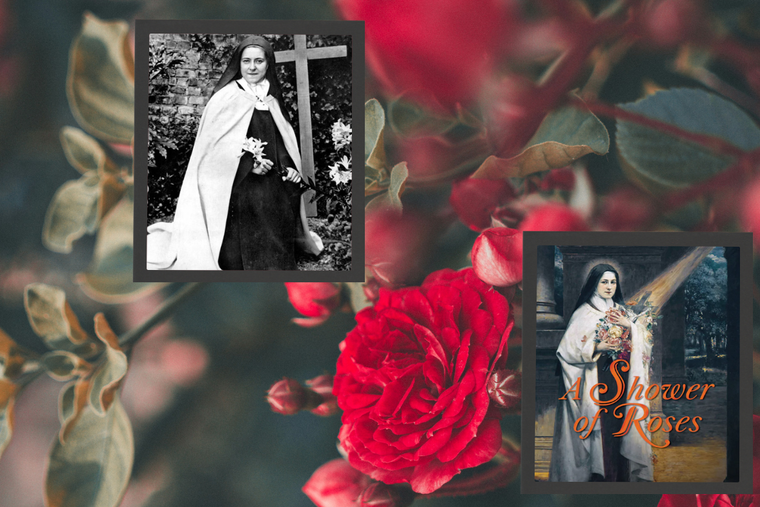
Read about the healings, conversions, material assistance and apparitions that were granted through the intercession of the beloved saint.
A SHOWER OF ROSES
THE MOST BEAUTIFUL MIRACLES OF ST. THERESE OF LISIEUX
By Camille Burette
Angelico Press, 2025
196 pages, $17.95 (paperback)
To order: AngelicoPress.com
Camille Burette, the archivist and author of A Shower of Roses, has sifted through the 14,000 materials detailing the spiritual miracles that St. Thérèse performed through her intercession with Jesus to include the most poignant among them in this volume. The miracles are archived in the Carmel of Lisieux, where the saint lived and died as a Carmelite nun.
This is a spiritual treasure house for those of us who, like me, have a devotion to the “greatest saint of modern times,” according to Pope St. Pius X. It also serves as an excellent introduction to the saint for those who may not be familiar with her life. Also known as the “Little Flower,” this humble, unassuming French saint has inspired millions to follow her “Little Way” of spiritual childhood, as described in her poetic autobiography, The Story of a Soul. She promised to “let fall a shower of roses” after her death and to “spend my heaven doing good on earth.” In 1997, Pope St. John Paul II conferred on her the title “Doctor of the Church.”
Each chapter covers a different aspect of the types of miracles, such as healings, conversions, material assistance and apparitions, that were granted through the intercession of the beloved saint.
Many French and German soldiers during World War I were protected by the Carmelite or were wounded but had miraculous recoveries. They heard a voice telling them how to avoid danger, or saw apparitions of Thérèse wearing her nun’s habit. One soldier said she lifted him by the right arm on the battlefield after he was wounded — and his bleeding stopped.
There are accounts of healings among ordinary people. One such miracle is detailed in the book: “In October 1909, Thérèse’s fame was beginning to reach beyond the borders of France. On the island of Madagascar, Mother Saint-Jean-Berchmans, the founder and superior of the Religious Sisters of Providence of Ambatolampy, handed out images of the young Carmelite nun to the inhabitants of the area.”
“In a village, a child was dying and his mother was mourning by his side. The missionary sister administered [emergency] baptism to the child, then gave the mother the portrait of Thérèse, urging her to invoke her with faith.”
“On the following night, the family’s home was filled with light,” the account continues. “Thérèse appeared near the newly baptized child and placed on him a gleaming white tunic, the symbol of innocence. Before the astounded eyes of his mother, the child woke up and smilingly extended his arms toward Thérèse: He was healed on the spot.”
Thérèse also obtained spiritual conversions for hardened hearts, and when funds were low in convents and among working people, the Little Flower intervened with financial assistance. This is recounted in the most famous “material” miracle of the Gallipoli Carmel, a poor monastery in Italy with a debt the nuns couldn’t pay. St. Thérèse appeared to the mother prioress, who was ill, and put 500 liras in the strongbox of the convent, which was 200 more liras than the payment of the debt required. St. Thérèse returned and put other sums of money in the box. After this occurred, the public realized the poverty of the Carmel and provided it with alms, so that St. Thérèse didn’t need to serve as “banker” there anymore.
Pope Francis was one famous recipient of her intercession recounted in the volume.
Prior to his election to the papacy, the Argentine-born prelate prayed the rose novena, consisting of 24 “Glory Be” prayers for the 24 years of St. Thérèse’s life. “When I have a problem,” he said, “I ask the saint not to solve it, but to take it into her hands and help me to accept it. And I always receive a white rose as a sign.” While he was in Argentina, then-Cardinal Jorge Bergoglio was scheduled to say a large outdoor Mass but had severe pain in his leg and didn’t know if that would be possible. “So he asked his chauffeur to wait for him at the next intersection. This is when an athletically built man came to meet him and offered him a white rose. Cardinal Bergoglio took the rose and blessed the man without saying a word. When Federico Wals invited him to get into the car, he replied, ‘No, no, you don’t understand: It’s the message I’ve been waiting for. It will be all right now.’ In the meantime, the man with the rose had disappeared, as well as the pain in his leg. The cardinal explained: ‘That’s the presence of the Little Thérèse. Tell our chauffeur to wait for us at the soccer field of Velez. We will manage.’ As a matter of fact, the future pope resumed his walk through the ten districts without feeling any pain for the rest of the day.”
Burette counsels those who petition St. Thérèse to have faith, confidence and persistence in prayer and to accept God’s will.
The touching accounts in this book indeed illustrate the power of prayer and the intercession of St. Thérèse.
As Thérèse told her sister, Céline, Carmelite Sister Genevieve of the Holy Face, “Let us not tire of praying; confidence works miracles.”
Marianne Komek is a freelance journalist, poet, and writer.