


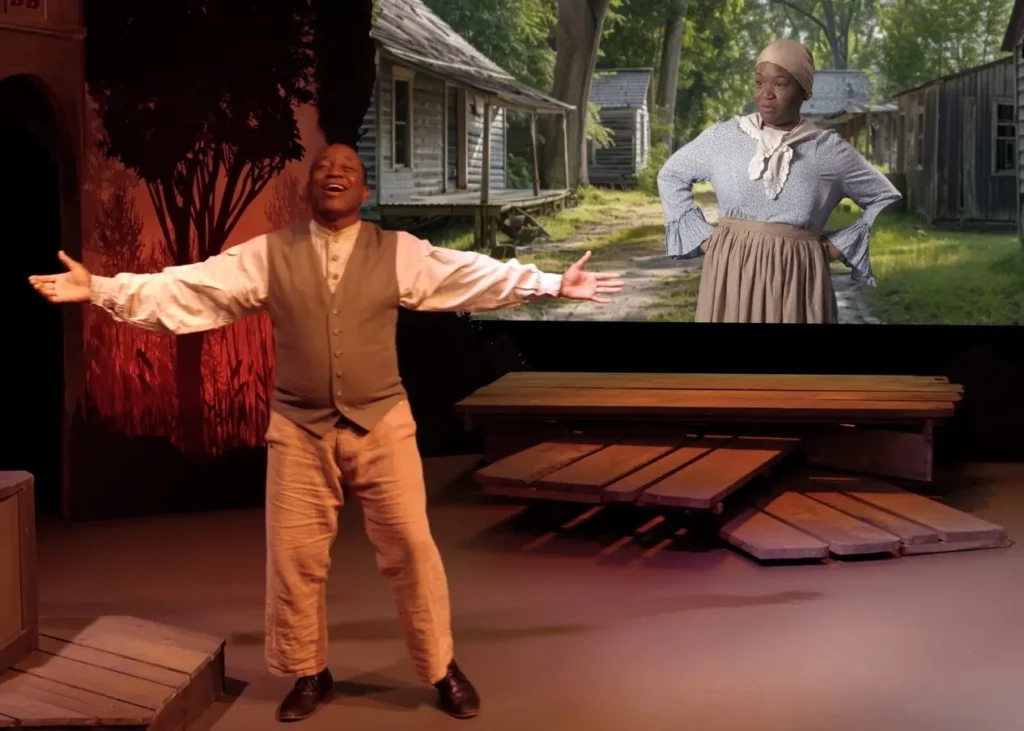
FILM REVIEW: One-man stage play becomes an inspiring movie about America’s first black priest.
Tolton: From Slave to Priest is a winning work from St. Luke Productions that takes a slightly different approach to films as it stirs emotions in telling the story of America’s first black priest in the late 19th century.
This story of Venerable Augustus Tolton has a distinct “personality” about it, primarily in the way it was done, as the film version of the live multimedia play with the same title was performed in theaters, churches and schools and seen by more than 75,000 people in 32 states.
It is very difficult to film a stage play and make it flow seamlessly as a film also. Not only does this production succeed, but it had to take unusual steps to triumph as it does.
Tolton as a play is essentially a one-man show and, in effect, transfers the same way onto film. Yet there are also other people populating the story of Tolton’s life. They react with him, and he with them, especially his mother, Mama Tolton. Although they all appear on film in the stage play, the movie takes it a step further: They are on film within a film — yet they always seem present and “live” with Tolton in their meetings with him and reactions to situations.
It takes an abundance of talent to make such a transfer succeed so extraordinarily well. In a word, director Leonardo Defilippis, who also co-wrote the script with his wife Patti Defillipis, has done amazing, creative work in bringing the stage version to the movie screen using the best of both mediums. It’s as if audiences are watching both a stage play and movie at the same time with the “live” Tolton on stage interacting with the filmed characters and they with him as if nothing separated them.
This is nowhere more beautifully done than in the exchanges Mama Tolton has with her son and he with her. Second to that: the scenes with Father Peter McGirr, a no-nonsense Irish priest who sees Tolton’s sanctity and helps him in his youth, promotes the idea of vocation, and continues to advance his journey to the priesthood — not stopping until he sees Father Tolton ordained.
In these and other scenes, the emotions can become more poignant or intense because this film version brings the stage play’s filmed characters to the audience with close-ups in the way a movie does. The filmed parts in a stage play cannot “move” or “enlarge” the characters in the same way. But the film version allows a person like Tolton’s friend to come “close-up” to the audience to share his knowledge of Father Tolton’s story with them.
Tolton comes to life thanks to actor Jim Coleman. He beautifully captures every bit of emotion, from the wonder and the humility of Tolton, to the young Tolton’s perseverance in the face of great hardship, his disappointments, his elation when all hurdles to the priesthood have finally cleared and he is ordained, and then his charitable resolve in the face of prejudice and antagonism when he comes back and is assigned to a parish in his hometown of Quincy, Illinois. Yet Coleman brings out Tolton’s absolute love for his people and his zeal, expending himself to bring Christ and the Catholic faith to people despite Himalayan-sized walls of resistance and prejudice that he experienced yet did not let defeat him.
Then there are the beautiful, heartwarming and soul-healing scenes he has with Mama Tolton, a real pillar of strength for her son, so beautifully brought to life by Elissa Sanders. She has the quiet determination of not giving up and trying to get the best for him, from going to school to learn to read and write to fostering and encouraging his spiritual growth. She is a model of love and support for him.


Several times, she sings Negro spirituals (yes, this word is used several times in the story because it takes place in the 19th century) that underline the story or highlight a direction in life — musically heartfelt and heartwarming. One duet with son Tolton is quite moving.
In just one instance, during hardships along the way, she tells her son how “Jesus got up when he fell and carried his cross.” And in Tolton’s struggles in life, “God will do it all” — she assures — only “You keep moving. Remember what St. Paul says” about being “content with weakness, insults, hardships, persecutions and calamities for the sake of Christ.” It is one of the beautiful ways she weaves Scripture into his situation. She is always there to support him and spur him on.
The fiery Father McGirr could not have been better played, thanks to Michael Lee. Quite stirring is his homily explaining about Jesus dying for everybody. “And let me assure all outsiders here, especially our colored families here present, Christ died for you, and you are one with Him and one with the church which He founded,” he preaches. “We are Catholic, which means universal. All people. May those who love us, love us, and those who do not, may God turn their hearts.”
During several of these scenes, the prejudice Tolton had to face growing up, then while wanting to be a priest, trying to get into a seminary, and even after ordination is tackled. People in his own town of Quincy eventually drove him to leave for a parish in Chicago because of their harsh prejudice and jealousy, as some white people were being drawn to his parish by his holiness and sermons. Addressing a crowd at a convention, Father Tolton said:
“The Catholic Church deplores double slavery, that of the mind and that of the body, and endeavors to free us of both. I was a poor slave boy, but the priests of the Church did not disdain me. It was through the influence of one of them that I became what I am today. It was a priest of the Church who taught me to pray and forgive my persecutors.”
Of course, there were triumphs, too, such as when Tolton spoke at the National Black Catholic Congress and was in demand as a speaker around the country because of the impression he made and the way he preached the Gospel. Again, Coleman is so moving in the way he brings Father Tolton to life in instances like these and, in fact, every challenging moment — and, alternately, triumphant moments too. He is suffering, yet his total reliance on Jesus for himself and for his people is a silent but powerful witness.
A gentleman character named Fred appears toward the end and offers some insights on what happened historically, especially later with Father Tolton’s ministry in Chicago. Bobby Bermea makes Fred a sincere, friendly voice filling in these details.
As Father Tolton’s story becomes better known, and his cause grows — maybe now that Blessed Fulton Sheen has become the first American-born bishop in the United States to be named “Blessed” — Venerable Augustus Tolton could be the first black priest in the United States named a “Blessed.” This film provides many reasons why Father Tolton should have that honor.
WATCH
Per ToltonMovie.com, the film premiered last month in Chicago, where he died, and then moved to Quincy, Illinois, where he is buried. Visit the website for other showings this month and next month, as well as to request a showing in your area.