<p><!-- BEGIN THEIA POST SLIDER --></p>
<p> <br />
</p>
<div>
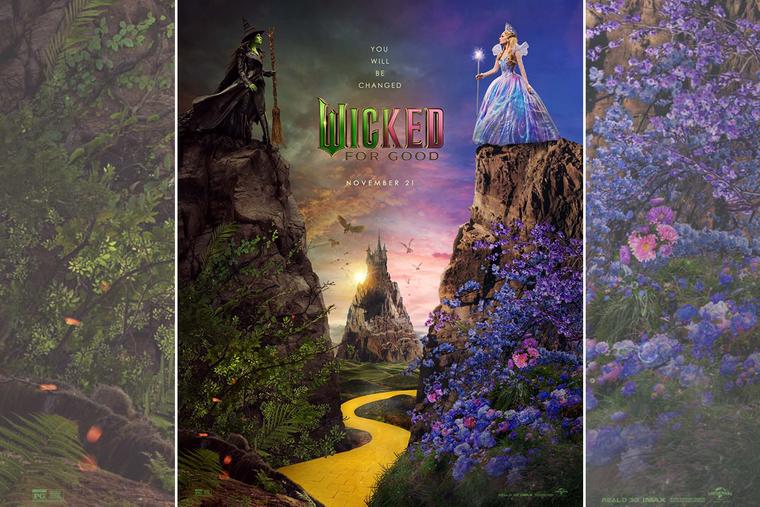
<p>The first <i>Wicked </i>film adaptation hit theaters in November 2024, giving rise to both wild celebration of its artistry and sudden disappointment over its coverage: it was only Act One!</p>
<p>But the year-long wait for the second act is finally over, and the result is a visually stunning movie that brings all the musical and philosophical sophistication of the stage show to the silver screen. It’s hard to think of a more entertaining way to spend two hours meditating on good and evil (and especially on the limits of our good intentions).</p>
<p>In addition, longtime fans of the musical will be relieved to learn that, whatever the co-stars said in interviews, and whatever their reasons for saying it, the producers managed to keep the movie in that glorious place where art is allowed to work on our imaginations without ham-fisted sermonizing about the politics of the moment.</p>
<p>For those who did not see the musical or the first installment of the movie (which I reviewed <a href="https://heightsforum.org/movie%20reviews/how-the-flying-monkeys-got-their-wings/">here</a>), the musical <i>Wicked </i>presents a history of Oz before Dorothy arrived there. The surprise to those raised on the 1939 movie <i>The Wizard of Oz</i> is that the Wicked Witch of the West (named Elphaba at birth) and Glinda the Good Witch were friends, indeed college roommates. In Act One, we see their friendship deepen as they transcend their very different backgrounds — Glinda, the popular child of privilege, and Elphaba, the outcast unloved even by her own father. But their shared interest in a handsome but brainless classmate, Prince Fiyero, portends conflict ahead, especially as Elphaba, Glinda, and Fiyero all become aware that “something bad is happening in Oz.”</p>
<p>In the musical version of the story, as in the 1939 version, the Wizard is a fraud who only pretends to be a “great and powerful” sorcerer. But <i>The Wizard of Oz</i> never really expanded on the Wizard’s <i>political authority</i>, whereas deception by political authority is at the heart of <i>Wicked.</i> The Wizard is evidently quite clever as a mechanic, and he uses his mechanical gift to <i>simulate</i> extraordinary powers, inventing machines to fool the people of Oz. In this project, he is joined by Madame Morrible, who pretends to be qualified to teach sorcery but accepts only “gifted” students because she relies on them for most of the magic.</p>
<p>By the end of Act One (or the first <i>Wicked </i>movie), Elphaba and Glinda both realize that the Wizard and Madame Morrible are pretenders imposing themselves on the people and animals of Oz. Glinda wants to accommodate herself to the Wizard’s authority, whereas Elphaba wants to unmask the deception at the root of that order. That’s why the Wizard has to demonize Elphaba as “the Wicked Witch of the West.”</p>
<p>This gives the second installment of the movie a somewhat darker character than Act One. <i>Wicked: For Good</i> opens with Madame Morrible’s voice warning Ozians about the Wicked Witch, in tones that would be equally at home in a movie adaptation of <i>1984.</i> And here, as in most good dystopian works, we know that righteousness is not with the law but with the outlaw. Elphaba is called “wicked” by the authorities because she wants to tell the truth, and we the audience know this. Meanwhile, the Wizard is called “Wonderful” by the people because he and his propagandist lie to the people at every opportunity — and we know this as well.</p>
<p>But <i>Wicked </i>never specifies <i>why </i>the villains are lying to preserve their power. Thank goodness! The Wizard’s sin in this work is fundamentally against the truth. Many viewers today will interpret it differently than they would have 20 years ago, and that is entirely as it should be; that’s one of the things that makes great art timeless.</p>
<p>But if <i>Wicked </i>portrays public authority as characteristically corrupt, it is certainly no love letter to populism. On the contrary, the fallibility of public opinion is one of the major themes of the work. Virtually every song and scene in which the public appears is informed by the knowledge that the Wizard and Madame Morrible are lying <i>and getting away with it.</i></p>
<p>I suspect that the chorus is wrong about absolutely everything in the entire show; primarily, they are wrong about who is promoting their good and who is threatening it. Significantly, however — and this is a point misunderstood by many of the work’s critics — the people see goodness and wickedness in the wrong places not because they don’t know good from evil but because they’ve been misinformed and manipulated by a warped public discourse. The Wizard’s cynical philosophy about goodness and wickedness is that “it’s all in which label / is able to persist.” Fortunately, that’s the view of the show’s villain, not its heroine.</p>
<p>If the first two great themes of <i>Wicked </i>concern public authority and public opinion, the other two great themes emphasize the limits of our ability to judge private motives. Even when we mean well, the consequences may fall well short of our intentions. And conversely, even acts undertaken from vicious motives may bring about consequences that make our actions appear kind to the outside observer. The movie’s plot offers numerous examples: Glinda’s selfishness and even her casual cruelty in youth often benefit others and fill them with gratitude, while Elphaba’s best intentions often misfire and create deep resentment.</p>
<p><i>Wicked </i>also suggests that the corrupting influence of power — whether political or magical — makes us especially unlikely to “make good” on our good intentions when we are attempting to change the natural course of other people’s lives.</p>
<p>And what about other people’s motives? They are notoriously (and frustratingly) opaque to us. We typically judge others by observing the effects of their actions and surmising their intentions, but we often forget to “mind the gap” between the two. That is, we assume that others must have intended exactly what result they brought about when, in fact, with others’ actions as with our own, the result is rarely fully foreseen and the intention is rarely perfectly executed.</p>
<p>C.S. Lewis’s devils make brilliant use of this phenomenon in <i>The Screwtape Letters</i> as well. In <i>Wicked, </i>we get to watch some of the characters learn this for themselves, looking self-critically at the way they have judged others.</p>
<p>Which brings us to the show’s real star: the score by Stephen Schwartz. It’s not just the Wizard in “Wonderful”: virtually every song is a meditation on the nature of goodness and wickedness, the lyrics repeatedly playing on common English phrases like “for good,” “make good,” “thank goodness,” and “goodness knows.” In song after song, when the soprano co-stars harmonize or sing contrasting melodies against each other, it is often difficult to tell them apart, which is surely part of the point of the work as a whole.</p>
<p>Schwartz wrote two new songs for the movie, “There’s No Place Like Home” for Elphaba and “The Girl in the Bubble” for Glinda. They didn’t get in the way, but they didn’t add much either. The rewriting of the Wizard’s signature musical number and <i>apologia</i>, “Wonderful,” was more unfortunate; it was as if a finely crafted work of art had been puréed in a food processor<i>. </i>But I assume this was done in large part to accommodate the fact that the movie’s Wizard (Jeff Goldblum) and his accomplice Madame Morrible (Michelle Yeoh) can’t really sing. In a cast otherwise entirely composed of insanely talented vocalists, that had to be intentional, didn’t it? Almost as if the real villains, the real wickedness, needed to be discernible after all?</p>
<p>The movie also includes some new dramatic elements that raised for me the question of what counts as magic in Oz. Throughout the movie, we understand Elphaba to possess “real” magic because she can fly and cast spells. By contrast, Glinda needs the Wizard to craft her a mechanical vehicle that only simulates flight by bubble. But in the end, as Elphaba herself realizes in a duet, Elphaba is limited in ways that Glinda is not. If the Wizard enchants with machines, and Madame Morrible enchants with press releases, and Elphaba enchants with ancient spells, what is Glinda’s characteristic magic? That sounds like a question of vocation, one that we all must wrestle with.</p>
<p>Most of the questions raised by <i>Wicked </i>are like that: things we should all spend more time thinking about. How fortunate, then, that we have this wonderful work to help us. When I took my kids to see this Broadway musical more than 15 years ago, I told them the bad news that this is the kind of show that only comes along once in a generation. In the years that have passed since then, I’m still waiting for its equal.</p>
</p></div>
<p><br />
<br /><a href="https://www.ncregister.com/commentaries/grannis-wicked-for-good">Source link </a></p>
<p><!-- END THEIA POST SLIDER --></p>

For Good,’ Truth Proves Stronger Than the Strongest Spell| National Catholic Register