


Although it may be an exaggeration to say that Leo XIV’s papacy began on the Iberian Peninsula, his recent six-day sojourn in Spain was a clear indicator of the kind of pontificate we can expect from him.
Leo’s pontificate will be one that looks to the peripheries of the faith, as Pope Francis did throughout his own. The difference lies in how we understand these peripheries.
During his 12-year reign, Pope Francis carefully avoided countries with the most ancient Christian traditions. He never made an apostolic visit to France, preferring to go to Strasbourg in 2014 without even stopping by the cathedral, which was celebrating its thousandth anniversary, and then making a last-ditch effort to visit Corsica without passing through Paris.
Spain, too, had not been a favorite destination for Pope Francis. The only plan that could materialize was a stop in the Canary Islands during his final (never-fulfilled) journey to Argentina, to provide relief to migrants stranded on the Atlantic islands. A stop in Madrid was, in any case, out of the question, much less Barcelona, even though he was expected in Manresa to celebrate the feast of St. Ignatius of Loyola.
In Europe, Pope Francis had sought out countries where the Catholic tradition was a minority, with a few exceptions: Lithuania, included in a Baltic tour that saw him visit Protestant Latvia and agnostic Estonia; and Poland, a mandatory stop for World Youth Day. Otherwise, Francis mostly visited countries with non-Catholic majorities, both in Europe and around the world.
Leo XIV has turned that on its head.
The first countries he has chosen to visit in Europe on his international travels are those with a solid Catholic history. The visit to Monaco, first and foremost, indicates his concern for small countries, demonstrating that the Holy See recognizes that indeed all states have an impact on the Society of Nations.
There was the recent trip to Spain. Soon, he will go to San Marino, technically an “international” voyage, even though it will not take him off the Italian Peninsula, a journey similar to the one that brought him to Monaco. Then, he will be in France, where he will not only visit the reopened Notre Dame but will also travel as far as Metz, in those border territories where the Napoleonic Concordat is still in force.
Everything suggests that, for Leo XIV, the New Evangelization is the primary theme.
These are all places previously considered the center of faith, with France often called la fille aînée de l’église (the “eldest daughter of the Church”) — each with an ancient Catholicism which, as of late, has caught the fascination of its citizens, despite the advancement of secularism.
These are peculiar peripheries, though. In France, especially, there has been a return of faith inexplicable to everyone, which has led to an increase in adult baptisms over the last five years.
Leo XIV thus made his task clear: to confirm people in the faith. And where better to do this if not from the nations that have maintained a Christian identity and heritage but seem to have lost their faith?
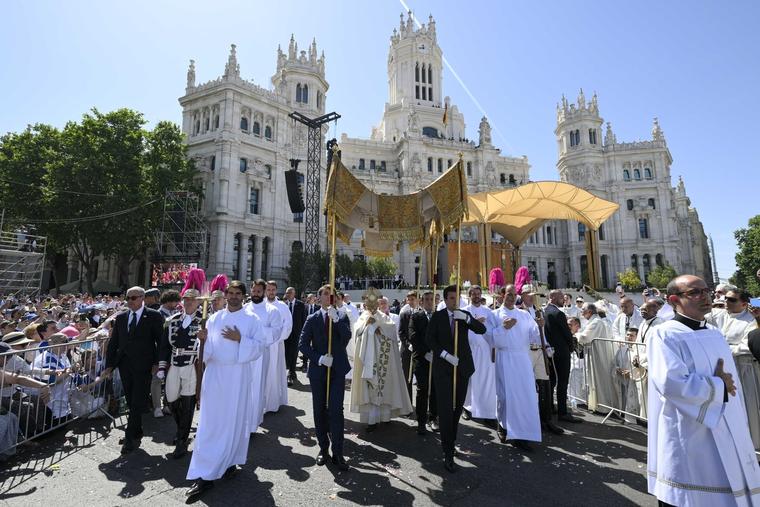
The trip to Spain was a clear example of this. The Pope’s presence reawakened faith like no one would have imagined. The 1.2 million people gathered to celebrate Corpus Christi in Madrid’s Plaza de Cibeles spoke volumes about the country’s profound Catholicism better than any speech.
The emotion of the people of Barcelona at the blessing of the Tower of Jesus of the Sagrada Família was tangible. Also in Barcelona, the Pope visited the monastery of Montserrat, where the inscription reads: “Catalonia will be Christian or it will not be.”
The presence of a pope was needed to remind the Spanish people of their faith.
At the Cortes, the Spanish parliament, Leo delivered a monumental speech. Even members from the populist Podemos party showed up at the chamber, despite having strongly criticized the decision to invite the Pope in the first place.
In his powerful speech, the Pope spoke out against populism and nationalism, but also against abortion and for human life, addressing critical issues facing all political factions, without exception.
Above all, the Pope reminded Spain of the cultural legacy the nation has given the world, beginning with the School of Salamanca, the intellectual movement of the brilliant Dominicans who studied the rights of the peoples of the New World, laying the foundations for what would become human rights.
In his speech to the diplomatic corps, Leo XIV recalled two other Spanish saints, St. John of the Cross and St. Teresa of Avila, urging them to build the state according to Christian principles, maintaining a healthy secularism, and at the same time not excluding religion from public life.
The speech to the Cortes drew a full eight minutes of applause, an enormous response in a chamber with a socialist and generally anticlerical majority.
But that’s what the Pope’s presence is for.
It serves to remind us that when we appeal to certain fundamental principles, we do so starting from a thought — that of the Church — which remains at the root of all reasoning. It serves to remind people of their Christianity, somewhat dormant because it lacks the necessary impetus that only the Pope’s presence can provide.
This is what the Pope’s presence is for: to make faith alive and present, to bring it out of the catacombs of thought, to restore Christ to the center, even on the peripheries of faith.
The trip to France will likely be met with the same enthusiasm, but one can imagine the Pope also visiting England, Germany, perhaps Austria, and Croatia in the coming years, in an ideal tour to the heart of the European faith, from which to relaunch the great European discourse.
In Spain, there will be a before-and-after of the Pope’s trip. But there will likely be a before-and-after during his pontificate as well because Leo XIV unveiled his major themes and highlighted his objectives, and he did so in a journey marked by joy and emotion, both on the part of the Pope and of those who attended.
We need the Pope to confirm us in the faith.
It’s a simple truth and a primary purpose of the Petrine office in the Church, after all, and Leo XIV just leaned way into it.