


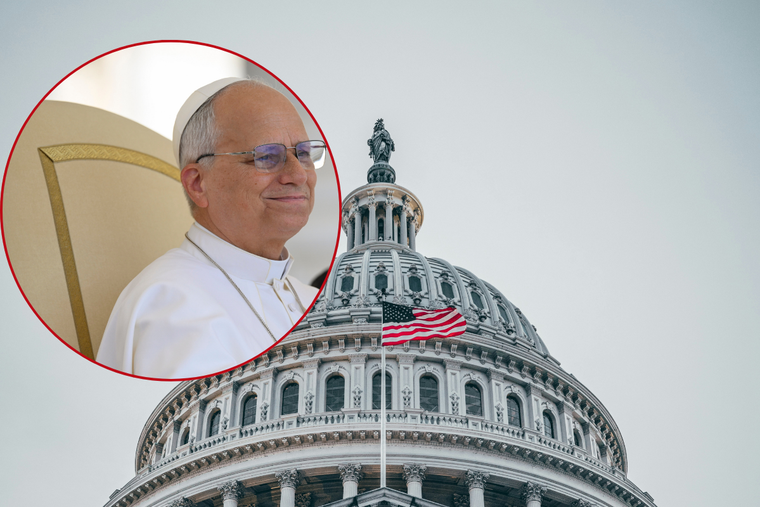
WASHINGTON — Pope Leo XIV’s call for policymakers to place guardrails on AI is being well-received on Capitol Hill and in state legislatures, with Catholic policy experts noting that the Pope’s recent AI encyclical is factoring into conversations about everything from online child protections to labor regulations.
Released on May 25, Magnifica Humanitas called on all levels of society to take steps to ensure that the disruptive new technology works for the good of all humanity and not a powerful few. In particular, the Holy Father urged lawmakers to establish “adequate regulatory tools capable of upholding justice and curving the distorting effects of technological power.”
According to Anthony Granado, associate general secretary for the U.S. Conference of Catholic Bishops (USCCB), policymakers seem to have taken the Pope’s call for greater regulation of artificial intelligence into account.
“I would say everyone I talked to is excited about Pope Leo and they’re excited about the Catholic Church,” said Granado, who meets regularly with political leaders on behalf of the U.S. bishops. “I think the Church, with Pope Leo, is in a very unique position to be a voice for reason and compassion on the area of AI technology. The Holy Father’s voice is very well respected. It’s just amazing.”
The encyclical also appears to be resonating at the state level, with policy advisers in one Midwestern capitol turning to Magnifica Humanitas as a reference for policy deliberations.
“Already, we have received a request from legislative staffers for our chaplain to lead a study group on the encyclical,” said Jason Adkins, executive director of the Minnesota Catholic Conference.
“My sense is that lawmakers are intrigued that the Church, led by Pope Leo XIV, is trying to engage these questions thoughtfully and provide an ethical framework to the consideration of how to navigate difficult issues at the nexus of technology and ethics,” he added.
Though Pope Leo calls on everyone to take part in reigning in AI in Magnifica Humanitas, he specifically calls on public officials to take charge when it comes to the lack of legislative guardrails.
“It is not enough to invoke ethics in the abstract; robust legal frameworks, independent oversight, informed users and a political system that does not abdicate its responsibility are required,” Pope Leo writes.
The Pope’s emphasis on regulation is aligned with American public sentiment. Across the country, Americans are skeptical of AI’s encroachment into everyday life, with 65% saying the government has done “too little” to regulate it, according to a 2026 University of Pennsylvania study.
Though there is strong bipartisan support and a widespread call from the public for AI regulation, Granado said, there is currently no federal legislation on the books.
“Right now, the AI space on policy and legislation is kind of all over the place, both at the state level and at the federal level,” Granado told the Register. But he said that the direction provided by Pope Leo in Magnifica Humanitas is clear.
“From the very beginning of the encyclical, the Holy Father clearly talks about the importance of regulation and AI,” he said. “We all have a part in slowing down, or what the Holy Father calls disarming, AI and this technology.”
Keeping Kids Safe Online
According to Granado, a bipartisan bill aimed at protecting children under age 17 online could be part of the answer to Pope Leo XIV’s call for stronger AI regulations.
The Kids Online Safety Act (KOSA), introduced by Sen. Marsha Blackburn, R-Tennessee, requires platforms like messaging apps, video games and streaming services to implement new safety features for minors and give parents greater control over the content their children are exposed to.
Certain forms of artificial intelligence used by social media platforms, like algorithmic content recommendations and chatbots, would fall under KOSA’s jurisdiction. Thus, Granado said, the USCCB believes the bill is a “good start” towards putting guardrails on AI usage in digital spaces.
“These online platforms are exposing kids to content that threatens their mental, emotional and even physical well-being. I’ve met some of these parents who’ve lost their kids to suicide,” Granado said. “Some people are convinced this is engagement with an actual person when it’s not.”
The bill, which has received bipartisan support, with 76 Democrats and Republicans co-sponsoring the bill, has been stalled in the Senate since 2025.
Joseph Meaney, a senior ethicist at the National Catholic Bioethics Center, agreed with the need for further AI regulation policy, particularly when it comes to children.
“One of the things that makes AI so attractive is that it always agrees with you,” Meaney said. “AI is always going to tell you that you’re right because it’s basically currying favor. It’s not giving an objective, true picture of reality.”
This dissonance between reality and the narrative presented by AI can harm a child’s sense of self and perception of the world, according to Meaney.
“Our brains don’t fully mature until we’re well into our 20s,” Meaney said. “It’s important that there’d be some kind of protective measures out there.”
Bills similar to KOSA have been passed at the state level already. Minnesota recently enacted the Stop Harms From Addictive Social Media Act, which the Minnesota Catholic Conference supported. The act requires parental consent to create a social media account for children under 16.
But a bill banning the recreational use of AI chatbots for minors, which Minnesota’s bishops had supported, failed to pass this past legislative session. Adkins explained that the issue is still a priority, as chatbots often undermine the formation of strong human connection by making vulnerable kids overly reliant on artificial connection.
“Coupled with the examples of chatbots endangering young people by encouraging them to harm themselves, there is ample justification to put this reasonable limitation on the use of chatbots by young people who have not reached sufficient maturity to use them well,” Adkins said.
Work, Weapons, and Healthcare
While child safety legislation is a good steppingstone, Granado stressed the need for AI regulation in several fields.
“We already see the impact that it’s having in the white-collar industry in the tech sector itself,” Granado said. “But we have broader concerns about replacing humans with robots and AI-related tech, without having support workers. If we’re simply displacing workers, it’s not only going to have an impact on families and communities, but the economy itself.”
Politicians on both sides of the aisle have raised concerns about AI-related job displacement. Sen. Joshua Hawley, R-Missouri, and Sen. Mark Warner, D-Virginia, introduced the AI-Related Job Impacts Clarity Act to the U.S. Senate in November 2025. The bill, which would require that employers publish reports of the human jobs lost to AI, is still up for debate in the Senate.
Meaney also highlighted the importance of placing guardrails on the use of AI in warfare.
“AI is now being incorporated into weapons, some of which are referred to as LAWS —Lethal Autonomous Weapons — and that is completely, ethically unacceptable,” Meaney said. “A situation where artificial intelligence would, without any human control, target and kill individuals in the battlefield — the gravity is just tremendous.”
AI’s intersection with healthcare is another field that will require oversight, according to Adkins.
“Certainly, artificial intelligence tools may be helpful in diagnosing conditions and offering suggestions for treatment,” Adkins said. “But in a healthcare model funded by private or public insurance, where conserving resources is a paramount value, AI tools may be used to deny coverage based on probabilities instead of human beings assessing the conditions of the actual human person.”
The Trump Administration
Though the Trump administration had previously been hesitant to restrict AI, Granado said a recent executive order signed by President Donald Trump could point to a shift in attitude. The order, entitled “Promoting Advanced Artificial Intelligence Innovation and Security,” asks AI companies to provide the federal government access to certain models that could be considered a security risk.
Granado sees the order as a turning point for the administration.
“There is an internal debate, as I understand it, at the White House,” Granado said. “But we would encourage the administration to listen to the constituents and to the bipartisan voices in the faith sector and in the political sector saying that we need some form of reasonable guardrails on this tech to protect the human person and human dignity.”
Though there is still a long way to go to create the guardrails on AI that Magnifica Humanitas calls for, Pope Leo brought the Church into the conversation surrounding AI regulation. According to Granado, it seems like policymakers are listening.
“A lot of people are listening,” Granado said. “We hope that will translate into action on Capitol Hill.”