


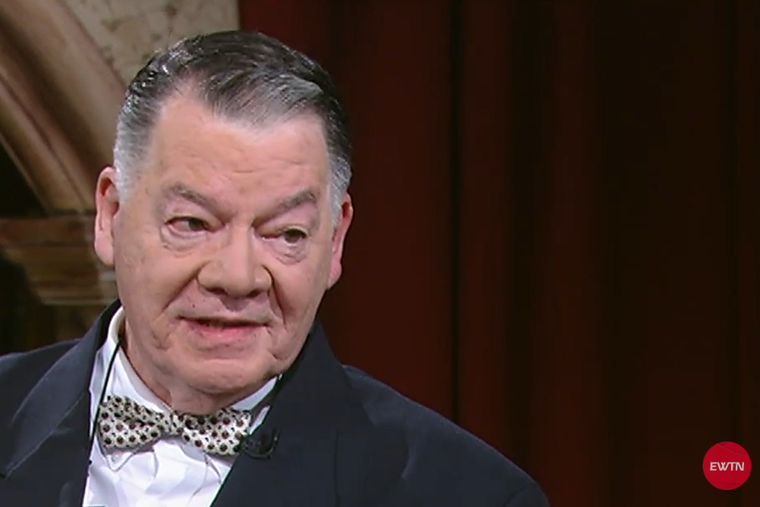
Richard Payne, familiar to EWTN audiences for many years through his films and series, including Saints Alive! and A Wolf in Sheep’s Clothing, died on July 18 at the age of 88.
“He will be greatly missed, certainly by me as a friend, and really by the Church as a man who stood up for what he believed and what he believed the Church believed,” EWTN President Emeritus and TV-radio host Doug Keck told the Register.
Richard’s youngest son, Stephen, his working partner in Arcadia Films, shared biographical information through a written release. Payne was born in Ottawa, Ontario, on March 18, 1938. He became a religious educator, curriculum director and scriptwriter for the Canadian Broadcasting Corporation and the National Film Board. In 1964, he married Mary Patricia Ann Sheridan. They had five children.
Moving with his family to the United States in 1967, Payne became an editor at Paulist Press.
“As an editor and acquisitions director he brought to print an astonishing company of the age’s great Catholic minds — among them Joseph Ratzinger, the future Pope Benedict XVI; Dorothy Day; Hans Urs von Balthasar,” related Stephen.
At Paulist Press, Payne served as editor-in-chief of The Classics of Western Spirituality. He commissioned its first 80 volumes, edited the 25-volume World Spirituality: An Encyclopedic History of the Religious Quest, and wrote himself.
In 1991, Payne returned “to work rooted entirely and unmistakably in his Catholic faith,” Stephen wrote. Together, father and son teamed to found Arcadia Films, based in Winsted, Connecticut. They worked together for more than 30 years, making more than 150 films “in service of the truth, beauty, and moral clarity of the Catholic faith.”
Major works reached EWTN audiences, some as co-productions with the network. Their series included The Saints Speak, Saints Alive!, Parable, and Eucharist. Their top documentaries were headed by Cardinal Gerhard Müller’s Manifesto of Faith, and A Wolf in Sheep’s Clothing and the sequel — The Gender Agenda —received a Gabriel Award.
But Richard Payne “was, above all, a man of prayer,” son Stephen wrote. “He bore long illness and heavy crosses in his final years with a faith that humbled everyone who came near him. He gave his mind to the great teachers of the Church and his whole heart to Our Lord and to Our Lady.”
He died on July 18, the anniversary date of the Blessed Virgin Mary’s first appearance to St. Catherine Labouré in 1830.
Richard Payne touched the lives of countless viewers and those who knew him.
John Elson, director of program acquisitions and co-productions for EWTN Global Catholic Network, listed all the titles and documentaries the network acquired from Arcadia Films or co-produced with Payne.
“When I think of Richard, I believe he embodied this scriptural passage: ‘Always be ready to give an explanation to anyone who asks you for a reason for your hope’ (1 Peter 3:15),” Elson said.
“The breadth and depth of his scholarship was always very impressive, as was his profound love and reverence for the Holy Eucharist, Our Lady (with a special emphasis on de Montfort’s Marian spirituality), and his passionate and tireless defense of the Church,” he added.
“Richard had an incredible ability to connect the ‘main heretical dots’ over centuries of history and bring to light what was largely invisible to the vast majority of Catholics,” Elson continued. “The first A Wolf in Sheep’s Clothing film gave viewers a profound and privileged understanding of how Marxism/socialism had penetrated American culture and then attacked the Church, and the second one explained the errant philosophical conceptions used to advance the diabolical ideology of transgenderism.”
Elson added, “Finally, Richard wasn’t simply devout, but profoundly talented and had a unique gift to communicate and translate his life of dedicated scholarship into the language of television in a profoundly impactful way, ministering to viewers intellectually and spiritually and touching them emotionally through his impressive screenplays and recorded narrations.”
Peter Gagnon, president of EWTN Studios, recalled to the Register, “I always enjoyed our meetings with Richard. I was intrigued to meet him the first time because, growing up, our family library had a number of The Classics of Western Spirituality books for which he was the editor. He was clearly a brilliant man, who had a tremendous love for the Church. His knowledge of the saints, the Church and world history always astounded me. He, along with his son Stephen, had a great creative eye for producing programs in a way that engaged and educated the viewer. His contribution to the Catholic world cannot be overstated.”
Longtime friend and collaborator Jim Morlino of Danbury, Connecticut, first met Richard and Stephen Payne years ago when he was video and audio producer for the Legionaries of Christ.
“While I was working there, I was aware of Stephen and Richard Payne and Arcadia Films because I’d seen their work on EWTN. So I held them in great regard.”
Soon, Morlino got the opportunity to work with them.
“We collaborated on multiple pieces over the years,” he recalled. “The first time I worked for them was when they were producing a series called Saints Alive!” which was filmed at the Basilica of the Immaculate Conception in Waterbury, Connecticut. Morlino was an assistant, but when the actor who was slated to play Blessed Michael McGivney dropped out at the last minute, the Paynes asked him to step into the role.
“I loved working with them. Years later, they hired me to film their big documentary, A Wolf in Sheep’s Clothing, and to be their director of photography for all the various interviews,” from California to Virginia, he explained.
“Richard was a fascinating man,” Morlino remembered. “He was a polyglot — spoke many languages, had an encyclopedic knowledge of Church history and a great devotion to the patrimony of the Church. He was a very, very faithful Catholic man who wanted nothing more than to spend his life working for Holy Mother Church.”
“Many times, we’d be in a social situation, or I’d see him at Mass, and he would begin speaking about some aspect of Church history or theology. I had to try with all my might to stay engaged in the conversation because much of it was so far over my head,” he added. “I really did appreciate how much he knew and how much he loved the Church.”
Morlino also recalled Richard’s musicianship. “Richard was an accomplished musician. He played upright bass and had a great appreciation for jazz and classical music — all kinds of music, really. And one day we were driving to L.A. from Phoenix after we had conducted an interview for A Wolf in Sheep’s Clothing. My background is in music, too, not as much the rarefied music of the classical world and jazz, as was Richard’s taste. I was more rock ‘n’ roll.”
When talking to Richard about his favorite British rock band that sometimes incorporated classical elements, Morlino played one of the songs and asked Richard to see if he knew what influenced it. “He listened attentively and started bobbing his head,” he recalled and said, “Johann Sebastian Bach, of course.”
“Richard will be sorely missed,” Morlino added.
Father James Sullivan, rector of the Basilica of the Immaculate Conception in Waterbury, celebrated Payne’s funeral Mass on July 24. He met Richard about 20 years ago and well remembers the filming of Saints Alive! at the basilica.
“He was truly brilliant. He really was,” Father Sullivan said. “He knew his theology so well, but he also had the heart of compassion. He had a really beautiful heart and was extremely intelligent.”
Father Sullivan read Payne’s books before they became friends; that friendship was focused on faith and fellowship. “We used to go out to breakfast from time to time — myself, Richard and Stephen, because they lived in Winsted and my first assignment was in Torrington. We were just a few miles away from each other. And obviously the conversations always went to spiritual matters and the Church and the world. And he had creative ideas.”
Doug Keck first met Richard Payne at the former Montfort Seminary in Bay Shore, New York, during a Marriage Encounter event. The Kecks were involved in Marriage Encounter, and the Paynes were shooting a documentary about St. Louis de Montfort.
“That was the first time we met Richard and Stephen. It was an interesting meeting because I had just arranged to come to work for EWTN, and they were telling me how they were planning on being at EWTN when the production was done. That was back in 1996, and we worked together for 25 years after that.”
Keck noted how “Richard was very intelligent, very calm, very measured, very passionate about the faith, passionate about the Church’s philosophy, passionate about the richness of the teachings.”
“And not only that, he had a great voice that we used as well,” he added.
Keck shared a particular memory. “He always was driving to do better no matter what plan we came up for the various programs we did over the years. We started doing a couple of spots and then we decided that saints were really important.”
Keck noted the Paynes’ knack for creating “great products on the screen to transmit the faith,” which “made them a wonderful team to work with.” Keck added of Richard, “I would say what he did for EWTN, especially with The Wolf in Sheep’s Clothing and then The Gender Agenda, was really allow us to convey to people how we got where we are, why is it that no one can talk to each other anymore,” adding that the Paynes’ programs “really did a great job of taking that basic idea that we had and converted it into a piece that was really, really popular and maintains this popularity today because its message continues to be prophetic.”