<p><!-- BEGIN THEIA POST SLIDER --></p>
<p> <br />
</p>
<div>
<p>Sixty years ago, Richard Burton starred in <i>Becket</i>, a film about today’s saint. The film gets some of the history wrong, e.g., it pretends that <a href="https://www.newadvent.org/cathen/14676a.htm">Becket</a> was a Saxon (to add to the conflict with King Henry II) when he was, in fact, a Norman. It tends sometimes to favor the monarch (not surprising — when the “Church of England” became a pet lapdog of the monarchy, a bishop like Becket standing for the Church’s rights would not be popular). That said, the film did popularize the story for modern people of this 12th-century English bishop. (T.S. Eliot also wrote a verse drama, “Murder in the Cathedral,” about the slaying.)</p>
<p><b>Thomas Becket was born about 1119</b> in what is now London. The family was of Norman origin; his father was a merchant and probably a knight. He was educated in England and studied in Paris, to return to his somewhat poorer family and enter business as a clerk. Among the people for whom he worked was Theobald of Bec, Archbishop of Canterbury, who sent him on several missions abroad (including Rome), had him study canon law, and made him an archdeacon. Bec later recommended Becket to be Lord Chancellor of England, to which Henry II appointed him in 1155.</p>
<p>Becket and the King had a very friendly relationship. Henry was pleased that Becket was an efficient executor and collector of taxes, rents and monies due him. Indeed, so happy was Becket with his friend that, in 1162, he used his then-prerogatives to nominate his chancellor to succeed the late Bec as Archbishop of Canterbury. That meant he was ordained priest and bishop in rapid succession.</p>
<p>Henry no doubt reckoned that Becket would be a practicing bureaucrat and lax churchman, continuing to put loyalty to the king first. But grace has a way of changing men and Becket took seriously his obligation as the senior churchman in England, becoming ascetic in his religious practices. What that meant was that Becket would defend the Church’s prerogatives and, since the greatest threat to those prerogatives was the king, it put the two men on a collision course.</p>
<p><b>Part of that conflict stemmed</b> from the question of church-state relations which, while always affected by local circumstances, also had a larger historical context (as we shall see in two days, discussing St. Sylvester). While Jesus spoke of the “things of God and of Caesar,” he neither meant that the two were equals nor provided a list of what things were whose. Church-state relations took various forms under Constantine (Christianity <i>a </i>legal religion) and later Theodosius (Christianity <i>the </i>imperial religion). But one must remember that these were the dying centuries of the Roman Empire: by the late fifth century, the Western Roman Empire fell and the Church had to step in as the only available institution with scope, reach, and qualified people to fill in the vacuum and provide some semblance of governance. </p>
<p>The year 476 is usually taken as the end of the Western Roman Empire, launching the “Dark Ages” during which the Church provided some measure of <i>de facto </i>governance. It was the Church, after all, that encouraged putting the political Humpty Dumpty of Western Europe back together again by betting in 800 on a Frank named Charlemagne as the new “Holy Roman Emperor.”</p>
<p>As time went on, nation-states began to coalesce, including in England. Their kings were Catholic, which meant they owed at least spiritual allegiance to the pope, which raised questions of how pope and king interrelated.</p>
<p><b>Back to England.</b> As a kingdom forming somewhat on the “peripheries” of Europe, England’s king sometimes exercised particular prerogatives over the Church and, with weaker archbishops, was ready to expand them. Becket was not a weaker archbishop. One area of conflict became whether clergymen accused of crimes were to be tried in royal (as Henry wanted) or ecclesiastical (as was the common custom in Christendom) courts. </p>
<p>It was not just a question of “clerical privileges.” Like the Sanhedrin in Jesus’ day (“we may not put anyone to death” — John 18:31), ecclesiastical courts were limited in how they could punish, e.g., they could flog, fine, laicize and excommunicate. Henry wanted to take clerics punished in ecclesiastical courts and <i>further </i>try and punish them, including execution. Becket contended that this violated what would become cardinal principles of basic justice and Anglo-American law: no double jeopardy, no two trials and punishments for the same offense.</p>
<p>Becket resisted. Henry II put Becket on trial. Becket fled into exile on the Continent in 1164. The Pope disapproved Henry’s position (which violated canon law). Becket and Henry reached a shaky <i>modus vivendi, </i>resulting in Becket returning to England Dec. 1, 1170. </p>
<p>But conflict ensued. Becket brought excommunications against the Bishops of York and London, who had collaborated with the King and trespassed on the rights of the Archbishop of Canterbury as Primate of England (including the former crowning Henry’s son as a quasi-co-king). Henry, who never really liked the compromise with Becket, is remembered in popular culture for complaining about that “troublesome priest.” Four knights went to Canterbury, threatened Becket, then came back later in the day at Evening Prayer on Dec. 29, 1170, branding Becket a “traitor.” When they could not force him out of the cathedral, they split his head open inside it.</p>
<p><b>The shock of another king being involved</b> in the murder of an archbishop (Becket’s killing occurred roughly a century after St. Stanisław was murdered by the Polish king in Kraków) sent shock waves across Europe. Becket was already canonized in 1173. Henry II was scourged at Becket’s tomb in 1174. </p>
<p>As noted above, Becket’s fortunes changed with the Protestant Reformation, which sought to deny the almost 1,000 years of British Catholic Christianity before Henry VIII’s ecclesiastical invention. During the Middle Ages, Becket’s tomb was a place of pilgrimage; with Henry’s <i>coup d’église, </i>Becket’s tomb was desecrated. </p>
<p>The larger issues underlying Becket’s martyrdom remain. The existence of Church <i>and </i>state means that the state can never claim absolute obedience of its citizens: there are principles (rights are moral principles) that stand in judgment over and against the state. But that insight is not as apparent as it seems: as we saw during COVID, there were Caesars who thought that “separation of Church and state” freed them from reckoning with any “things of God.” The lessons of Becket remain vital for our day.</p>
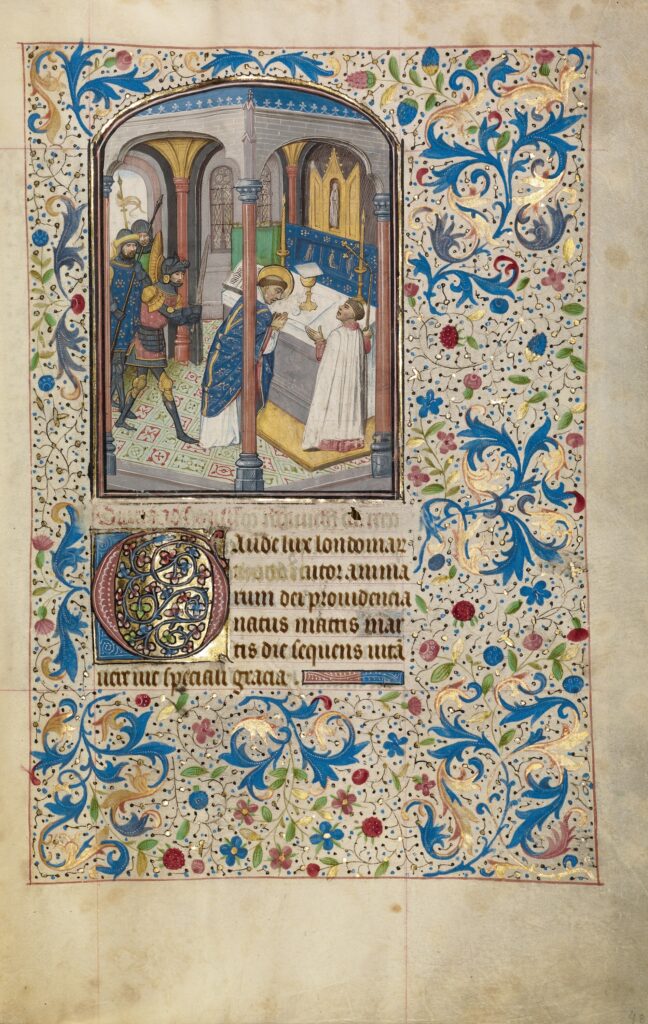
<p><b>Today’s saint is depicted</b> <b>in an illumination</b> by Willem Vrelant. Vrelant was a Flemish book illuminator active in the mid-1400s. He seems to have spent part of his time in Utrecht (today’s Netherlands) but this illumination, dating from the early 1460s, was made in Bruges (today’s Belgium) for the <a href="https://www.getty.edu/art/collection/object/103RVC">“Arenberg Hours.”</a> “Hours” were illuminated manuscript prayerbooks, often commissioned by rulers or the wealthy, that were popular in this time. The Arenberg Hours are held by California’s Getty Museum.</p>
<p>The illustration itself is small (roughly 10 x 7 inches). While Becket was killed at Vespers time, he is frequently depicted as celebrating Mass, his acolyte standing next to him with his processional cross. Three knights are depicted entering from the back, the first with a sword — it makes the point of being “stabbed in the back,” as killing a bishop <i>inside a church </i>would have been seen as especially infamous. It seems his acolyte, who can see behind Becket, is also warning him of the impending danger. As is typical of Gothic illustration, three-dimensionality is weak: consider the angle of the altar table. The text below is a Latin poetic tribute to Becket.</p>
<p>To read more, see <a href="https://www.newadvent.org/cathen/14676a.htm">here</a>, <a href="https://en.wikipedia.org/wiki/Constitutions_of_Clarendon">here</a> and <a href="https://www.getty.edu/art/collection/object/103S6P#full-artwork-details">here</a>.</p>
<p> <!-- EMBED START Image {id: "editor_5"} --> </p>
<figure><img src="https://publisher-ncreg.s3.us-east-2.amazonaws.com/pb-ncregister/swp/hv9hms/media/20241229081256_3683a8c8907239a6ad4ebe5c22bd055e0fa4d2680ccb13f74d8389cd4a0db2ff.jpg" data-media-id="editor_5" data-image-id="20241229081256_3683a8c8907239a6ad4ebe5c22bd055e0fa4d2680ccb13f74d8389cd4a0db2ff" data-rendition-name="original" width="1897" height="3000" loading="lazy" alt="Willem Vrelant, “The Martyrdom of St. Thomas Becket,” Full"/><figcaption>Willem Vrelant, “The Martyrdom of St. Thomas Becket,” early 1460s, Getty Museum, Los Angeles, Ms. Ludwig IX 8 (83.ML. 104), fol. 48.<span/></figcaption></figure>
<p> <!-- EMBED END Image {id: "editor_5"} --> </p>
<p> </p>
</p></div>
<p><br />
<br /><a href="https://www.ncregister.com/blog/saints-and-art-st-thomas-becket">Source link </a></p>
<p><!-- END THEIA POST SLIDER --></p>

St. Thomas Becket, Defender of Religious Freedom| National Catholic Register