<p><!-- BEGIN THEIA POST SLIDER --></p>
<p> <br />
</p>
<div>
<p>Under Pope Francis, the concept of “synodality” has rapidly become a central focus of the institutional Catholic Church, serving as the entire basis of a four-year global “Synod on Synodality” that organizers promise will reshape the entire Church following its conclusion this October.</p>
<p>But the process has been dogged by concerns that some of the key theological concepts involved continue to be used in ways that are unclear, imprecise, or even problematic. In fact, the 2023 October Synod assembly itself concluded that there was a need to “clarify the meaning of synodality at different levels,” lest the concept sound “too vague or generic or appears as a fad or fashion.”</p>
<p>This push-and-pull dynamic — with some focusing on pushing synodality forward while others caution about the dangers of cutting theological corners — showed up again this week at the University of Notre Dame, where two high-profile synod participants offered diverging emphases at a Feb. 26-28 conference <a href="https://mcgrath.nd.edu/conferences/academic-pastoral/the-place-of-episcopal-discernment-in-the-synodal-journey/">on synodality and the episcopacy</a> that was attended by more than 60 U.S. bishops </p>
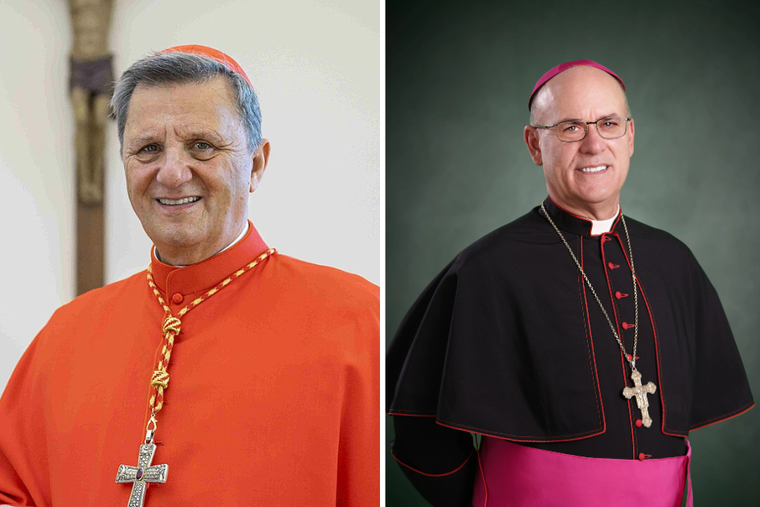
<p>Cardinal Mario Grech, who heads the Vatican office responsible for the synod, gave a keynote address on the “The Role of the Diocesan Bishop in a Discerning Church,” focusing on how local ordinaries participate in a synodal Church and the need for bishops to undergo a “synodal conversion” —intellectually, spiritually, pastorally and humanly — to get there.</p>
<p>In something of a contrast, Bishop Kevin Rhoades of the Diocese of Fort Wayne-South Bend, Indiana, one of five U.S. Conference of Catholic Bishops’ delegates to the Synod on Synodality, offered a short response that heavily emphasized getting the theology of synodality and related concepts right — and warned about what might happen if the Church fails to do so.</p>
<p>In other words, while Cardinal Grech had largely moved forward to the “how” of implementing synodality, Bishop Rhoades drew attention to what he perceived as lingering ambiguities about its “what.”</p>
<p> </p>
<h3><b>‘How’ vs. ‘What’</b></h3>
<p>The different emphases were evident in how Cardinal Grech and Bishop Rhoades talked about two things closely related to synodality: the Holy Spirit and the <i>sensus fidei</i>.</p>
<p>While Cardinal Grech said that a bishop’s ministry must be informed equally by each of the three Persons of the Trinity, he chose to focus on the “often-underemphasized” role of the Holy Spirit, describing the local bishop as “an active mediator, promoter, facilitator and servant of the work of the Spirit in the diocese.” In order to do this, Cardinal Grech spoke of the need for bishops to encourage “prayerful listening to the Holy Spirit and communal discernment among the faithful in all areas and structures of parish and diocesan life.” </p>
<p>But Bishop Rhoades, while underscoring that the Church “becomes a museum” without the Holy Spirit, expressed concern about the danger of an understanding of the Spirit that becomes disconnected from Christ, which he said would undermine authentic synodality. He noted that while Pope Francis’ <a href="https://www.vatican.va/content/francesco/en/homilies/2023/documents/20231004-omelia-nuovi-cardinali.html">homily</a> at the start of the October 2023 Synod Assembly described the Holy Spirit as “the protagonist of the synod,” it began with the Pope urging participants to first gaze on the face of Jesus.</p>
<p>Bishop Rhoades, who previously told the Register that the synod can be fruitful only if <a href="https://www.ncregister.com/features/for-this-us-bishop-synodality-is-aimed-at-one-thing-mission">it avoids becoming self-referential</a>, stressed in his Notre Dame talk that without a focus on Jesus, “it is difficult for us to truly discern the action of the Holy Spirit, who is, in fact, the Spirit of Christ.”</p>
<p>“Without fixing our gaze on Jesus and opening our ears to his teachings, we can be deceived by the spirit of the Antichrist,” said Bishop Rhoades, the USCCB’s previous doctrine head, who currently leads its Committee for Religious Liberty.</p>
<p>The different emphases were also in play in terms of how Cardinal Grech and Bishop Rhoades discussed another important — and much disputed — concept related to synodality: the <i>sensus fidei</i>. </p>
<p><a href="https://www.vatican.va/roman_curia/congregations/cfaith/cti_documents/rc_cti_20140610_sensus-fidei_en.html">The term</a>, according to the Vatican’s International Theological Commission, refers to the faithful’s “instinct for the truth of the Gospel, which enables them to recognize and endorse authentic Christian doctrine and practice, and to reject what is false.” </p>
<p>In his talk, the Maltese cardinal said that the <i>sensus fidei</i> and the laity’s participation in the prophetic office indicates a “necessary <i>circularity</i> in the relationship between the faith perceptions of the hierarchy and those of the rest of the faithful,” with the Pope and bishops “as the authoritative overseers of this circular ecclesial process.”</p>
<p>As a result, the synodal bishop must “seek out the perspectives of the Spirit-aroused <i>sensus</i> <i>fidei </i>of all the baptized,” which “the Holy Spirit bestows on all, but each with a different perspective on the truth of the Gospel.” </p>
<p>Quoting Pope Francis, Cardinal Grech said, “Let us trust in our people, in their memory and in their sense of smell; let us trust that the Holy Spirit acts in and with our people and that this Spirit is not merely the ‘property’ of the ecclesial hierarchy.”</p>
<p>Cardinal Grech also noted that diocesan bishops should “reach out to everyone” as a way of gauging the <i>sensus fidei</i> in their synodal efforts.</p>
<p>Bishop Rhoades agreed that synodal bishops should “listen to the living voice of the people of God and recognize its instinct for the Gospel,” but stressed the need for bishops to also “carefully discern the authentic manifestations of the <i>sensus fidei</i>, distinguishing them from popular opinions, particular interests, political ideologies and the spirit of the age” — concerns that were absent from Cardinal Grech’s presentation.</p>
<p>“This is especially important in our culture today, where there is so much polarization in our nation and also sometimes with the Church,” said Bishop Rhoades, who added that many baptized in the West nowadays are formed by “currents of relativism and secularism.”</p>
<p>The Indiana bishop said that while traditionalism “often fails to recognize that the Church’s Tradition is a living Tradition,” “progressivism often mistakenly identifies certain signs of the times which are antithetical to Scripture and Tradition as movements of the Holy Spirit.”</p>
<p>He also added that in the context of synodal discernment, it is important to remember that certain dispositions identified by the Church, such as “active participation in the life of the Church” and “attention to the magisterium,” are necessary for believers to authentically participate in the <i>sensus fidelium</i>.</p>
<p> </p>
<h3></h3>
<h3><b>A Reoccurring Pattern</b></h3>
<p>Monday’s talk and response wasn’t the first time that concerns about theological clarity quickly emerged in the wake of a Synod on Synodality document or speech.</p>
<p>For instance, during the 2023 synod assembly, some bishops <a href="https://www.pillarcatholic.com/p/draft-synodal-text-bishops-to-push">reportedly pushed back</a> against the draft’s description of the <i>sensus fidei</i>, which they said did not adequately describe its relationship to Church teaching and could possibly reduce the approval or rejection of doctrine to a matter of public polling.</p>
<p>Similarly, concerns about the synod’s pneumatology, or theology of the Spirit, have also abounded. Father Robert Imbelli, a professor emeritus of theology at Boston College, has said that some synod documents <a href="https://www.firstthings.com/web-exclusives/2023/07/what-henri-de-lubac-would-think-of-the-synod-on-synodality">suffer from a “Christological deficiency.”</a> And Archbishop Anthony Fisher of Sydney, a synod participant, said that a proposal at odds with the Gospel can’t be from the Holy Spirit, who he said is often over-invoked in the context of the synod.</p>
<p>“We’ve got to be careful about blaming everything — all our opinions, our interests, lobbies and factions — putting all that on the Holy Spirit,” the <a href="https://www.catholicnewsagency.com/news/255747/archbishop-if-a-synod-proposal-is-at-odds-with-the-gospel-that-s-not-of-the-holy-spirit">Australian archbishop told CNA in October.</a></p>
<p>In fact, the host of the Notre Dame conference, the McGrath Institute for Church Life’s John Cavadini, has also expressed concerns about the vision of the Church expressed in the October 2023 synod document, which he said <a href="https://www.ncregister.com/commentaries/the-need-for-a-deeper-theology-of-synodality">“seems to teeter on a Protestant understanding of ministry.”</a></p>
<p>The ambiguities and concerns surrounding what exactly synodality is and how it’s supposed to work aren’t especially surprising, given the lighting speed at which the concept has been thrust into the ecclesial spotlight in recent years.</p>
<p>Catholic commentator Stephen White has described synodality <a href="https://www.thecatholicthing.org/2021/07/15/synodality-is-what-you-make-of-it/">as “a neologism in search of a theology.”</a> Cardinal Joseph Tobin of Newark, New Jersey, said at the November 2022 USCCB meeting that the Synod on Synodality process was like building a plane in midflight. And the Australian theologian and synod assembly participant Renee Köhler Ryan previously told the Register that the 2023 assembly, the first synod to ever have widespread participation by laymen and women, was like a “choose-your-own-adventure.” </p>
<p> </p>
<h3></h3>
<h3><b>Assuaging Concerns?</b></h3>
<p>To be clear, Cardinal Grech seemed to address at least some of the criticisms that have been leveled against the theological clarity of the synod in his talk. For instance, he went out of his way to say that the <i>sensus</i> <i>fidei</i> does not establish a sort of alternative magisterium, adding that what is claimed by a group cannot be authentic if it is rejected by the Church’s pastors. He also said that a synodal bishop will “seek to safeguard all three Trinitarian dimensions of the Church’s nature,” not just the pneumatological.</p>
<p>But the fact that Bishop Rhoades focused his response on insisting on theological precision in the use of synod-related terms is significant. It suggests that, at the halfway point between last year’s synod assembly and the final one this coming October, concerns among some Church leaders about potentially fraught synodal ambiguities haven’t been assuaged. </p>
<p>Of course, the opening one-two of Cardinal Grech’s remarks and Bishop Rhoades’ response wasn’t the final word on synodality at the three-day conference. Bishop attendees — among them two American cardinals, seven archbishops, as well as Cardinal Christophe Pierre, the apostolic nuncio to the U.S. — also heard from an array of theologians, including The Catholic University of America’s Christopher Ruddy, the John Paul II Institute’s Nicholas Healy, and Anna Rowlands, an English theologian who also serves as an expert for the Synod on Synodality.</p>
<p>Perhaps Cardinal Grech, the U.S. bishops and other participants adequately addressed ongoing concerns about the synod’s lack of theological precision during the closed-door proceedings at Notre Dame. </p>
<p>But if not — or if the synod’s official documents and statements from its leaders continue to be marked by what some perceive as problematic ambiguities — expect Church leaders like Bishop Rhoades to continue to offer critiques and requests for clarity and for concerns about the synod’s potential impact to continue.</p>
</p></div>
<p><br />
<br /><a href="https://www.ncregister.com/news/synod-on-synodality-notre-dame-conference">Source link </a></p>
<p><!-- END THEIA POST SLIDER --></p>

Synod on Synodality Still Dogged by Concerns About Ambiguities — Even as Organizers Gear Up for Implementation| National Catholic Register