<p><!-- BEGIN THEIA POST SLIDER --></p>
<p> <br />
</p>
<div>
<p>COMMENTARY: The Revolution of 1989 was a unique experience in the bloody history of a century in which mass violence was the typical means of effecting great social change.</p>
</p></div>
<div>
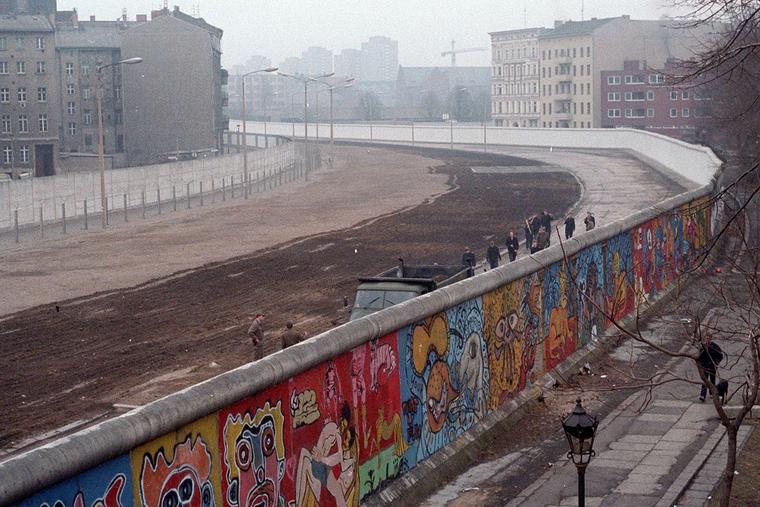
<p>Thirty-five years ago, the son of a great historian helped make history when he asked the question that triggered the demolition of the most grotesquely expressive artifact of the Cold War. </p>
<p>My friend Daniel Johnson, son of the author of <a href="https://en.wikipedia.org/wiki/Modern_Times:_A_History_of_the_World_from_the_1920s_to_the_1980s" target="_blank" rel="noopener"><i>Modern Times</i></a> and then a reporter for London’s <i>Daily Telegraph</i>, flew to Berlin on Nov. 9, 1989. East Germans were engaging in mass protests against their oppression while others were fleeing the oxymoronic German Democratic Republic through a newly opened border with Hungary. Chaos reigned, and the East German regime held a televised press conference to try to get the situation under some sort of control. The Communist Party spokesman, Günter Schabowski, began by announcing that the party’s central committee had decided that East Germans could both travel and emigrate to the West, which had been forbidden since the Berlin Wall was built in 1961. </p>
<p>The questions came flying from the reporters: When would this take effect? Did this new regulation apply to Berlin, divided by the Wall for almost three decades? Schabowski lurched beyond what he was supposed to say and responded, Yes, the new rule was in force immediately, and Yes, it seemed to apply to Berlin. </p>
<p>Fluent in German, Daniel Johnson then posed the question that helped change the world: “Herr Schabowski, what will happen to the Berlin Wall now?” Schabowski, who hadn’t been told what to say if this came up, hesitated for a few seconds and then changed the subject. But to those present and those watching on TV, “the <i>pfennig</i> [penny] dropped,” as Johnson later wrote. If there were free travel and emigration to the West, what was the point of the Wall? </p>
<p>It was finished, and in a few hours, jubilant East Berliners, having watched this in amazement on their TVs, had taken sledgehammers to the obscenity that had long divided their city, and that more than 100 people had died trying to get across, under, over, or around. </p>
<p>In the early hours of the next morning, East and West Berliners were dancing in jubilation atop <i>Die Mauer</i> (the Wall) in front of the Brandenburg Gate. (The mind-boggling scenes on NBC that night and over the next days were made possible because producer Maralyn Gelefsky had somehow, amidst the chaos, found a cherry-picker from which mounted cameras could display the jubilation below.) </p>
<p>The auto-liberation of east-central Europe had begun in earnest in June 1989, when semi-free Polish elections returned anti-communist Solidarity candidates to all the contested seats in the Polish parliament–which, three months later, elected Tadeusz Mazowiecki, a longtime Catholic intellectual activist become Solidarity leader, prime minister. Other dominos in the Soviet-led Warsaw Pact system began to fall, and then came the night of Nov. 9-10, 1989, when the breaching of the Wall by celebrating Germans made what came to be known as the Revolution of 1989 irreversible. </p>
<p>It took another two months to complete the job, but when the Velvet Revolution in Czechoslovakia put Václav Havel in that country’s presidency on Dec. 29, 1989, it was well and truly finished. Over the next two years, brave souls in Lithuania, Ukraine, and elsewhere completed the dismantling of history’s greatest tyranny when their declarations of independence dissolved the Soviet Union. </p>
<p>The Revolution of 1989 was a unique experience in the bloody history of a century in which mass violence was the typical means of effecting great social change. Romania excepted, the revolution was nonviolent, and even there, the violence was constrained. Why was that the case? Because a revolution of conscience had rippled through east-central and eastern Europe in the 1980s. People determined to “live in the truth” rather than submitting further to the communist <a href="https://hac.bard.edu/amor-mundi/the-power-of-the-powerless-vaclav-havel-2011-12-23" target="_blank" rel="noopener">culture of the lie</a> created an effective, nonviolent resistance movement, inspired in no small part by Pope John Paul II’s history-bending pastoral pilgrimage to Poland in June 1979. That movement had its martyrs — Blessed Jerzy Popiełuszko in Poland, Jan Potocka in Czechoslovakia — but its strength of conviction ultimately proved stronger than the truncheons, water hoses, and even tanks of the various community regimes. (The rich spiritual and moral texture of those years is brilliantly captured in the documentary produced by the Knights of Columbus, <a href="https://jp2film.com/" target="_blank" rel="noopener"><i>Liberating a Continent</i></a><i>.</i>) </p>
<p>Speaking to the United Nations in 1995, John Paul II credited the Revolution of 1989 to those who had been willing to “take the risk of freedom.” It was not a freedom of license that he praised and which those nonviolent revolutionaries had lived, but a freedom of living in the truth — the truth about the human person, human community, human origins, and human destiny. There are crucial lessons in that for us today. </p>
</p></div>
<p><br />
<br /><a href="https://www.ncregister.com/commentaries/weigel-taking-the-risk-of-freedom-berlin-wall">Source link </a></p>
<p><!-- END THEIA POST SLIDER --></p>

Taking the Risk of Freedom| National Catholic Register