


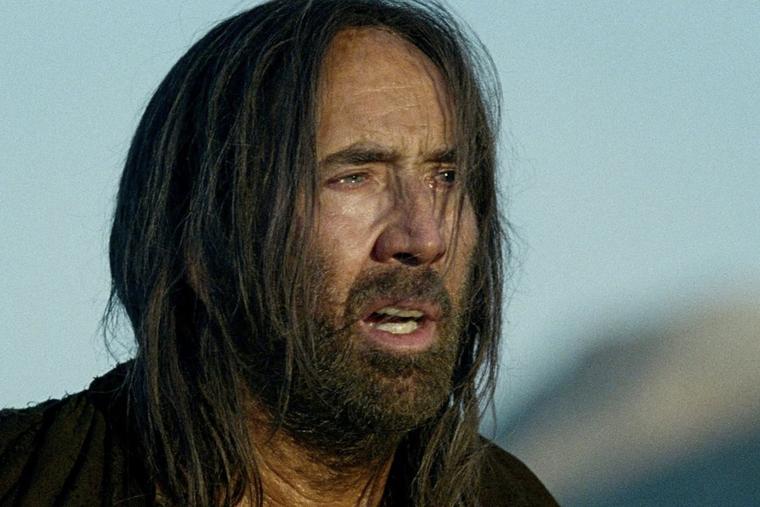
A title card at the beginning of The Carpenter’s Son informs us that the movie is based on The Infancy Gospel of Thomas, which “describes events missing in the gospel timeline.”
That’s certainly an interesting way to characterize this obscure early text, already mined by Anne Rice for her novel Christ the Lord: Out of Egypt (2005), which was itself adapted in 2015 as The Young Messiah. Two movies in 10 years do not make a trend, but it’s notable that Jesus media is in such demand that creators are looking to the swampy fringes of apocrypha to spice up their content.
But what exactly is the so-called Infancy Gospel of Thomas, and what does it tell us about Jesus?
An Apocryphal Source?
The Infancy Gospel is a strange text. Due to the name, it’s often confused with the Gnostic Gospel of Thomas, which is popular with the conspiracy-minded until they actually read it, whereupon they realize it was suppressed not because of its daring contradictions of Catholic orthodoxy, but because it’s bonkers. Academics have made a cottage industry of claiming Thomas is a legitimate early text representing a strain of “lost Christianity” repressed by the institutional Church rather than what it really is: a forgery by Gnostic heretics.
The Euangelium Thomae de Infantia Saluatoris (“The Gospel of Thomas of the Savior’s Childhood”) is a second-century text found in multiple translations and recensions, and appears to have no links to the Gospel of Thomas whatsoever, and contains no unique historical content. It doesn’t betray any discernible Gnostic influence, although elements of it may have been used by later Gnostic writers. It was likely composed by a gentile Christian in Greek in a pious, if misguided, attempt to expand upon Luke-Acts. While the result is certainly outrageous and arguably blasphemous, it is, like the Protoevangelium of James, not particularly heretical. It is, however, one of the most peculiar of all the early apocrypha.
The text is a series of wonder tales from the early life of Jesus, ages 5 to 12, which attempts to illustrate aspects of his life up to and including the finding in the Temple. It’s found, in whole or in part, in many manuscripts and many languages, and the work was a popular curiosity well into the Middle Ages. There are multiple variants in Greek and Latin, as well as in Slavonic, Ethiopic, Arabic and Georgian. There was even an Irish verse version written in 800.
The most recent English edition is Tony Burke’s in New Testament Apocrypha: More Canonical Scriptures Vol. 1. In his introduction, Burke explains that until the full Gospel of Thomas was discovered in 1945, scholars assumed The Infancy Gospel was the Gospel of Thomas purged of Gnostic content. The Syriac version that Burke translates, however, is very early, and is merely called The Childhood of the Lord Jesus. It lacks the introductory material and other content found in the Greek manuscripts that claimed Thomas as the author, which suggests this attribution was a late addition.
Curses and Blessings
A summary of the content will give you an idea of why someone might have thought it had the raw material of a horror movie. We first meet the young Jesus at age 5, damming a stream to make mud, which he fashions into 12 birds. These he brings to life and urges to fly away. Because he does this on the sabbath, a Pharisee reports him to Joseph, who rebukes his son. When the son of a Pharisee breaks the dam, Jesus curses him, and we are told he “withered.” Later, in the marketplace, another child bumps into Jesus, who promptly kills the offender with a word.
The townspeople try to drive them away, and Joseph chastises him and pulls his ear. Jesus blinds his critics, and the rabbi Zacchaeus urges Joseph to let him teach the boy. Jesus begins a lengthy exchange with the Rabbi, displaying his superior knowledge and wisdom until Zacchaeus is defeated and recognizes the divinity of Jesus, calling him “either a god, or an angel” who can “set fire to fire.”
Jesus restores all he has cursed, and proceeds to perform a series of miracles: restoring to life a boy who died, healing a young man’s foot, fetching water in a cloak, harvesting 100 cors of wheat after sowing a single measure of seed, and stretching a beam in Joseph’s workshop. At this point, he is 8 years old, and sent again to learn his letters (which he already knows). This second teacher strikes him and is killed instantly. He then saves his stepbrother James from a snakebite and performs two more resurrections before the text segues into the finding in the Temple.
Scholars commonly see this pattern of killing and reviving as a progression from cursing to blessing, but not all of Jesus’ victims are revived in every manuscript, and Burke’s commentary in New Testament Apocrypha Vol. 1 suggests that some troubled copyists added the revivals to show Jesus growing in compassion. Burke sees another possibility: The curses simply reflect the power of Jesus and his prophetic gift.
Luke-Acts, the main influence upon The Infancy Gospel, shows Jesus and the apostles both blessing and cursing, with examples such as the woes from the Sermon on the Plain and the deaths of Ananias and Sapphira. This also calls to mind 2 Kings 2:24, where Elijah curses children who mock his baldness, and 42 of them are killed by bears.
Although not found in Luke, the cursing of the fig tree serves as another precedent. Understood this way, the work would appear to be an imaginative attempt to fill in the gaps of Jesus’ life and show his power in a way that would be typical of an ancient biography of a great figure, albeit in a most unusual way.
The Carpenter’s Son doesn’t make use of most of this, instead offering a disjointed sequence of events until it just sort of stops with Joseph dead and Jesus wandering off into the wilderness with Mary trailing behind. He revives a locust he accidentally kills, but then murders an innocent young man to avoid detection and never bothers to resurrect him.
He performs some CGI exorcisms, wrestles with Satan, and allows Joseph to die after being stabbed by the devil. Although Jesus is supposed to be about 14 in the movie, he doesn’t have any sense of his mission, his divinity or his parentage, which are established in Scripture by at least the finding in the Temple at age 12. Questions about faith articulated by Nicolas Cage’s Joseph at the film’s opening are mostly forgotten along the way.
Naturally, the faithful will wonder if a self-described “Jesus horror movie” — a movie in which a moping, teenaged Jesus fights a nonbinary Satan (pronouns: they/legion) while Cage’s Joseph struggles with his faith and pop star FKA Twigs pouts vapidly as the Blessed Mother — is heretical, blasphemous or any number of other appalling things, but it’s simply too mindless and incoherent to be genuinely offensive.
It’s a grimy, meandering and pointless exercise that can’t quite decide if it wants to be a genuine exploration of faith or an exploitative thriller, and thus winds up being nothing at all.